
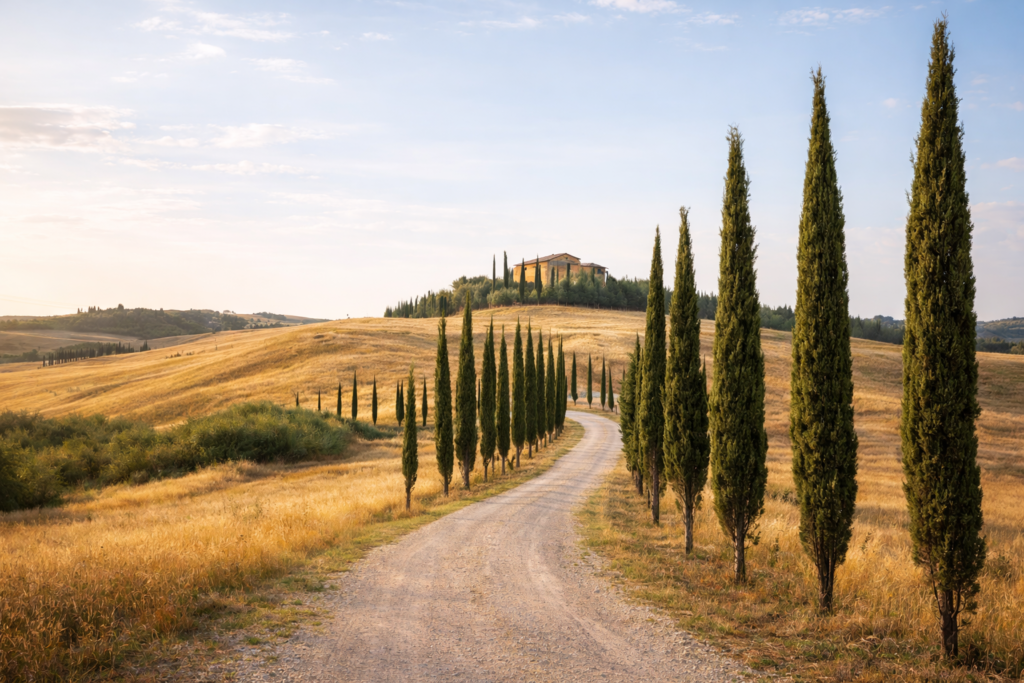
Passing Through Tuscany: What’s Actually Worth Stopping For
We drove past it on the way down. On the way back to Germany, we stopped — and that decision changed what we remembered about the whole trip.
Planning a Tuscany road trip stop usually feels optional — something you might do if you have time. On the way down to Rome, we drove straight through. The motorway passes through the hills south of Florence — you can see the landscape from the autostrada, the cypress trees on the ridgelines, the colours changing as the road climbs — and we kept going.
On the way back to Germany, something was different. We were less hurried. By that point, the trip had already given us what it promised, and a looseness settled into the drive north. As a result, Tuscany felt different when it appeared again in the windscreen. We stopped in Florence. And that half-day became one of the better memories of the whole trip — not because Tuscany is surprising, but because we finally let it be what it is.
This post is about that stop — what we did, what was worth it, and what I’d tell someone planning the same drive.
01 — The Tuscany Road Trip Stop Decision
Coming north on the A1 after Pompeii and Naples, Tuscany arrives gradually. The flat coastal plain south of Rome gives way to hills, and the hills become more specifically themselves — rounder, greener, the slopes planted with vineyards and olives in a way that doesn’t exist further south. By the time you pass the exit for Chiusi, the landscape outside the car looks like the paintings.
What the drive down looked like versus the drive back
Going south, we’d been too purposeful to stop. The Colosseum was booked for the following morning. There was somewhere to be, and Tuscany would still be there on the way back. That logic holds — and it also turns out to be the correct logic. Stopping on the return journey, when the destination pressure is gone and the trip has already delivered its main events, gives Tuscany a quality it probably wouldn’t have had as an opener. You arrive at it satisfied rather than impatient, and that changes how you receive it.
The moment the drive changes
We exited at Chiusi-Chianciano Terme and took smaller roads west. Within ten minutes of leaving the motorway, we were on a road that didn’t feel like transit at all. It felt like somewhere people choose to be.
Most road trips from Germany or northern Europe stop in Tuscany on the way down — it’s the logical first rest point before Rome. But the drive down carries anticipation and urgency that Tuscany absorbs poorly. On the return, when the trip is already complete and you’re carrying it with you, the landscape has space to land. If your schedule allows only one Tuscany stop, make it the northbound one.
02 — The Val d’Orcia: The Tuscany of the Photographs
The Val d’Orcia is the part of Tuscany that most people mean when they picture Tuscany — rolling hills, cypress trees in rows, the SP146 road that runs from the motorway exit to Pienza with such consistent beauty that it has been photographed from approximately every angle. It is exactly as good as it looks. That fact is worth stating plainly because it is rarer than it should be.
The SP146 — the road that earns everything
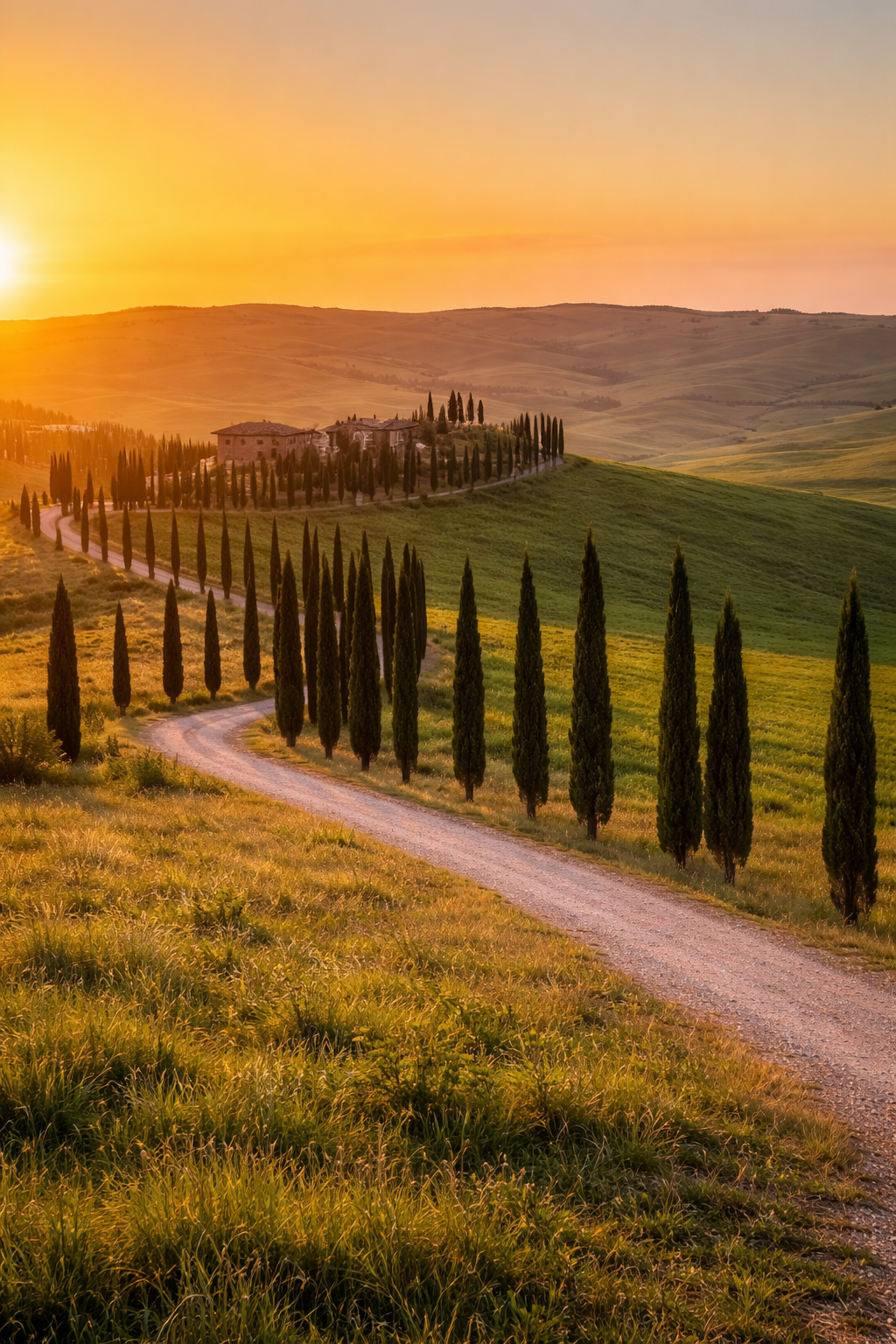
We drove the SP146 from Chiusi toward Pienza in the late afternoon. Climbing through the Val d’Orcia in a series of long curves, the road passes the cypress-lined section about halfway along — the hills rolling away on both sides in colours that shift between gold, green, and the particular ochre that Tuscan soil turns in dry weather. Consequently, we drove slowly — not because the road required it, but because driving quickly would have been a waste.
How long to allow (and why it stretches)
The SP146 is approximately 30 kilometres from the motorway exit to Pienza. Furthermore, it takes significantly longer than that distance suggests — partly because of the road character, partly because you will stop at least once without planning to. We stopped by a vineyard near a cypress grove, got out, stood for five minutes, got back in. That was the moment that made the detour worth it.
Pienza — the town at the end of the road
Pienza sits on a ridge at the western end of the SP146 — a small Renaissance town built almost entirely in the 15th century to a single plan, which gives it an unusual coherence. The main square, the cathedral, and the palazzo all face each other across a piazza that is neither grand nor small but exactly proportioned. From the walls on the south side of the town, the Val d’Orcia spreads below you in the view that makes Pienza worth the detour even if you don’t go inside anything.
Allow thirty minutes. That’s enough to walk the main street, stand at the walls, and have a coffee. In contrast to Florence or Siena, Pienza doesn’t demand more than it offers — and what it offers in thirty minutes is considerable.
Parking in Pienza is outside the old town walls — there are free spaces on the approach road and paid spaces closer to the gate. The town is compact and entirely walkable. Arrive before 4pm in summer if you want to avoid the afternoon tour groups, which descend on the SP146 around that time. A weekday visit is noticeably quieter than a weekend one.
03 — Florence: What One Afternoon Gives You
Florence was a longer stop. We came into the city in the early evening, parked outside the historic centre, and spent several hours there before continuing north. It was not enough time for Florence — Florence doesn’t do enough time — but it was enough to understand why people return.
What Florence does to you in a short visit
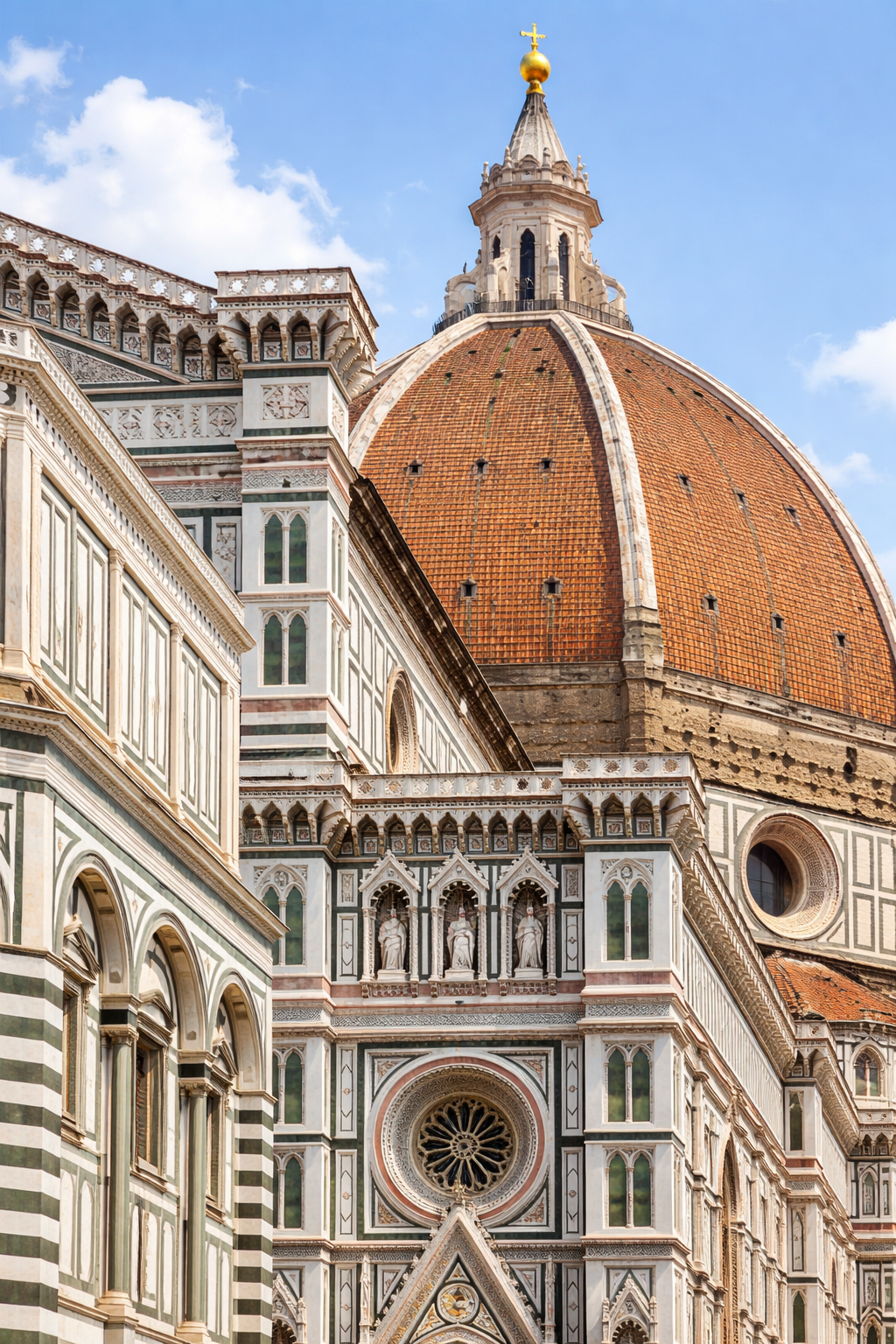
The centre of Florence is compact in a way that makes a short visit surprisingly coherent. Piazza della Signoria, the Duomo, the Ponte Vecchio, and the Uffizi all sit within easy walking distance of each other, and simply moving between them — not going inside anything, just existing in the streets — gives a strong sense of the city. The Duomo alone, which announces itself from several streets away and then becomes suddenly, overwhelmingly present when you turn the right corner, is one of those architectural experiences that works even without context.
What we actually did — and what we’d skip
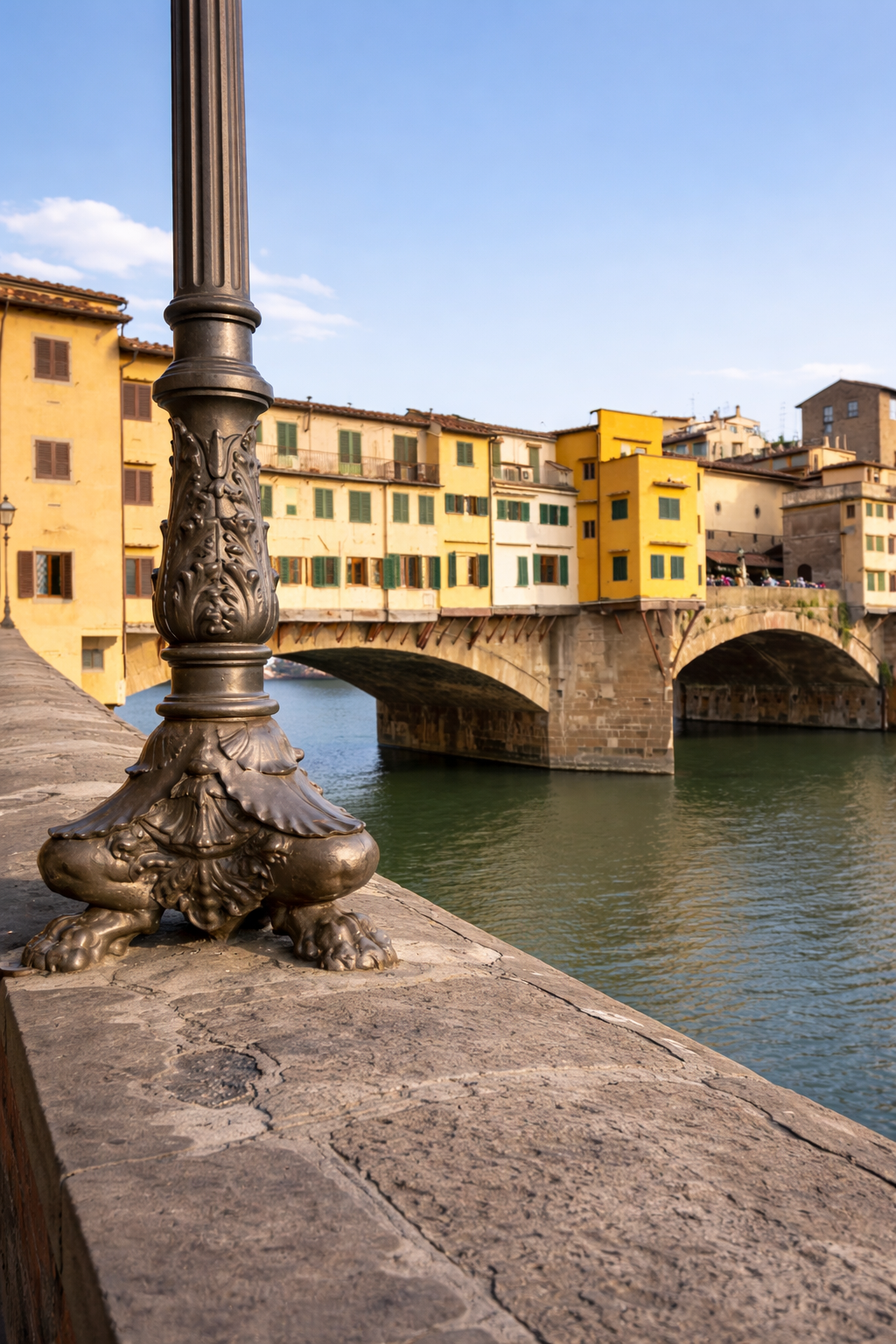
We didn’t go into the Uffizi — that requires advance booking and several hours we didn’t have. Instead, we walked across the Ponte Vecchio, found a bar near the Piazza della Repubblica, ate well, and left at dusk. As a result, Florence felt like a preview rather than a visit. That was fine. In some ways it’s the right relationship to have with a city this dense — leave wanting more rather than leaving depleted.
What to do with limited Florence time
If you have three to four hours — the realistic window for a road trip stop — the most useful structure is this: arrive by early afternoon, walk from the Ponte Vecchio to the Duomo (twenty minutes, covering the Piazza della Signoria en route), walk the perimeter of the Duomo, continue north through the market streets to the San Lorenzo area, eat somewhere in the centre, leave before the evening traffic builds.
The Uffizi and the Accademia (which houses Michelangelo’s David) both require advance booking and several hours. Moreover, both deserve more time than a road trip stop allows — they are better suited to a return visit with Florence as the destination rather than the transit point. That said, if you have half a day and have pre-booked, either museum is worth doing even briefly.
Don’t attempt to drive into the historic centre — Florence has extensive ZTL zones with automatic cameras. Park at one of the park-and-ride facilities on the outskirts (Piazzale Michelangelo or Villa Costanza are well-signed from the motorway) and take a tram or bus into the centre. Parking is €2–5 for the day, tram is €1.50 per journey. This is significantly easier and cheaper than central parking.
04 — Other Towns Worth the Detour
Tuscany has more towns worth stopping in than any road trip conveniently allows. However, if your route takes you through the region, a few specific ones earn a mention beyond the Val d’Orcia and Florence.
A hilltop town above the Val d’Orcia, famous for Brunello di Montalcino wine and for a fortress that looks exactly as a Tuscan hilltop fortress should. Allow an hour — the fortress walls offer the best views in the region, and the wine shops in the main street are worth ten minutes even if you don’t buy anything. Additionally, Montalcino is noticeably less visited than Pienza despite being only twenty kilometres away.
A larger hilltop town on the eastern edge of the Val d’Orcia. The main street climbs steeply from the town gate to the Piazza Grande at the top — a fifteen-minute walk that passes wine cellars, ceramic shops, and views over the surrounding valley at every turn. Montepulciano rewards ninety minutes and works well combined with Pienza as a half-day Val d’Orcia loop.
A different scale entirely from the Val d’Orcia towns — Siena is a full city with a medieval centre that requires at least half a day to do properly. The Piazza del Campo is one of the finest public squares in Europe, and the Duomo di Siena is arguably more visually extraordinary than Florence’s. That said, Siena is not a passing stop — it demands time, and arriving with only an hour is frustrating rather than satisfying. Include it only if your schedule genuinely allows a half-day.
Trying to see too much in a single day. Pienza, Montepulciano, Montalcino, Siena, and Florence are each individually worth a stop — combined into one day, they become a driving exercise with brief exits for photographs. Choose one area: either the Val d’Orcia (Pienza + Montepulciano + the SP146 roads) or Florence and the Chianti hills. The landscape between the stops is as good as the stops themselves, and it only reveals itself when you’re not rushing between them.
05 — When to Go
Tuscany’s quality changes significantly by season — more so than most Italian regions — and the timing of your road trip stop genuinely matters.
Spring and autumn — the two best windows
April and May bring the Val d’Orcia at its most photogenic: the fields are green, poppies appear in the grass around the cypress trees in May, and the light has a clarity that summer heat removes. Crowds are present but manageable, and accommodation prices remain below the summer peak.
Autumn — and why it may be better
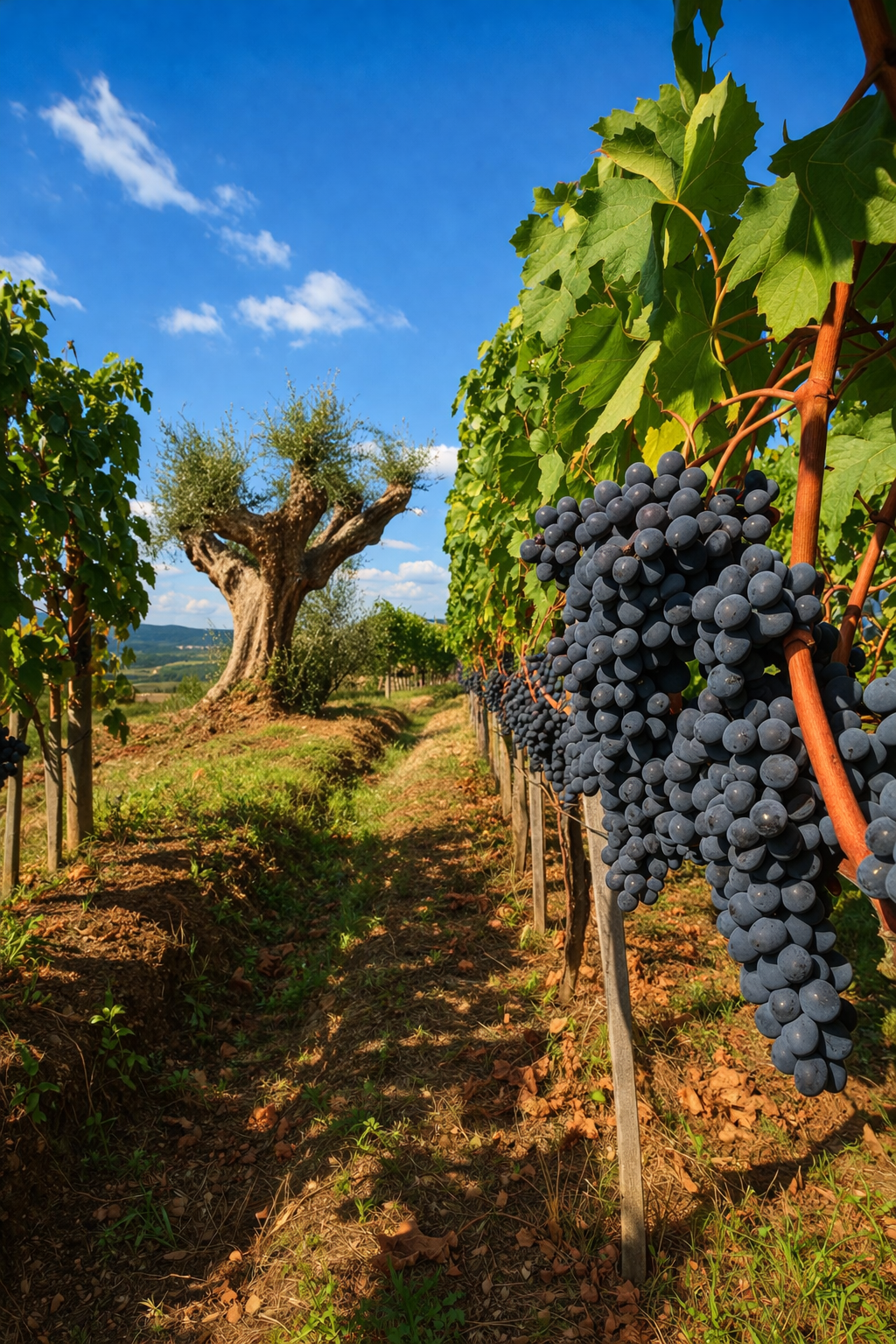
September and October are equally good and in some ways better. The harvest brings the vineyards to their most visually striking state — grapes heavy on the vines, the air carrying the smell of fermentation from the cantinas. Furthermore, the summer tourists have largely gone by mid-September, the light is lower and warmer than in summer, and the roads are noticeably quieter. If your return drive from southern Italy falls in autumn, the timing works in your favour.
The second and third weeks of September are the peak of the Tuscan harvest. The vineyards are full, tractors move between rows, and the cantinas are open for tastings. If you time your return drive for mid-September, the SP146 between Chiusi and Pienza looks genuinely different from its summer version — warmer light, more activity in the fields, and the particular quality that only the changing season produces.
What summer is actually like
July and August in Tuscany are hot, crowded, and expensive. The Val d’Orcia landscape itself doesn’t change — the cypresses and hills remain — but the roads carry more traffic, Pienza fills with tour groups by mid-morning, and accommodation prices reach their annual peak. That said, summer is not impossible, particularly if you arrive early in the morning before the heat builds. The SP146 at 8am in July, with low sun and no other cars, is still the SP146 at 8am in July.
06 — Practical: Fitting Tuscany Into the Drive
Where it sits on the road trip route
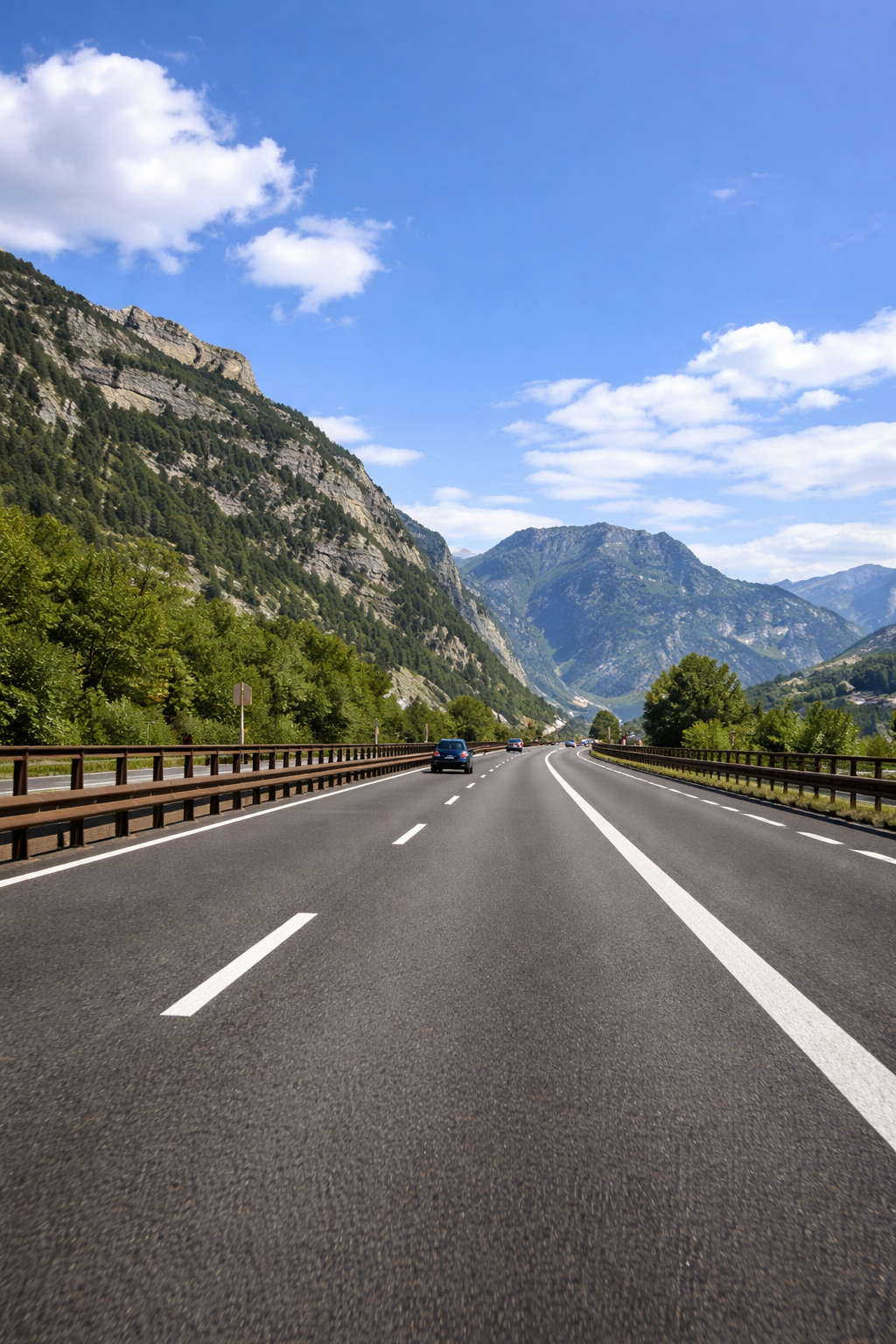
Coming north from Naples or Rome on the A1, Tuscany begins to appear around the Orvieto exit and becomes fully itself by the time you reach Chiusi. The motorway from Naples to the Val d’Orcia exit takes roughly three to three and a half hours without stops — making it a natural afternoon destination after a morning departure from Naples or Rome.
| Naples → Val d’Orcia exit | ~3.5 hours on the A1. Exit at Chiusi-Chianciano Terme for the SP146 toward Pienza. |
| Rome → Val d’Orcia exit | ~2 hours on the A1. More flexible — allows a morning Rome departure with a Tuscany afternoon. |
| Val d’Orcia → Florence | ~1.5 hours. A logical continuation — drive the SP146, stop in Pienza, continue north to Florence. |
| Florence → German border | ~4.5–5 hours via the A1 and A22 over the Brenner Pass. Manageable in a long afternoon and evening. |
| Motorway exit for Val d’Orcia | Chiusi-Chianciano Terme on the A1. Well-signed, easy to find. |
| Florence parking | Piazzale Michelangelo park-and-ride or Villa Costanza — both accessible from the motorway, tram into the centre. |
| ZTL zones | Florence historic centre is entirely ZTL — do not drive in. Val d’Orcia towns have no restrictions but limited parking near the centres. |
The one-day structure that worked for us
We left Naples mid-morning, drove the autostrada north, exited at Chiusi after lunch, drove the SP146 to Pienza, spent thirty minutes there, drove on to Florence, spent four hours in the city, and continued north toward the Brenner Pass. Overall, it was a long day — but it was also one of the better days of the trip. Tuscany is well-suited to this kind of loose, unhurried movement. No plan is required. Just an exit off the motorway and the willingness to take it.
We’d allow more time in Florence — four hours is not enough for a city that dense, and we left feeling like we’d seen the edges rather than the centre. On a future trip, Florence would either get a full day or we’d skip it on this pass and come back when we can give it what it deserves. The Val d’Orcia stop, by contrast, was exactly the right length — an hour on the SP146 and thirty minutes in Pienza. That we’d keep unchanged.
The Val d’Orcia and Florence
Timing and practicalities
We drove past it on the way down and stopped on the way back.
That turned out to be the right order.