
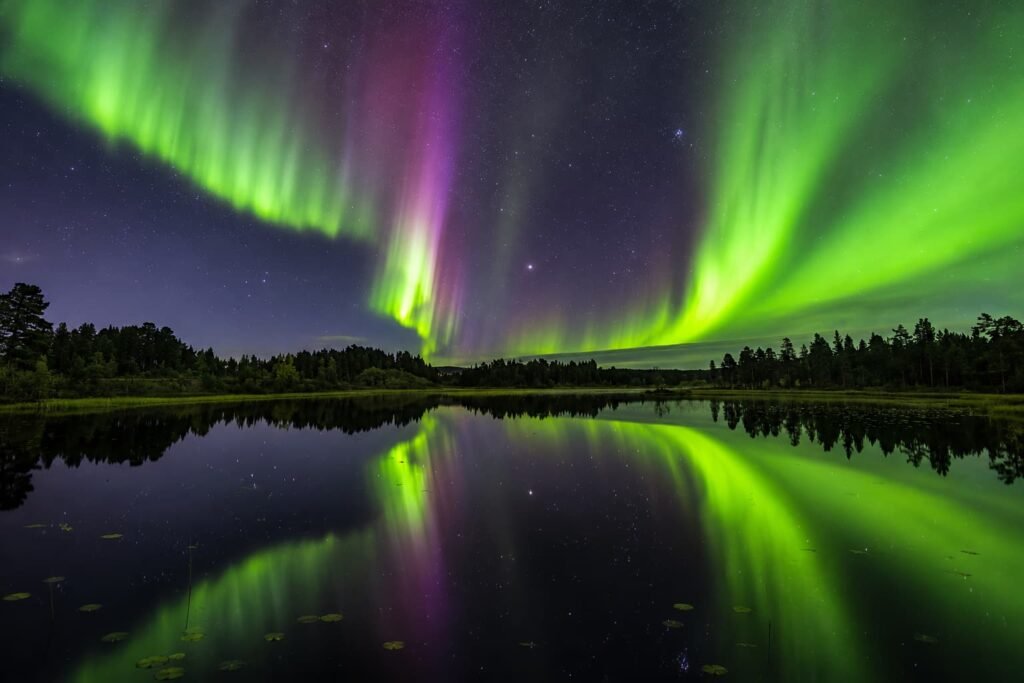
Northern Lights in Europe: 12 Best Places Ranked by Real Odds
Cloud decides your trip more than the Sun does. Here is where a clear, dark sky is most likely, what each place costs, and the honest catch for every one.
Northern lights in Europe come down to one practical question: where are you most likely to get a clear sky on a dark night? Solar activity gets the headlines, but cloud decides the outcome far more often than the Sun does. So this list ranks twelve places by real odds instead of by how good the photos look.
The timing is good for a first attempt. In fact, the Sun passed its peak activity in late 2024, and forecasters expect the declining phase to keep producing strong storms, which are the nights when the aurora reaches furthest south. Norwegian space physicist Pål Brekke has suggested the winters around 2026–27 should still be very good. Even so, no place here can promise a sighting, and nobody honest will tell you otherwise.
Still, what you can control is the base you choose, the number of nights you stay, and whether you know the downside before you book. Each entry below ends with exactly that: the catch.
How I Ranked the Northern Lights in Europe
Four factors decide where a place lands. However, they do not carry equal weight, so they are listed here in order of how much each one moves your odds.
- Distance inside the auroral oval: the further north you are, the more nights the aurora is overhead rather than low on the horizon
- Clear-sky climate: inland and mountain sites usually beat the coast, because maritime weather brings cloud
- Darkness and dark-sky access: you need a short walk or drive away from streetlights, not a hotel balcony facing a car park
- Cost and access: a perfect sky is no use if the flights, beds and tours price you out of staying long enough
The Finnish Meteorological Institute puts numbers on the first factor. On a dark, cloudless night, the chance of seeing the aurora is roughly 75% at Kilpisjärvi and about 50% across central Lapland, according to its aurora statistics for Finland. Those figures assume a clear sky, though, and getting one is the hard part. For that reason, climate carries so much weight in the ranking.
One honest note on the order: Tromsø ranks second even though a few inland places have better cloud odds, because it blends strong odds with easy access and a chase-tour system built for exactly this problem. So if you ranked purely by sky, Kilpisjärvi would sit higher.
The 12 Places at a Glance
| Rank | Place | Country | Clear-sky odds | Cost | Access | The catch |
|---|---|---|---|---|---|---|
| 1 | Abisko | Sweden | High | Moderate | Remote | Small, books out, wind can close the lift |
| 2 | Tromsø | Norway | Medium | High | Easy | Coastal cloud, busy tours |
| 3 | Kilpisjärvi | Finland | High | Moderate | Remote | Few beds, long transfers |
| 4 | Finnish Lapland | Finland | Medium–High | Low–Moderate | Easy | Rovaniemi sits further south |
| 5 | Alta | Norway | Medium–High | High | Moderate | Fewer tours than Tromsø |
| 6 | Svalbard | Norway | Medium | Very high | Moderate | Everything outside town is guided |
| 7 | Kiruna / Jukkasjärvi | Sweden | Medium–High | High | Easy | Priced for tourists |
| 8 | Senja | Norway | Medium | Moderate | Hard | Coastal cloud, winter roads |
| 9 | Lofoten | Norway | Medium–Low | Moderate | Moderate | Maritime weather |
| 10 | Rural Iceland | Iceland | Medium–Low | High | Easy | Cloud changes fast |
| 11 | Faroe Islands | Faroe Islands | Low | High | Moderate | Low odds, frequent cloud |
| 12 | Highlands / Shetland | Scotland | Low | Low | Easy | Needs a strong storm |
01 — Abisko, Sweden: Best Northern Lights in Europe for Odds

Abisko earns first place on climate alone. The village sits inside a ring of mountains that blocks much of the cloud rolling in from the Norwegian coast, and locals call the patch of open sky over Lake Torneträsk the blue hole. It does not clear every night, but over a few nights it still clears more often than most places on this list.
The signature experience is a chairlift ride of about 20 minutes up Mount Nuolja to the Aurora Sky Station, at roughly 900 metres. Meanwhile, night visits run through the winter season, typically from mid-November to mid-March, and start from around 1,300 SEK with warm overalls and boots included. Dates shift each year, so check them before you book. Alternatively, you can skip the lift and simply walk out from the village to the lakeshore.
Getting here also takes planning. For example, you can fly to Kiruna and transfer, or take the overnight train from Stockholm, which takes around 16 to 17 hours. Because timetables on this route have been changing, confirm the current service first.
The catch: Abisko is tiny, with limited beds that fill early, and there is little to do on a cloudy day. Wind can close the chairlift, too, and the sky station is not a guaranteed upgrade over a dark lakeshore.
02 — Tromsø, Norway: Easiest First Trip for Northern Lights in Europe

Tromsø sits at roughly 70°N, squarely under the auroral oval, and it is the one city here built around the problem of cloud. The coast can be grey and snowing while the sky an hour inland is clear. So the standard answer is a chase tour: a small-group minibus that follows the weather rather than staying put.
Those tours typically run six to ten hours, and the better ones will drive into Finland or Sweden if that is where the sky is open. Bring your passport for exactly that reason. In practice, the system works. Instead of staking your whole evening on the forecast over the city, you hand the cloud problem to a guide who watches several countries at once.
The polar night here lasts from about 27 November to 15 January, though you can see the aurora well outside those dates. Besides the sky, the city gives you cafés, museums and a flight network that makes a long weekend realistic.
The catch: prices are high, and a chase tour typically costs somewhere around US$150 to $300 per person. Because of coastal cloud, some nights end with a long drive and no aurora, and popular viewing spots can feel crowded. So book at least two tour nights, not one.
03 — Kilpisjärvi, Finland: Remote and Rewarding

Kilpisjärvi sits at the far northwestern tip of Finland, in the mountains near the Norwegian and Swedish borders. It has the strongest numbers in the Finnish Meteorological Institute data, with that 75% chance on a dark clear night, and almost no light pollution. Mountain terrain also helps with cloud.
The village is small: a supermarket, a couple of restaurants and a handful of hotels and cabins. That is part of its appeal, because you can walk to the lakeshore, or take a short guided evening, and the whole place goes quiet after dark. Norwegians and travellers based in Tromsø sometimes make the long drive here for an evening when the coast is cloudy.
Most visitors fly to Kittilä and transfer by road, which takes several hours. Therefore, plan to stay put rather than hop around.
The catch: access is the problem. Beds are limited, transfers are long, and prices run higher than the village size suggests. It also offers little beyond the aurora and winter walking, which means it suits people who want that and nothing else.
04 — Finnish Lapland: Best-Value Northern Lights in Europe

Finnish Lapland is the practical choice for most people because it has direct flights, a wide range of beds from simple cabins to glass-roofed rooms, and plenty of tours. Prices are generally lower than in Norway, and the aurora season runs from late August to early April.
Where you base yourself matters, though. According to the same Finnish data, the chance on a clear, dark night is roughly 50% in central Lapland around Levi, Ylläs and Saariselkä, and 40 to 50% in Rovaniemi. Further north, around Inari and Utsjoki, it rises toward 75%. The far north also has darker skies and fewer crowds.
For a first trip, the Inari and Saariselkä area balances odds and logistics well. Meanwhile, Levi suits you if you also want skiing. For help choosing a base, see our guide on where to stay in Lapland.
The catch: Rovaniemi is the easiest to reach but sits right on the Arctic Circle, with more light and lower odds than the north. Santa-themed crowds also dominate parts of the season. Choose a base further north if aurora is the priority.
05 — Alta, Norway: The Aurora Research Town

Alta has a strong claim to being where aurora science began. In 1899, physicist Kristian Birkeland built what is recognised as the world’s first permanent aurora observatory on Mount Haldde, about 900 metres above the fjord. The restored building still stands, and the Alta Museum tells the story. As a result, the town has a depth most chase destinations lack.
On the sky side, Alta sits at roughly 70°N and well inside the oval. Its fjord-head location is more sheltered than the outer coast, although coastal cloud still reaches it. Because fewer visitors come here than to Tromsø, tours are smaller and viewing spots are quieter.
Alta also has a fascinating rock art site nearby, which gives a cloudy day something to do. For most visitors, the practical route is a flight via Oslo, then a short transfer into town.
The catch: it has fewer tours and fewer choices than Tromsø, so a bad forecast leaves you with less to work with. Prices follow Norwegian levels, and the Haldde hike is a summer and autumn trip, not a winter one.
06 — Svalbard, Norway: Most Unusual Northern Lights in Europe

Svalbard is the odd one out, and that is the point. Longyearbyen sits at about 78°N, where the polar night runs from roughly 26 October to 16 February. The sun does not rise for months, so the sky is dark at hours when it would be bright almost anywhere else. In the darkest weeks, the aurora can appear even in the twilight around midday.
Longyearbyen is a small, well-run town where you can walk freely. Beyond the settlement, however, polar bears change the rules. Anyone leaving town needs proper protection against them, and for most visitors that means an armed, trained guide. The Governor of Svalbard’s guidance on firearms sets this out clearly. In practice, almost every night-time excursion is a guided one.
Still, the reward is the setting: snowmobile trips under a polar sky, sled-dog evenings and a landscape that feels like another planet.
The catch: it is expensive, everything outside town is guided, and the cold is serious. So book guided trips well ahead, and treat the aurora as a bonus on a trip that is mostly about the Arctic itself.
07 — Kiruna and Jukkasjärvi, Sweden

Kiruna is Sweden’s northernmost city, around 68°N and well inland. It has an airport, a rail link and a good range of tours, so it is one of the easier Swedish bases. Nearby Jukkasjärvi is known for its ice hotel and for winter activities that pair well with an aurora evening.
Because it sits inland, cloud odds are better than on the Norwegian coast. It also works as a gateway, since from Kiruna you can reach Abisko by road or rail in a couple of hours, so you can combine both in one trip.
For a mixed itinerary, many people base in Kiruna for activities and move to Abisko for the last nights. That way, you get comfort first and the better sky second.
The catch: prices are set for tourists, and the town itself has enough streetlight that you need to drive out for a dark sky. Jukkasjärvi is a polished experience, which suits some people more than others.
08 — Senja, Norway: Scenery First

Senja is often described as Lofoten without the crowds. It is a rugged island in northern Norway, with steep mountains rising straight out of the sea, and on a clear night the aurora over those peaks is a photographer’s dream. Since it sits within reach of Tromsø by road, it works as a self-drive add-on.
The setting is the draw, because small fishing villages, quiet bays and very few other visitors make for a calmer trip than the busier chase hubs. Likewise, if you like to move at your own pace, it suits a slow-travel mindset well.
That freedom has a price, though: you are on your own for forecasts, driving and timing, with no chase guide to move you toward clear sky.
The catch: it is coastal, so cloud is a real risk. Winter roads can be demanding, services are thin, and you need a car and confidence driving in snow. Treat it as a scenery trip that may include the aurora, not the reverse.
09 — Lofoten, Norway: Spectacular, Weather Permitting

Lofoten is the image most people have in mind: red fishing cabins, sharp peaks and green light overhead. It sits at roughly 68°N, inside the oval, so the lights are possible on any clear night. The problem, however, is the clear night itself.
Meanwhile, the islands face the open Atlantic, and maritime weather brings rain, wind and cloud through much of the winter. That does not rule the trip out, but it changes how you should plan. Stay longer, keep your schedule loose, and treat any clear spell as a gift rather than an expectation.
Lofoten is also a trip worth taking without the aurora. Our full guide to the Lofoten Islands covers the villages, the roads and what the winter version feels like.
The catch: this is the maritime-weather problem in its purest form. Cloud is common, winter roads can be tricky, and the best-known viewpoints get busy on a clear night. Plan around the landscape and let the aurora be extra.
10 — Rural Iceland

Iceland sits at roughly 64 to 66°N, at the southern edge of the strongest part of the oval. Moreover, direct flights make it the easiest place on this list to reach from North America. Away from Reykjavik, the skies are dark enough that a decent storm shows well.
The weather is the limit, though, because Atlantic systems move through quickly and cloud can come and go within an hour, so flexibility matters more than any single forecast. Our Iceland Ring Road guide covers the driving side of a longer trip.
The catch: cloud is unpredictable, winter days are short and prices are high. So go for Iceland as a whole, with the aurora as a bonus.
11 — Faroe Islands: Low Odds, Big Scenery

The Faroes sit near 62°N, south of the main oval, and they are cloudy for much of the year. Aurora is possible, especially during stronger storms, but it is not the reason to go. Instead, the islands make sense because of the cliffs, villages and the sheer remoteness.
Still, if you visit in winter and the sky does clear during a storm, the result can be memorable. Our Faroe Islands travel guide explains what to see regardless.
The catch: low latitude and frequent cloud mean the odds are poor, so do not build a trip around the lights.
12 — Scottish Highlands and Shetland

Scotland is on this list because it is the only place here that you can reach by train and a short drive from a large city. Shetland needs only a modest geomagnetic storm to see a display, roughly Kp 3 to 4 by most estimates, and the northern Highlands need around Kp 4 to 5. In stronger storms, however, the lights have reached much further south.
Be realistic about what you will see, though. Even from Shetland or the Cairngorms, a typical display is a pale glow or arc on the northern horizon, often clearer on a camera than to the eye. Our guides to the Scottish Highlands and Scotland in autumn cover the trip itself.
The catch: you need a strong storm and a clear night to line up, and neither is under your control. Treat any sighting as a lucky extra, not a plan.
When to See the Northern Lights in Europe in 2026/27
The season for northern lights in Europe runs from late August to early April, according to Visit Finland. Summer nights in the far north are simply too bright. Within that window, however, the equinox months, September and October plus February and March, tend to be the best, because geomagnetic disturbances are more frequent and the weather is often clearer than in deep winter.
That surprises people, because December and January have the longest nights but are not always the clearest. Finnish data points to March and early April as the best time for weather in northern Finland, and September can offer more cloudless nights than midwinter.
The moon matters too, because a bright full moon washes out fainter displays, so a new-moon week gives you the darkest skies. New moons fall on about 9 November and 9 December 2026, then 8 January, 6 February and 8 March 2027. So treat each date as accurate to within a day.
If you are choosing a month, our guides to where to go in Europe in November and where to go in December can help you compare options. Prefer warmth in January? Our guide to where to go in January 2027 covers eight warm alternatives, and our picks for the best places to spend New Year’s Eve 2026 help if you will be travelling over the holidays.
How Many Nights You Need for Northern Lights in Europe
Plan three to five nights for northern lights in Europe, and more if you can. After all, each clear night is a fresh chance, and a single night leaves your whole trip at the mercy of one forecast. Three nights gives you a reasonable cushion, while five gives you a good one.
If you only have two nights, choose a place for its cloud climate rather than its scenery, which means Abisko or Kilpisjärvi over Lofoten. Keep your plans flexible, too, because the best aurora night is often the one you did not expect, and a rigid itinerary makes you miss it.
Chase Tour or DIY for Northern Lights in Europe
Both work, and the right choice depends on where you are. For example, in Tromsø, a chase tour is the sensible default, because the main obstacle is coastal cloud and a guide solves it by driving to clear sky, sometimes across a border. You also avoid winter driving on unfamiliar roads at night.
In Abisko and Kilpisjärvi, you can often walk out from your accommodation to a dark spot, so a tour matters less. Going it alone also works well in Finnish Lapland if you are comfortable driving in snow.
If you drive yourself to see the northern lights in Europe, use a Kp or aurora forecast app alongside a cloud-cover map, and check the Finnish Meteorological Institute’s live aurora forecast. Above all, never park on a main road to watch the sky, which is dangerous. For general driving tips, our Norway road trip guide is a good starting point.
The Cheapest Place to See the Northern Lights in Europe
As a general rule, Finnish and Swedish Lapland cost less than Norway, and Svalbard sits at the top of the price range. Scotland is cheapest of all, but its odds are the lowest. Still, treat these as directional, because prices shift by season and by how early you book.
Three habits keep costs down on any northern lights in Europe trip. First, self-cater where you can, since food is a big expense in Scandinavia. Second, travel in the shoulder months of September, October and March, when beds cost less and the odds are good. Third, pick a base with a short walk to a dark sky, so you do not need a tour every night. For lodging ideas, see our guide to where to stay in Lapland.
What to Pack
Cold is the main enemy on any northern lights in Europe trip, because you will stand still for long periods. So pack layers: a thermal base, a mid-layer and an insulated outer shell. Add insulated boots, warm gloves with a thin liner pair, a hat and a neck warmer. Many tours and night visits lend thermal overalls and boots, so ask before you buy anything.
If you want photos, bring a tripod, a spare battery kept warm inside your jacket, and a headlamp with a red light setting. Finally, hand warmers help too. Our Europe packing list covers the wider basics.
Choose the place with the best sky, stay long enough to get lucky, and let the cloud decide the rest.
The nights you spend waiting are part of the trip too.