
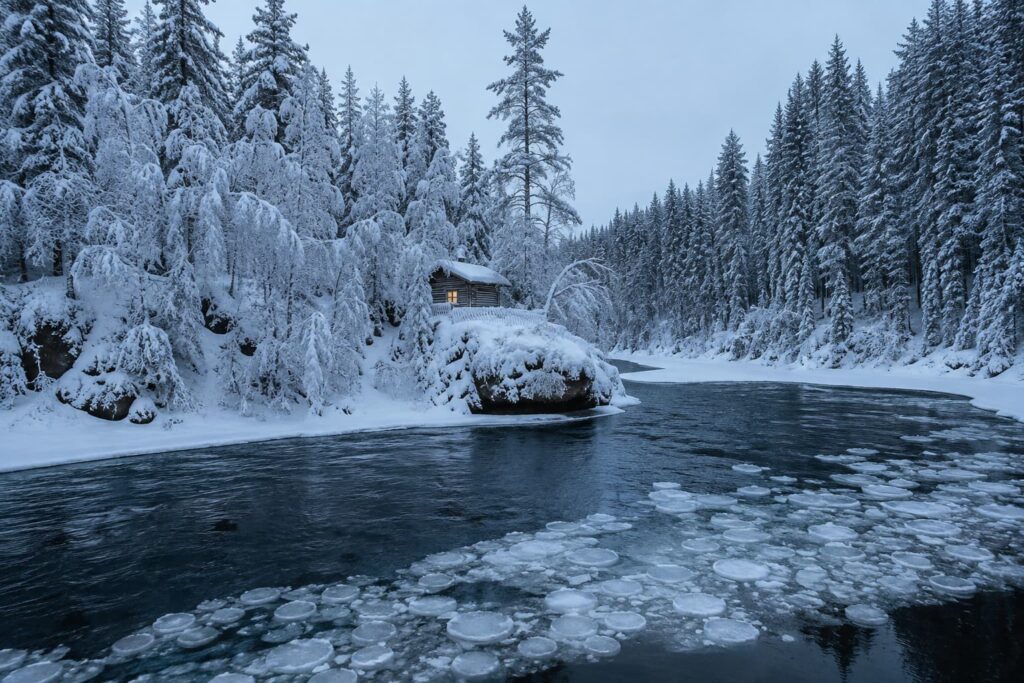
Where to Stay in Lapland: How to Choose the Right Base
Rovaniemi, Levi, Saariselkä, and Inari — each scored on the thing it actually trades away: sky darkness against convenience, wilderness against logistics, atmosphere against cost.
Deciding where to stay in Lapland is the first decision — and the one that settles almost everything else. The airport you fly into determines your flight cost. The base determines the drive radius you’ll live inside for every day of the trip. And the latitude of that base determines how much polar darkness you’ll actually experience, which is probably the main reason you’re going.
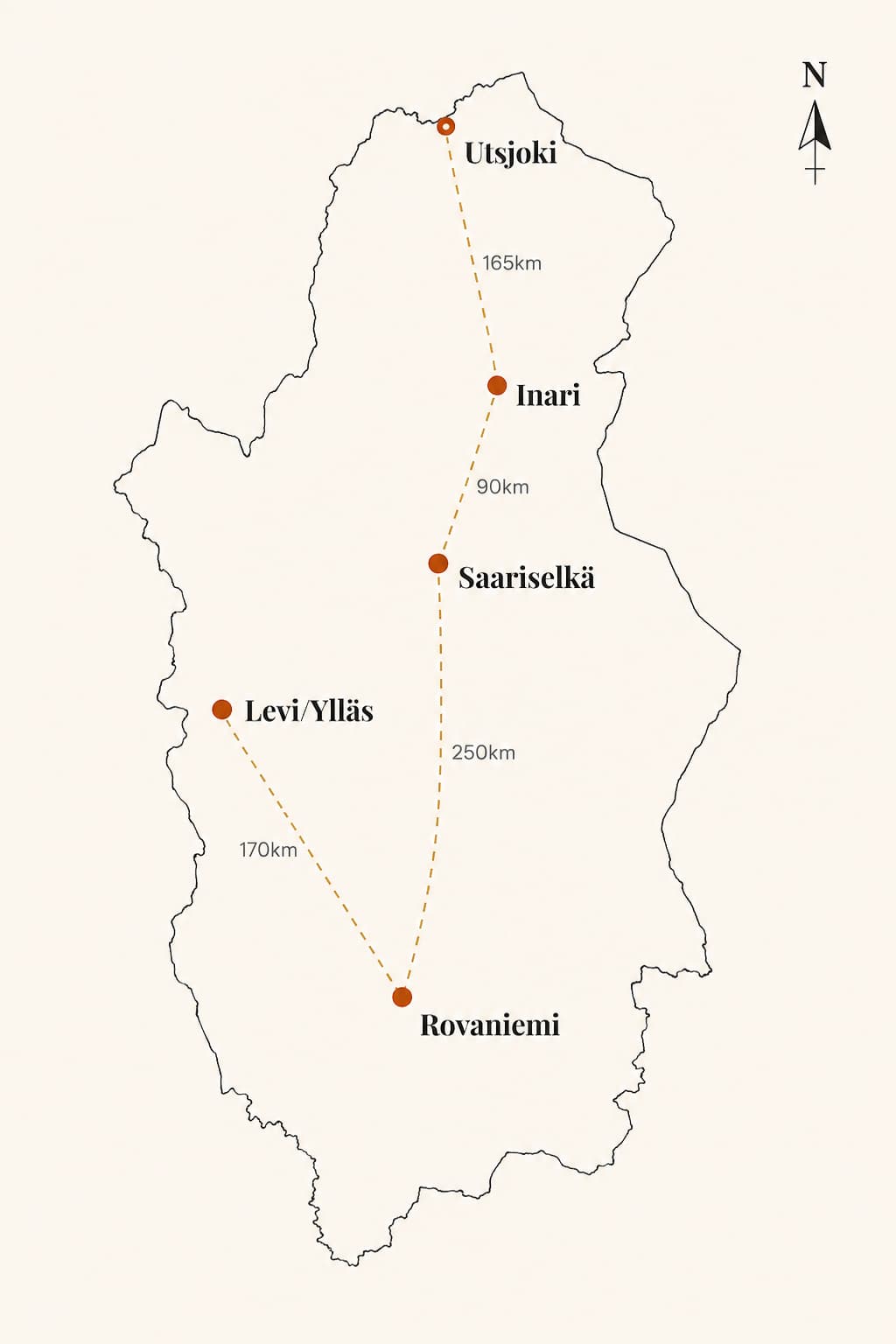
The region is large. Rovaniemi to Inari is roughly 330km — close to five hours on a winter road. That’s not a hotel choice, it’s a trip architecture choice. Every guide treats it as the former. Most guides to visiting Lapland in winter also have a base to sell.
What follows is a base-by-base comparison: what each place actually gives you, what it takes away, and the one question worth answering before you book any of them. For context on timing, the full Lapland winter guide covers the best months in detail.
- The decision that shapes the whole trip
- Where to stay in Lapland: base by base
- Where are the best northern lights in Lapland?
- What the polar night actually is
- What is the best month to visit Lapland?
- Is Santa Claus Village worth it?
- Getting around — why the airport matters
- How many days, and what it costs
- FAQ
01 — The decision that shapes the whole trip
Most people book Lapland in winter the way they’d book a city break: pick a hotel, pick some activities, arrive. The difference is that in a city, almost everything is within walking distance or a short taxi ride. In Lapland, the thing you came for — darkness, wilderness, the lights — is a function of how far north you are. Moving 160km north of Rovaniemi, to the ski resort of Ylläs, adds 14 days of polar night. Moving another 300km to Utsjoki adds 36 more. These aren’t scenic differences. They change what the trip fundamentally is.
The comparison below uses five criteria for each base: sky darkness (latitude and light pollution), crowd level, accessibility (airport and road distance), what’s within reach, and cost range for a standard mid-range week. Each entry ends with a stated trade-off, not a description.
02 — Where to stay in Lapland: base by base
There is no universally correct answer. There is a correct answer for what you’re actually optimising for. The table below makes those trade-offs visible side by side.
| Base | Polar night | Crowds | Nearest airport | Best for | Trade-off |
|---|---|---|---|---|---|
| Rovaniemi | ~2 days | High (family packages, Santa tourism) | RVN — direct from Helsinki | First visit, convenience, families | Brightest skies, busiest streets |
| Levi / Ylläs | ~16 days | Moderate (ski resort atmosphere) | KTT — 15 min from Levi | Skiing + aurora, lively village | More resort than wilderness |
| Saariselkä | ~30 days | Low–moderate | IVL (Ivalo) — 30 min south | Dark skies without losing comfort | Quieter but still well-serviced |
| Inari | ~40 days | Low | IVL (Ivalo) — 40 min north | Sámi culture, lake, deep quiet | Fewer activities, slower pace |
| Kemi | 0 (south of Arctic Circle) | Low | OUL (Oulu) — 1.5 hrs south | Icebreaker cruise, SnowCastle | Specialist add-on, not a northern lights base |
Rovaniemi — where to stay in Lapland for your first visit
Rovaniemi sits directly on the Arctic Circle — the theoretical southern limit of the polar night. True kaamos here lasts around two days. For most of December and January, the sun technically rises but barely clears the horizon before setting again; the effective daylight window is under two hours. That’s dark enough to feel genuinely arctic, and it supports aurora hunting from September to April.
What Rovaniemi has that nowhere else does: the densest infrastructure. Every major operator runs tours from here. The Arktikum museum covers the science and Sámi history of the region and is worth half a day regardless of the weather outside. There are restaurants, a functioning city, and a train station connected to Helsinki overnight. The airport has capacity for package-deal volume, which means flights are frequent and prices are competitive.
What it doesn’t have: the sky darkness that people often picture when they think of Finnish Lapland. Every 100km north brings measurably darker nights and thinner crowds. Rovaniemi trades both of those things for convenience. That’s a fair trade if convenience is what you need — it isn’t a compromise to be embarrassed about — but it’s worth knowing that the Lapland of the Instagram grid is photographed further north.
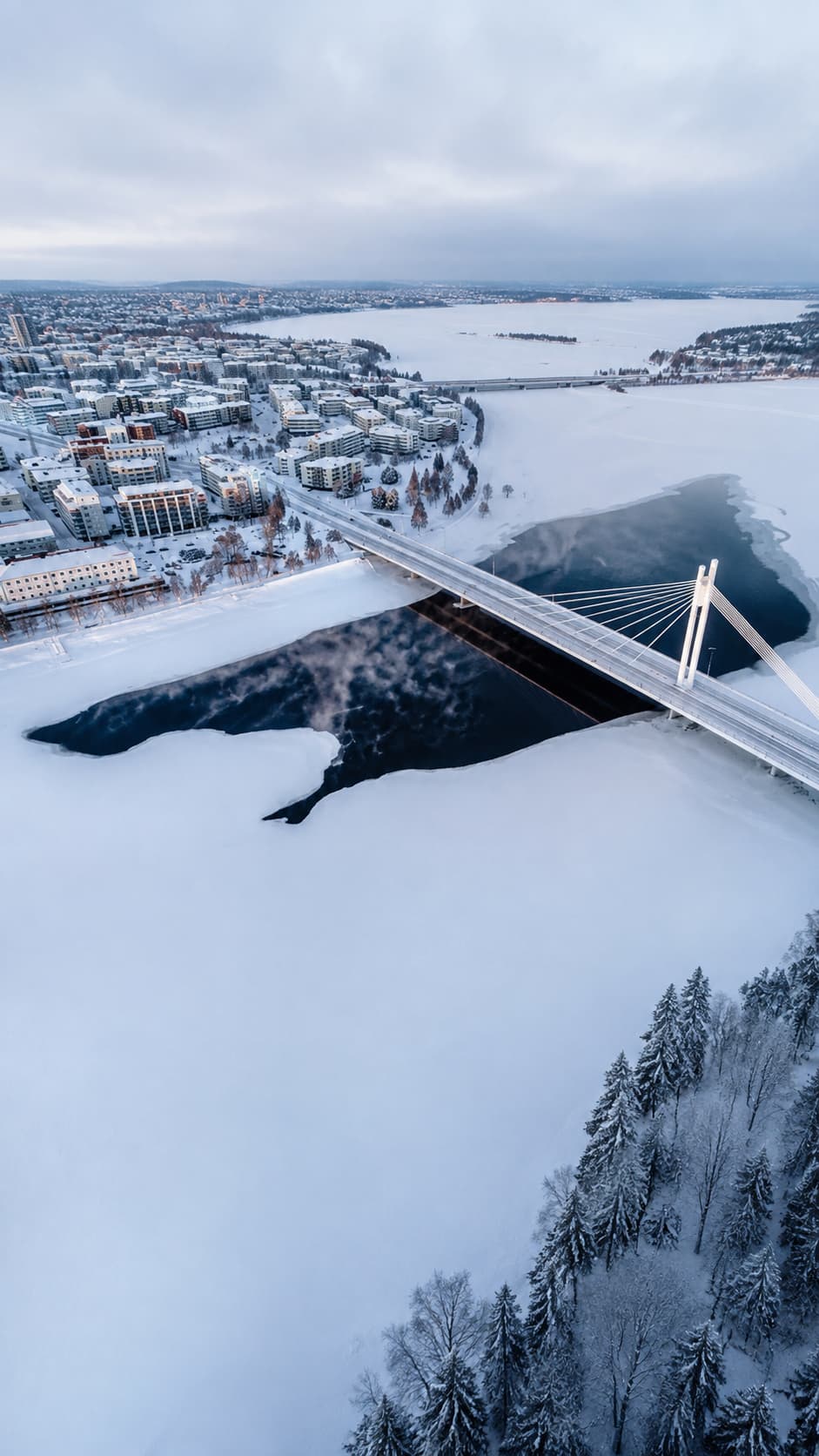
Levi — where to stay in Lapland for skiing and aurora combined
Levi sits about 170km north of Rovaniemi at a latitude where the polar night lasts 16 days. It’s a ski resort in the proper sense — lifts, pistes, a village of hotels and restaurants that comes alive in the evening — and that shape suits some people well and others not at all.
The Kittilä airport (KTT) is 15 minutes away and has direct connections from Helsinki. If you’re combining skiing with aurora hunting, Levi makes the logistics genuinely easy. The ski slopes close around 4–5pm in winter, which leaves long evenings for aurora watching from the open fell landscape above the treeline.
The trade-off: Levi feels more like a mountain resort that happens to be in Lapland than the other way round. If you want wilderness stillness, you’ll find more of it elsewhere. Ylläs, the adjacent fell to the south with a smaller, calmer village, is often a better compromise for people who want skiing plus atmosphere without the resort energy of Levi’s main strip.
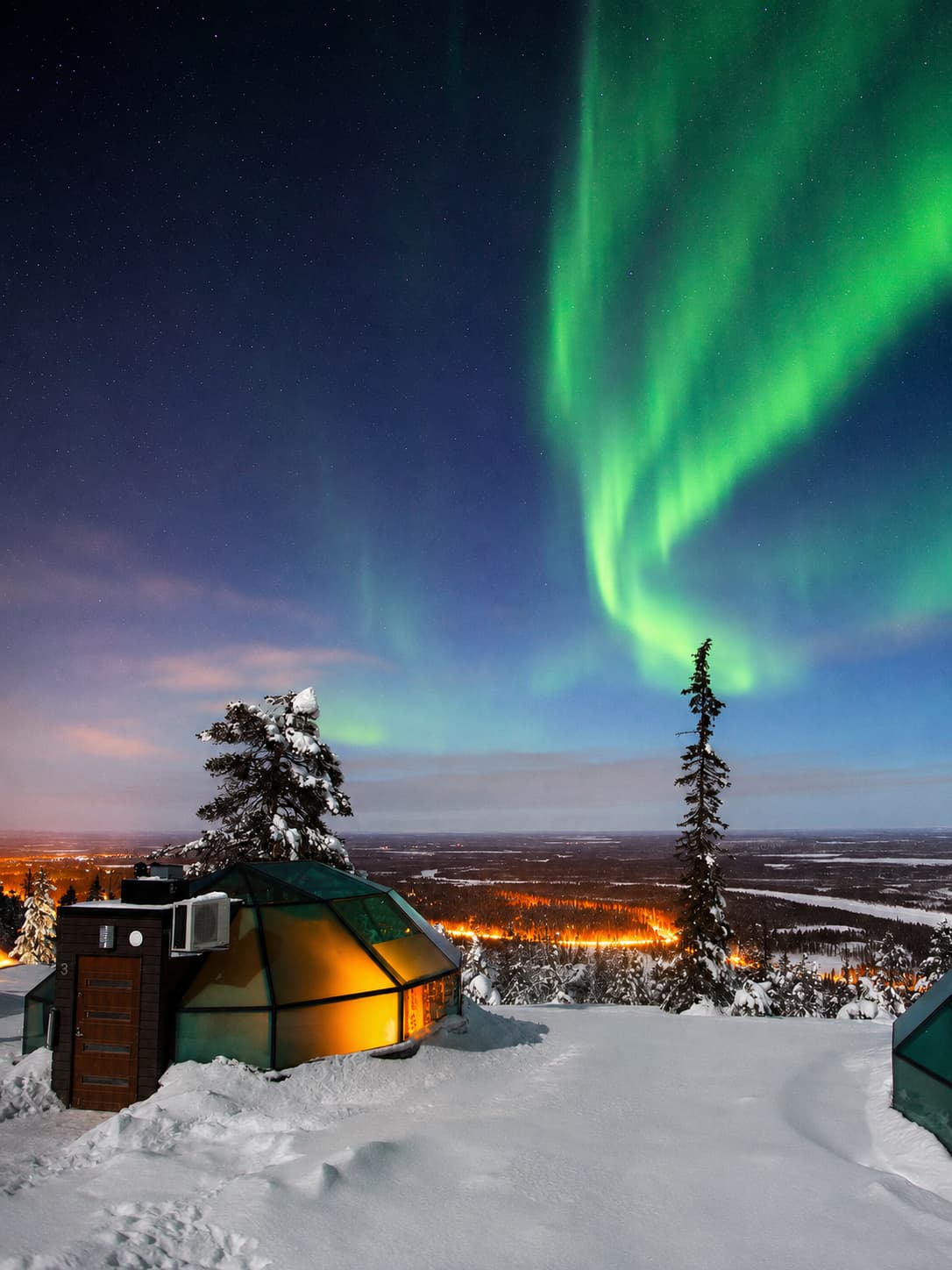
Saariselkä — best place to stay in Lapland for dark skies
Saariselkä is 250km north of Rovaniemi at around 68°N. The polar night here lasts approximately 30 days. The Ivalo airport (IVL) is 30 minutes south, and the same Finnair Helsinki service serves it daily.
This is the most underrated base for the specific combination of aurora access and serviceable accommodation. It sits inside Urho Kekkonen National Park — Europe’s second-largest — which means the wilderness arrives at the edge of the village rather than requiring a drive to reach it. The fells above Saariselkä are open and exposed, ideal for seeing the lights from a high vantage without trees blocking the low-horizon displays.
It’s quieter than Rovaniemi and Levi, but not empty. There are hotels, guided activities, and enough infrastructure that a first-time visitor won’t feel stranded. For solo travellers and couples who came for the lights rather than the resort, this is worth serious consideration.
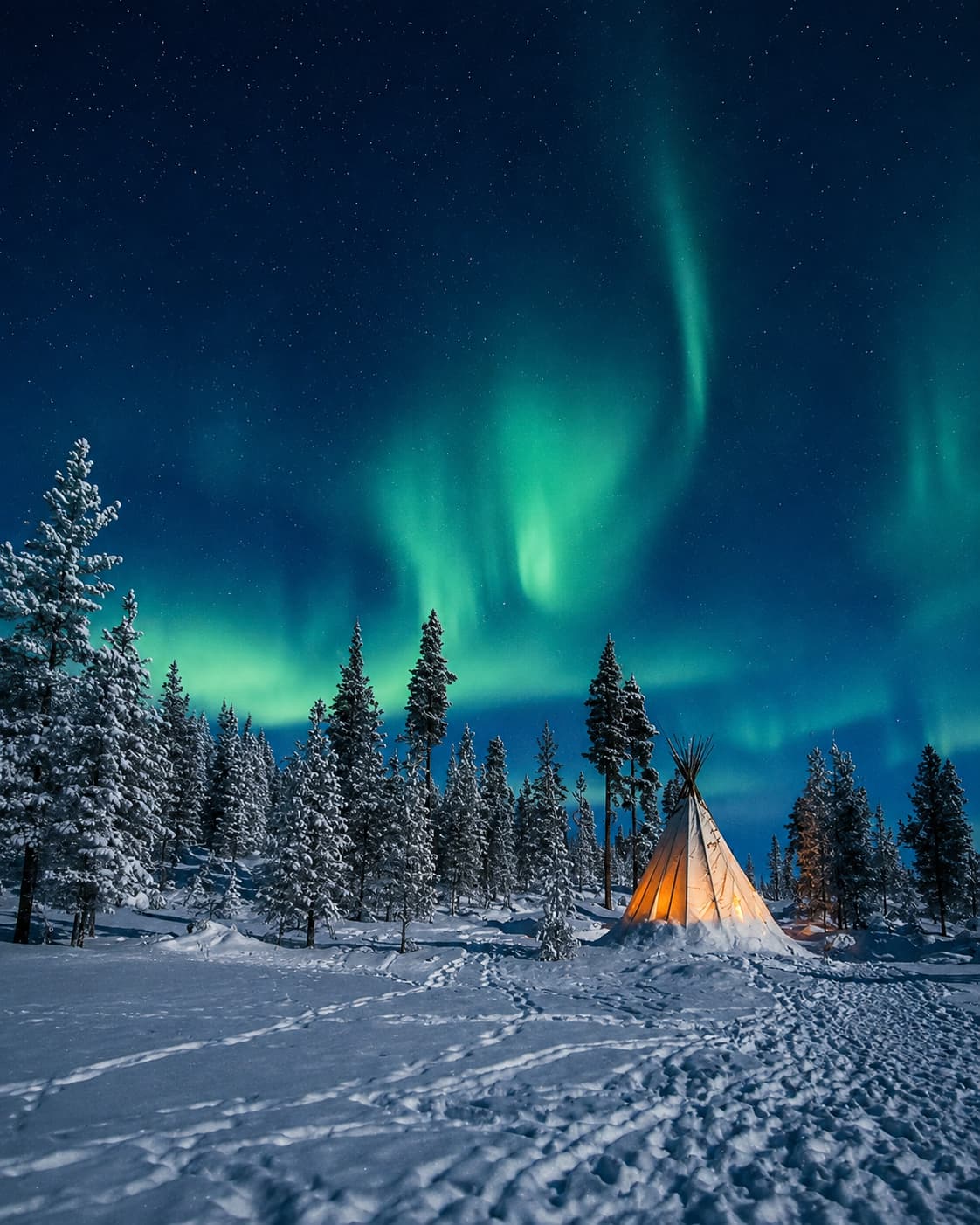
Inari — where to stay in Lapland for the deepest quiet
Inari sits at roughly 69°N, 330km north of Rovaniemi. The polar night lasts around 40 days. Ivalo airport is 40 minutes south — the same airport used for Saariselkä, but reached by heading north rather than south. From Rovaniemi airport, the winter drive takes close to five hours.
What Inari has that nowhere else does: the cultural weight of the region. This is the administrative capital of the Finnish Sámi people, and the SIIDA museum — covering Sámi history and the natural history of the north — is one of the most thoughtfully executed small museums in Scandinavia. Lake Inari, frozen solid through winter, is 1,040 km² of flat white emptiness with unobstructed horizons in every direction. On a clear night, it’s one of the best aurora-viewing surfaces available anywhere.
The trade-off is real. Inari is genuinely remote, there are fewer organised activities than at the resort bases, and the pace is slow in a way that rewards patience rather than packing the days. It’s the right call if you want to be at the quiet end — and know, going in, that that’s what you want.
Kemi — the specialist add-on
Kemi sits south of the Arctic Circle and doesn’t belong in a base-selection guide for northern lights. It belongs in a guide to the Sampo icebreaker cruise and the SnowCastle. Both are genuinely worth doing — the icebreaker especially is a singular experience, floating on the surface of the frozen Bothnian Sea in a dry suit while the ship churns open water ahead of you. But Kemi is a day trip or an overnight bolt-on to a Rovaniemi base, not the foundation of a Lapland winter trip.
03 — Where are the best northern lights in Lapland?
The northern lights in Lapland in winter are a function of latitude, light pollution, and cloud cover — in roughly that order. Finnish Lapland sits inside the auroral oval at all its bases, which means the lights are theoretically visible from anywhere in the region on a clear, active night. The practical differences come from light pollution and cloud cover, and the latitude effect compounds both.
Rovaniemi, as the largest city, has the most light pollution. A display at Kp 2 that would fill the sky at Inari might be barely visible from Rovaniemi’s city centre. Most tour operators address this by driving clients out of the city — 20 to 40 minutes — which works reasonably well, but it adds logistics and means you’re dependent on their scheduling.
Further north, at Saariselkä, Inari, and Utsjoki, the lights appear over open fell landscape with no city glow to compete with. At Lake Inari, the frozen surface reflects low-horizon displays back upward, which amplifies green and purple light in a way that photographs from inside a dark building do not capture.
One useful benchmark: the Finnish Meteorological Institute operates aurora camera stations at Sodankylä, Muonio, Kilpisjärvi, and Utsjoki. Their live feeds are publicly available and give the clearest real-time picture of what’s happening across the region.
The counterintuitive point on aurora odds: December and January, despite being the darkest months, are not statistically the strongest aurora months. Cloud cover is at its peak in deep winter across inland Lapland. September–October and February–March combine equinox-driven geomagnetic activity with better sky conditions. More on this in the next section.
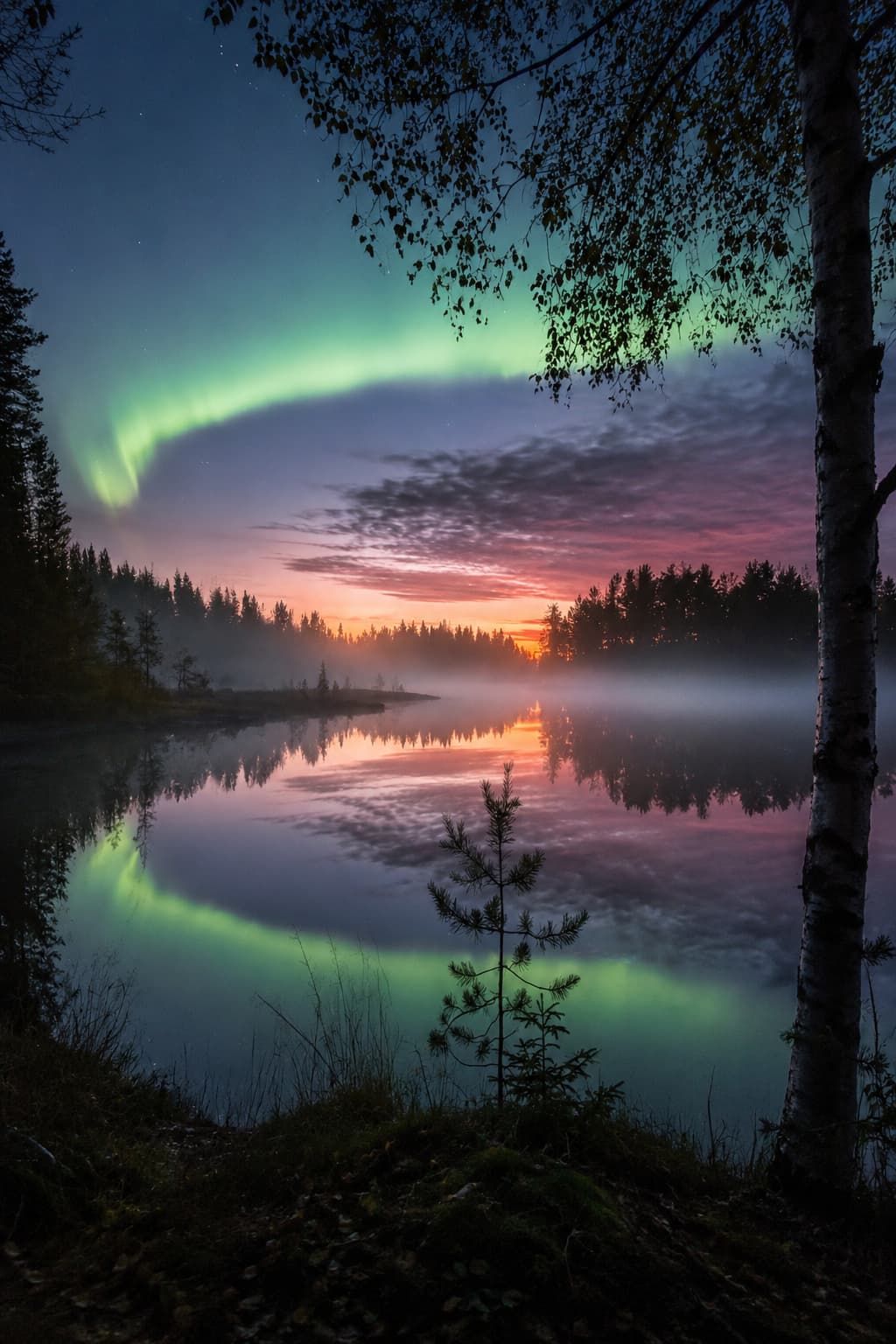
04 — What the polar night actually is, and where you’d have to go for it
Kaamos — the Finnish word for the polar night — refers to the period when the sun stays below the horizon for the entire day. It’s one of the defining features of Lapland in winter, and one of the most misunderstood. Not dim, not low: absent. At Rovaniemi, which sits almost exactly on the Arctic Circle, this happens for approximately two days around the winter solstice. The sun doesn’t rise for roughly 48 hours.
That’s technically polar night, but it’s a much briefer version than most people imagine. Even through December and January in Rovaniemi, there are several hours of soft blue twilight each day. Photographers actually prefer this light — it’s flat, directional, and available for hours rather than minutes. But it’s not darkness.
The difference as you go north is significant. At Ylläs, 160km north, polar night lasts 16 days. Sodankylä, about 130km north of Rovaniemi, experiences around 40 days. Farther north at Utsjoki, Finland’s northernmost municipality at 69.9°N, the sun doesn’t rise from late November to mid-January — 52 consecutive days of polar night. The sky above Utsjoki at noon in December is a deep indigo, briefly lightened by reflected light from the south, and then dark again.
Whether this matters depends on what you’re after. If the darkness is the point — the austere, planet-edge quality of true kaamos — Inari or Utsjoki is where you’d find it. If you want snow, cold, northern lights, and reindeer, all of that is available in Rovaniemi. The darkness is a different thing. If you’re weighing a winter trip more broadly, November in Europe covers some useful alternatives in the same planning window.
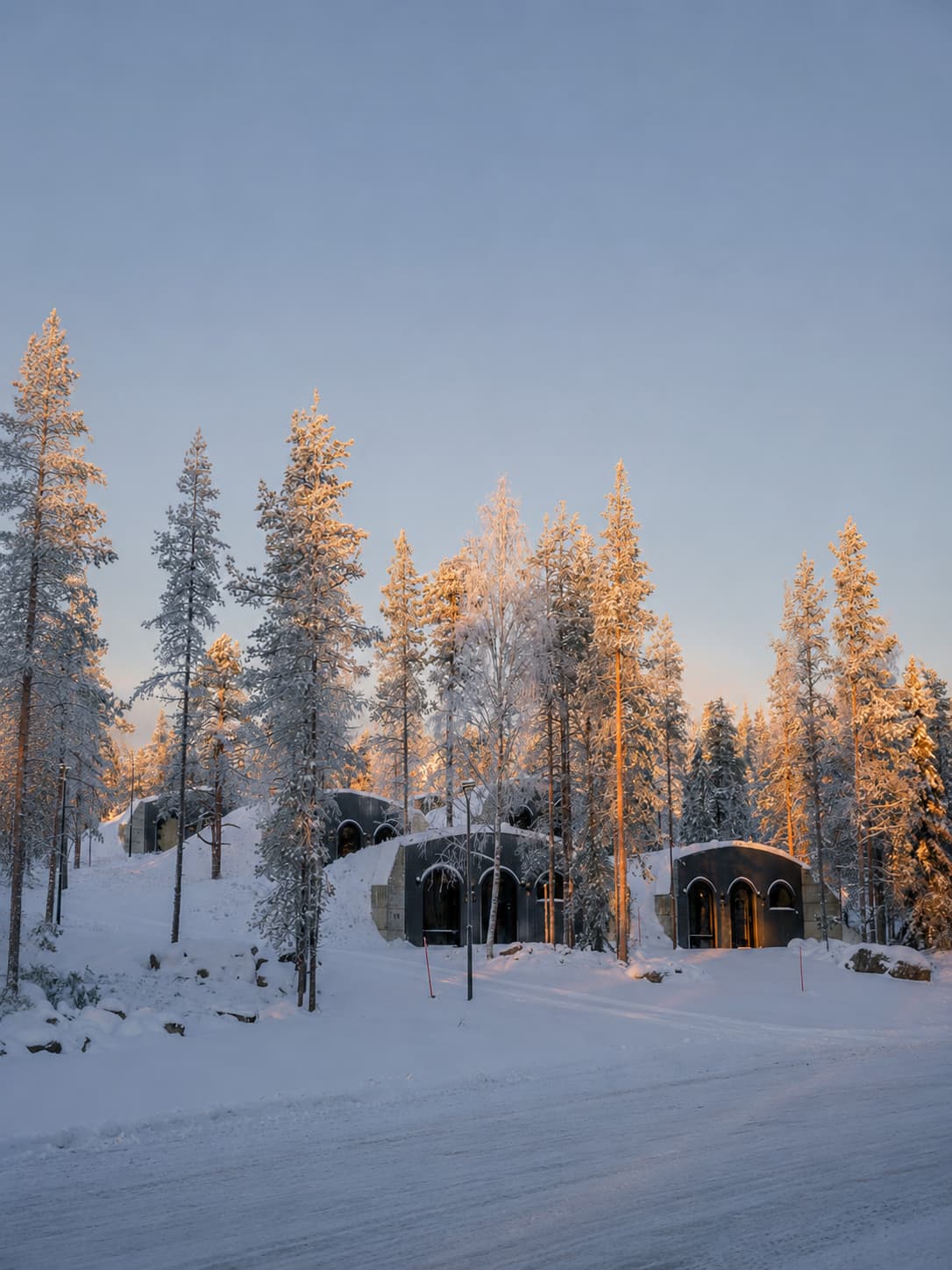
05 — What is the best month to visit Lapland in winter?
Choosing when to go is the second major decision after where to stay in Lapland. The answer depends on what you’re optimising for — and what Lapland in winter actually means to you: aurora probability, or the depth of the polar experience.
For aurora probability, September–October and February–March are the statistically stronger months. The equinox effect — increased geomagnetic activity around the spring and autumn equinoxes — pushes solar wind toward Earth at higher intensity during these periods. September and October add the bonus of manageable temperatures (−5°C to −15°C rather than −20°C to −30°C) and significantly better sky conditions. February and March deliver deep snow and long enough darkness without the extreme cold of the solstice months.
For the winter experience in full — the deepest snow, the longest darkness, the Santa infrastructure if you’re travelling with children — December and January are the obvious months. The trade-off: cloud cover is higher, aurora probability is actually lower per clear night, and prices are significantly elevated. December is the most expensive month to visit Lapland by a meaningful margin. Accommodation that costs €150/night in March can run €250–€375 in December. Glass igloo stays, already expensive, can triple in price at Christmas.
Lapland by Month: Aurora, Darkness, and Price
March deserves more credit than it receives. Snow is typically deeper in March than in December. Daylight returns enough to make skiing on the fells genuinely enjoyable. Aurora season runs until mid-April. And the prices — across flights, accommodation, and activities — drop substantially compared to the Christmas peak. The trip in March is the same Lapland for less money and better aurora odds.
06 — Is Santa Claus Village worth it?
Santa Claus Village is a real place on the Arctic Circle just outside Rovaniemi. It has free entry, roughly 50 independent businesses (shops, restaurants, activity operators), and a paid layer on top that includes the official Santa meeting experience. The paid encounter with Santa — the choreographed room, the certificate, the professional photos — costs around €30–€45 per child depending on the package. It’s designed for the moment, it’s professionally run, and if you’re travelling with young children who have been told they’re going to meet Santa in his actual home, it will deliver what it promises.
For adults without children, the village is brief. It’s worth an hour in the early afternoon — the landscape around the Arctic Circle marker is genuinely atmospheric in deep snow, and the reindeer kept on the grounds are the real kind, not props. The commercial density picks up quickly, though, and there isn’t much reason to stay beyond a short exploration.
Worth noting: the village is entirely separate from the Arktikum, which is the substantive museum experience in Rovaniemi covering polar science and Sámi culture. If you have one day in Rovaniemi and want to come away knowing something about the place, the Arktikum is the better use of it.
07 — Getting around, and why the airport matters
Getting around on a Lapland in winter trip hinges on one variable most people don’t check until they’re booking: which airport. Three airports serve Finnish Lapland: Rovaniemi (RVN), Kittilä (KTT) for Levi and Ylläs, and Ivalo (IVL) for Saariselkä and Inari. All have daily Finnair connections from Helsinki, and the flights run 1.5 to 1.75 hours. Helsinki itself is a 3-hour flight from most major Western European airports.
The error most people make is choosing the cheapest flight rather than the closest airport. If you’re based in Inari and fly into Rovaniemi to save €60, you’ve added roughly five hours of winter driving each way. In December at −25°C, that’s not neutral. It’s the most demanding driving you’ll do — compact ice, reindeer on the road, total darkness — and it uses two days of a seven-day trip.
Car or tours — what to book when deciding where to stay in Lapland
A rental car costs €60–125/day depending on vehicle size. Winter tyres are mandatory November to April and are included in all rentals — you don’t pay extra for studded tyres. The freedom a car provides is substantial: you can drive out of any base at any hour of the night when the aurora forecast improves, rather than waiting for a minibus tour departure.
The case for tours: if you’re in one resort and booking guided activities, most operators include hotel pickup. You won’t need a car. Tour operators also know the local landscape and cloud patterns, which has genuine value when you’re new to reading aurora forecasts. For a first trip to Rovaniemi without plans to drive north, tours are probably the more efficient model. For anyone basing themselves outside the main resorts — at Inari especially — a car is close to essential.
08 — How many days, and what it costs
Deciding how long to spend on a Lapland in winter trip starts with aurora probability. Four nights is the practical minimum for a serious attempt. Aurora activity is unpredictable — cloud cover is the main variable — and four clear nights gives you enough attempts to have reasonable odds. Three nights is possible but tight; you can easily spend one night clouded out and one recovering from a late night, which leaves one real attempt. Five to seven nights is comfortable for combining aurora hunting with daytime activities and a slower pace.
On cost: a mid-range week in Lapland — flights from a major European city, a solid hotel or cabin, three or four organised activities, and daily meals — runs approximately €2,000–€3,000 per person in March or October. The same trip in December runs €2,500–€3,500 or more. The main driver is accommodation: a hotel that costs €150/night in late February can reach €300–€375 at Christmas. Glass igloo stays, which exist at multiple resorts and involve sleeping under a glass ceiling for aurora viewing, range from €300–€500 per night in shoulder season to €600–€990 in peak December.
The most consistent money-saving move is timing: March delivers an equal or better winter experience — deeper snow, often better aurora odds, returning daylight for skiing — for meaningfully less money than December. If you’re comparing winter trip costs more broadly, the Japan trip cost guide makes a useful counterpoint for what a similar budget gets you in a very different direction.
Lapland Without Children and Choosing Between Finland and Tromsø
Splitting Bases and What to Wear in Lapland
Best Month for the Northern Lights in Lapland
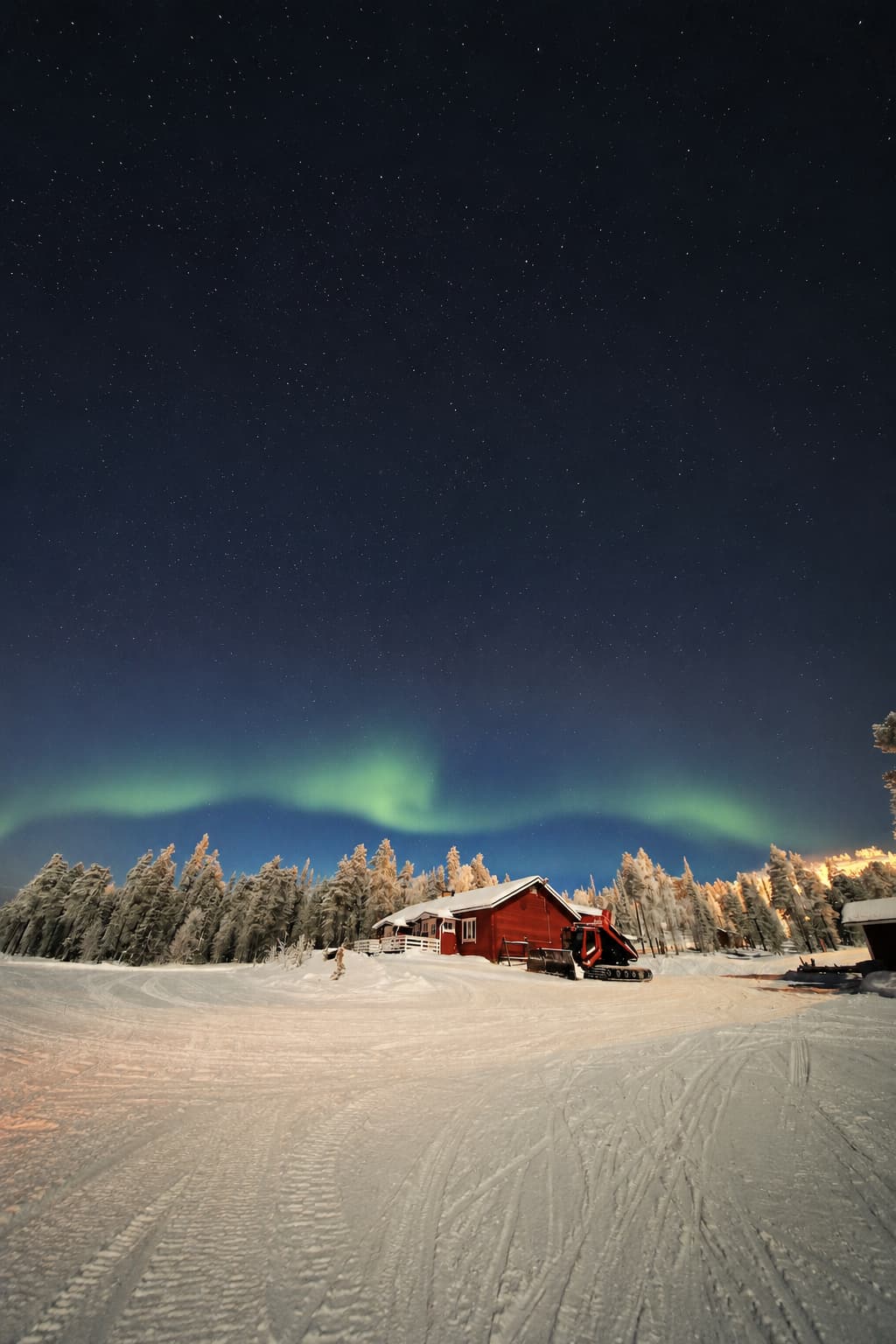
The base you choose doesn’t just change where you sleep.
It changes what the trip is — and what darkness means to you.