Things to Know Before Visiting Morocco: What Actually Matters
Most Morocco tip lists treat a plug adapter and street harassment as equally important bullet points. This one ranks by consequence — what actually changes your trip, what’s worth knowing, and what the other lists overweight.
Why These Morocco Tips Matter
There are things to know before visiting Morocco that will genuinely reshape how your trip feels — and then there are things that every travel blog lists at equal volume because the format demands fifteen bullet points. The currency you cannot buy in advance matters more than which plug adapter to pack. Knowing how to walk through a souk without guilt matters more than memorising tipping percentages. The distance between Marrakech and Chefchaouen matters more than whether stray cats are photogenic.
So rather than another flat list, this guide separates what matters from what’s manageable. Five things that will change your trip if you ignore them, a set of genuinely useful smaller details, and a final section for everything the other lists spend too long on. If you are still deciding where to go, the best places to visit in Morocco overview covers the destinations themselves — this post is about navigating the country once you have decided.
01 — Things to Know Before Visiting Morocco: The Five That Matter Most
Every tip on this list came from the same question: would ignoring this actually change how your trip felt? These five cleared that bar convincingly. Everything else is useful detail, but these are the decisions.
The hassle is real — and it varies by city
Morocco’s reputation for persistent sales pressure is not exaggerated, but it is badly calibrated in most travel writing. In Marrakech’s Jemaa el-Fna and the surrounding souks, the attention is intense, especially during your first few hours. People will call out prices, follow you for a block, insist you look at their shop. Fes brings a different kind of pressure — less vocal, more physical, with occasional false guides who attach themselves and later demand payment. In smaller cities like Essaouira or Chefchaouen, the atmosphere shifts noticeably. The sales approach softens, and you can browse without being followed.
However, none of this has to ruin your trip, and the advice to “just ignore it” undersells the skill involved. What works is a specific kind of polite disengagement — a brief “la shukran” (no thank you) without slowing down, no eye contact with the sales pitch, and above all no guilt about walking away mid-sentence. That last part is the hardest for most visitors, because it feels rude by the social norms you arrived with. It is not rude here — it is how the system works. Additionally, learn to distinguish between genuine friendliness and the “that way is closed, I’ll show you” scam, which is common in both Marrakech and Fes. If someone insists a road is closed and offers an alternative route, it almost certainly is not.
Cash rules everything
The Moroccan dirham is a closed currency — you cannot legally buy it before arriving. Plan on withdrawing from an ATM at the airport or exchanging cash (euros, pounds, or dollars) at a bureau de change once you land. ATMs are widely available in cities, but rural Morocco still runs largely on cash, and even in tourist areas, souks, petit taxis, and street food stalls will not take cards.
Consequently, small notes matter far more than people expect. Keep a supply of 10 and 20 MAD notes separate from your main wallet. Large notes (100 and 200 MAD) are difficult to break at market stalls, and taxi drivers will sometimes claim they have no change — a negotiation tactic, not an honest statement. At the end of your trip, exchange leftover dirhams before leaving the country, as converting them back at home is difficult or impossible.
The country is bigger than the map suggests
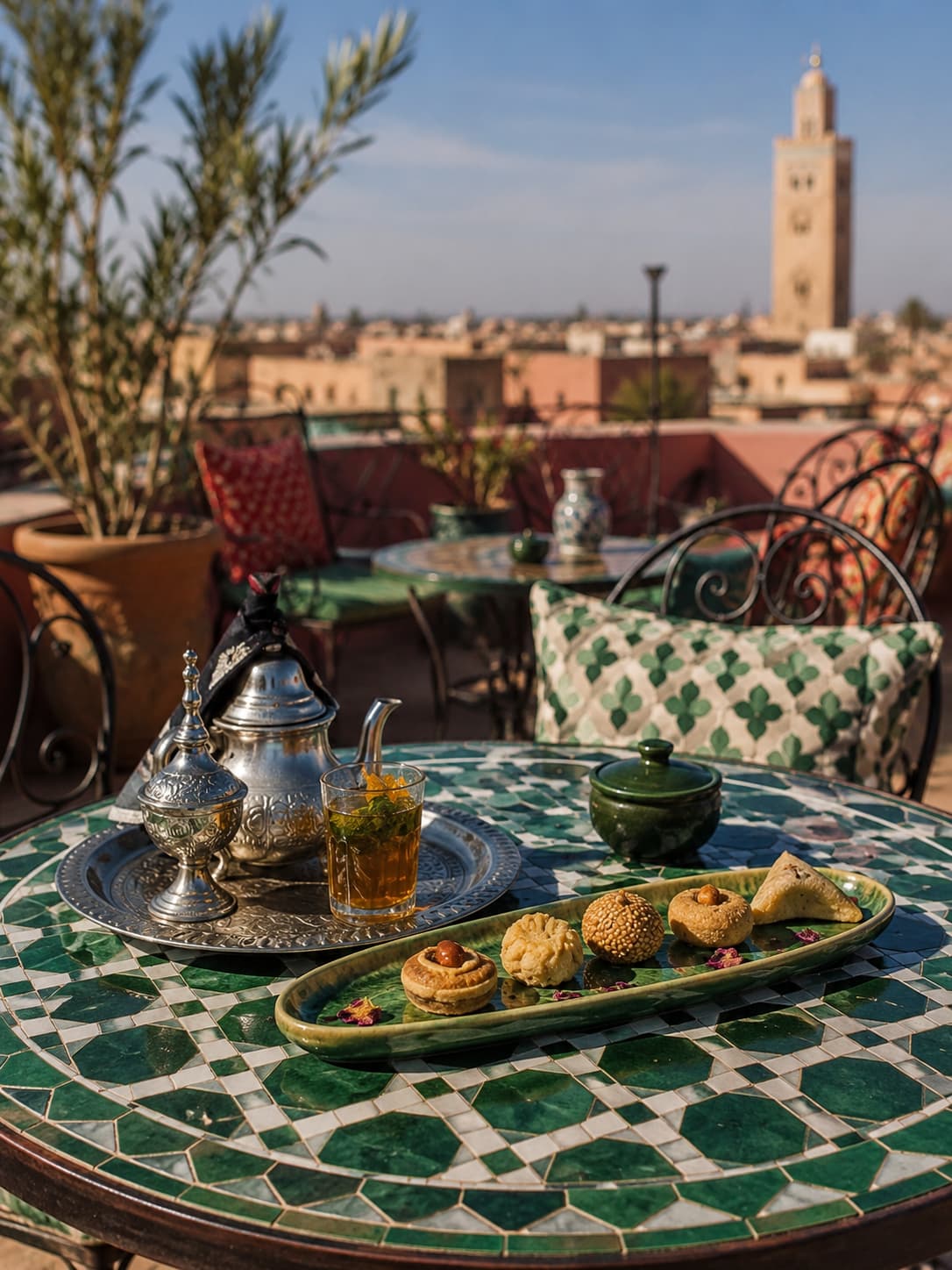
Marrakech to Chefchaouen is roughly 600 kilometres and takes a full day by road — nine hours minimum with realistic stops. Fes to Merzouga for the Sahara dunes is another five-plus hours across the Middle Atlas. These distances are not immediately obvious on a map, and they are the single biggest reason first-time visitors overpack their itineraries. As a result, most bad Morocco trips are actually itinerary problems dressed in culture-shock clothing. The 7 vs 10 day Morocco itinerary breaks down the realistic route options — two to three bases with day trips works far better than five cities in seven days.
Summer heat is a planning constraint, not a footnote
Marrakech and Fes regularly exceed 40°C in July and August, with June pushing toward it. That is not “warm” — it is heat that limits what you can do between midday and late afternoon. Sightseeing in the medina at 2pm in August is genuinely punishing. Coastal cities like Essaouira stay significantly cooler, and the Atlas Mountains offer relief, but if your itinerary is Marrakech-Fes-desert in July, expect to rearrange your days around early mornings and late evenings. Spring (March–May) and autumn (September–November) are the comfortable windows.
Haggling is a system, not a fight
Opening prices in Moroccan souks are not real prices — they are the opening position in a negotiation both parties expect to have. Starting at 40–60% of the quoted price is reasonable for most goods, and walking away is part of the process, not an insult. If a seller lets you go, the price was already close to their floor. When they call you back, there is more room.
For petit taxis, the system is different. Meters are legally required, and asking for the meter — “le compteur, s’il vous plaît” — works in most cases. Most city rides land between 10 and 30 MAD on the meter. If a driver refuses, try the next taxi rather than negotiating a flat fare, which will always be higher. At airports, fixed-price taxi systems exist — look for the official booth rather than accepting quotes from drivers who approach you outside the terminal.
02 — Is Morocco Safe for Tourists?
Yes, broadly — and this is one of the most important things to know before visiting Morocco for the first time. Violent crime against tourists is rare. The actual risks are pickpocketing in crowded medinas, overcharging (taxis, restaurants near major squares, carpet shops), and the persistent attention described above. These are manageable inconveniences, not safety threats, and they are concentrated in the tourist centres of Marrakech and Fes rather than spread evenly across the country.
For solo women, the experience requires honest framing. Verbal attention from men — comments, invitations, persistent conversation — is common, particularly in Marrakech and Fes. It is rarely threatening, but it is relentless in certain areas. Essaouira, Chefchaouen, and the Atlas towns are notably calmer. The skill set is the same as the souk skill: firm, brief disengagement without guilt. Headphones — even without music — signal unavailability more effectively than explanation. A detailed account of what solo travel in a similar context actually feels like is elsewhere on the blog.
Overall, Morocco does not require more caution than other popular destinations in Southern Europe or Southeast Asia. It requires different caution — social management rather than physical vigilance.
03 — What Do Female Tourists Wear in Morocco?
Context matters more than rules — and among the things to know before visiting Morocco, dress is one that other guides either overcomplicate or oversimplify. In the medinas of Marrakech and Fes, covering shoulders and wearing trousers or skirts to the knee reduces unwanted attention noticeably — not because it is required, but because it changes how people respond to you. Beach towns like Essaouira, Agadir, and Taghazout, shorts and swimwear are normal. At upscale riads and hotel pools, wear whatever you would at any resort.
For religious sites, shoulders and knees must be covered. The Hassan II Mosque in Casablanca — one of the only mosques in Morocco open to non-Muslims — enforces this at the entrance. Carrying a lightweight scarf in your bag solves most situations without over-packing: it works as a shoulder cover, a head covering for mosque visits, and a sun shield in the desert. There is no legal dress code for tourists in Morocco, and nobody will stop you from wearing shorts in Marrakech. The question is whether the attention it attracts is worth the comfort.
04 — What Should You Not Do in Morocco?
Some of these are legal, some are social — all will make your trip worse if you ignore them. Among the things to know before visiting Morocco, these are the genuine don’ts rather than overcautious filler.
Photograph people without asking
This is a bigger issue in Morocco than in most countries. Many people object strongly to being photographed, and some — particularly in the souks — will demand payment if you point a camera at them. In other words, ask first. Street photography from a distance is generally fine; close-ups of faces or market stalls are not.
Bring a drone
Drones are effectively banned for tourists in Morocco. They are routinely detected by airport X-ray scanners and confiscated on arrival, regardless of size. Even small consumer models are seized. You may be able to collect yours on departure — with a storage fee — but recovery is not guaranteed. Leave it at home.
Follow unsolicited guides
Someone who approaches you in a medina offering to “show you the way” or claiming that “the tanneries are closed but I know a way” is not helping — they are generating a transaction. The medina is not closed, and neither are the tanneries. Thank them and keep walking. If you want a guide, book one through your riad or a licensed agency.
Assume everyone is Arab
Morocco’s population includes a significant Amazigh (Berber) community with its own distinct languages, traditions, and cultural identity. Calling all Moroccans “Arabs” is inaccurate and, for some, offensive. The country’s official languages are Arabic and Amazigh. A brief awareness of this goes further than most visitors realise.
Additionally, avoid photographing government buildings and military installations, and keep public displays of affection restrained — particularly outside major cities and resort areas.
05 — Is It OK to Visit Morocco During Ramadan?
Not only is it fine — it can be genuinely rewarding, and the Ramadan question belongs on any honest list of things to know before visiting Morocco. Ramadan shifts roughly 11 days earlier each year on the Gregorian calendar. In 2027, it is expected to begin in early-to-mid February and last until mid-March, though exact dates depend on moon sighting and are confirmed by Moroccan authorities shortly before.
During Ramadan, the daily rhythm changes everywhere. Most Moroccans fast from dawn to sunset, and the pace of life slows noticeably during the afternoon. Tourist-oriented restaurants in Marrakech, Fes, and other major cities remain open, but smaller local restaurants may close during daylight hours. Eating and drinking in public during fasting hours is not illegal for tourists but is considered disrespectful — eat at your riad or in a tourist restaurant rather than on the street.
After sunset, the atmosphere transforms. Iftar — the evening meal that breaks the fast — turns cities into something closer to a nightly festival, with streets filling up, food stalls opening, and families socialising until late. In short, Ramadan narrows some daytime options but opens an evening experience most visitors never see. The trade-off is worth knowing about, not avoiding.
Separately from Ramadan, Fridays are the weekly holy day year-round. Expect some shop closures and quieter mornings, though major tourist attractions generally remain open.
06 — Morocco Travel Tips: The Smaller Stuff Worth Knowing
Everything below rounds out the things to know before visiting Morocco — genuinely useful but not in the same tier as currency, hassle, and heat. Other guides give these items equal billing. They do not deserve it.
Can you drink tap water in Morocco?
No — stick to bottled water, which is cheap and available everywhere. A 1.5-litre bottle costs 5–7 MAD at a corner shop. Ice is the subtler risk: in restaurants that cater to tourists, ice is typically made from filtered water, but at street stalls and smaller local spots, ask before assuming. For coffee and cooked food, tap water used in cooking is not a concern — the risk is drinking it straight.
Riads vs hotels
Riads — traditional courtyard houses converted into guesthouses — are the quintessential Morocco stay, and in the medinas they are often the better choice for atmosphere and location. They tend to be smaller, more personal, and better positioned than hotels for exploring on foot. That said, riads vary enormously in quality, and a well-reviewed hotel in the ville nouvelle can be a better option if you want reliable amenities over character.
Tipping norms
Tipping is expected for small services — 2–5 MAD for bathroom attendants, 5–10 MAD for someone who helps with bags or gives directions you requested, 10–20 MAD per night for riad housekeeping, and rounding up taxi fares to the nearest 5 MAD. At restaurants, 10% is appreciated. None of these amounts are large, but not having small coins causes friction. Keep a pocket of change separate from your wallet.
Toilets
Carry tissue. Many public bathrooms, particularly in the medinas and at bus stations, do not have toilet paper, or an attendant will hand you a few sheets for 1–2 MAD. Some facilities have Western-style toilets; others have squat toilets. Neither is worth stressing about — just be prepared.
Languages
Moroccan Arabic (Darija) is the everyday spoken language, and it is quite different from the Modern Standard Arabic taught in courses. French is widely spoken in cities and is the default language for business, government, and education. English is common in tourist-facing roles in Marrakech, Fes, and Essaouira but patchy elsewhere. In Amazigh-speaking areas — the Atlas Mountains, parts of the Rif — French is your most useful second language. A few words of Darija (“la shukran” for no thank you, “bslama” for goodbye) go far.
Plug adapters
Morocco uses Type C and Type E plugs — the same two-pin round plugs used across mainland Europe. If you are coming from the UK or US, bring an adapter. That is genuinely the entire tip.
Morocco Travel Tips FAQ
First-Timer Mistakes and Practical Morocco Advice
Morocco rewards the prepared and unhurried. Most of what makes a first trip difficult is not the country itself — it is the gap between expectation and reality. These are the things to know before visiting Morocco that close that gap, and what remains once you do is one of the most interesting places you will ever visit.