
Pompeii + Naples in One Day: The Road Trip Stop That Does Both
2–3 hours in the ruins, then drive 25km north and eat the best pizza of your life — this is the day that makes the southern loop.
01 — Why This Combination Works
A Pompeii Naples one day itinerary fits naturally into a southern Italy road trip. Most attempts to combine two major sites in one day involve a compromise — an early departure, a rushed exit, or the feeling that you gave neither place its due. This one is different. The reason is geography.
Coming north from the Amalfi Coast, Pompeii sits directly on the route. It is not a detour. The ruins are simply there, at the point where the coastal road meets the motorway. Naples follows naturally 25 kilometres afterward. The day is not forced — it is the road doing what roads do.
The road trip context — where this stop fits
On a typical southern Italian loop, the sequence runs: Amalfi Coast for two or three days, then north through Pompeii and Naples toward Rome, or east toward Puglia. The Pompeii exit is signposted from the SS18 coastal road. The drive from Positano or Praiano takes roughly an hour to an hour and a half, depending on traffic.
Because of this positioning, the day feels continuous rather than divided. You leave the Amalfi Coast in the morning, absorb a few hours in Pompeii, and then continue north into Naples for the afternoon. Each location transitions into the next without friction and without backtracking. There is no logistical negotiation involved.
If you are ending your southern loop in Naples — as many road trips do, given the city’s airport and train connections — this day also functions as a natural conclusion. You arrive with something already completed. That takes the pressure off the city and allows it to be experienced properly.
Why most people skip one or rush both
The common mistake with Pompeii is expansion. People arrive planning two hours and end up spending five. The site is larger than it appears on a map, and each section leads naturally into the next. By the time they leave, it is mid-afternoon. Naples has been compressed to a rushed dinner. The city requires time to feel properly, and a rushed evening cannot provide it.
The opposite mistake is equally common with Naples. Visitors arrive, eat pizza, walk briefly through the historic centre, and leave feeling they have seen it. Naples does not reveal itself quickly. The atmosphere builds gradually — through the noise of a particular street, the quality of light in a courtyard, the way a conversation spills out of a bar. All of this takes time.
The balance comes from restraint at Pompeii. Spending a focused two to three hours there — seeing the things that matter and leaving before the day tilts — gives Naples the afternoon it needs. Depth in Pompeii, pace in Naples. That is the principle the day runs on.
02 — Pompeii: How to Use Your 2–3 Hours Well
Arrive early — the one rule that matters
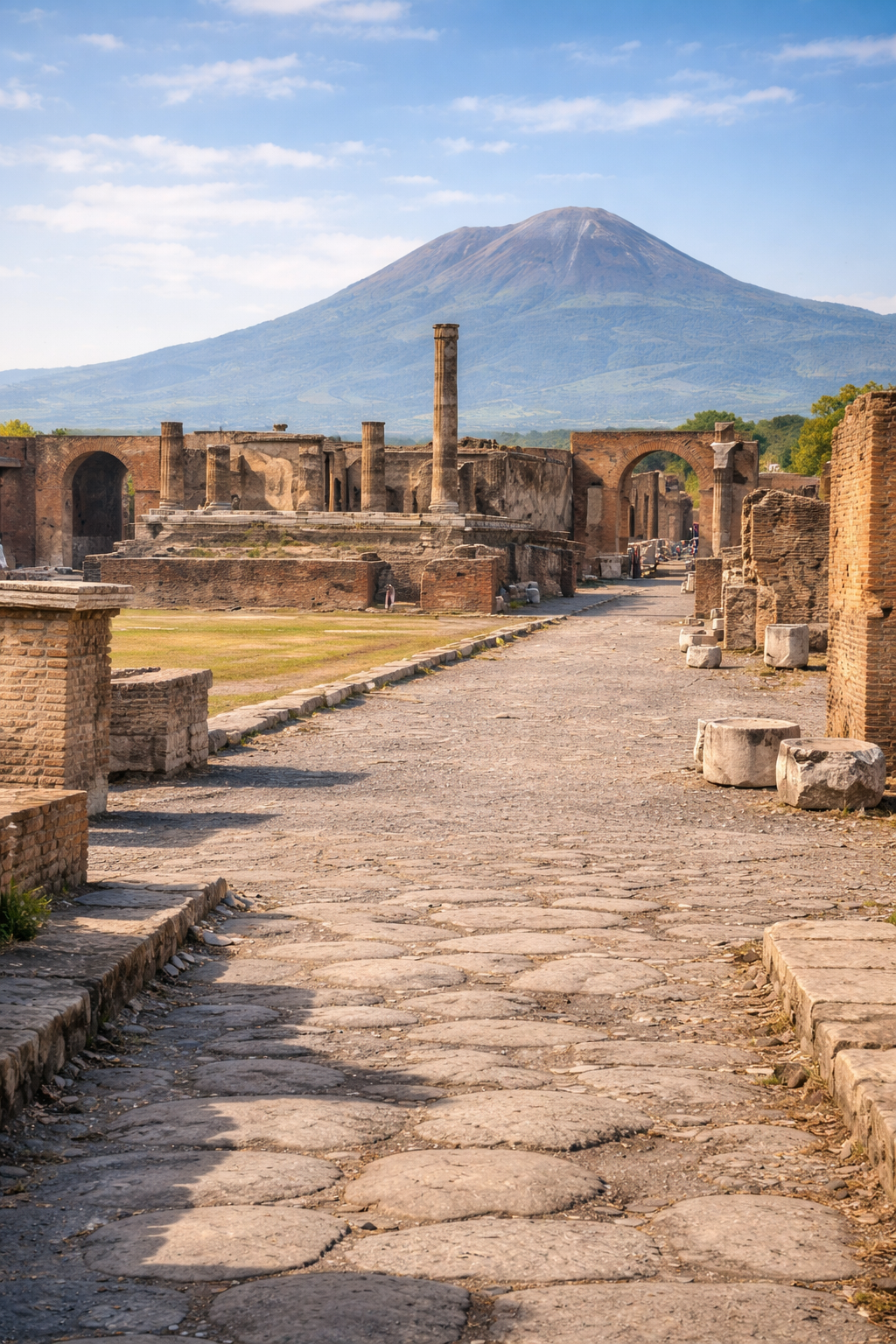
Arriving early changes the experience more than any other single decision. By 9am, the main streets are still and the light is low and directional across the stone. The Forum, seen first thing in the morning with almost no one else in it, gives you a genuine sense of the city’s scale. That sense is significantly harder to access by 11am, when tour groups have arrived and movement through the main routes slows.
Furthermore, Pompeii in summer heat is a different physical experience from Pompeii in the morning. The site has almost no shade. By midday in July or August, the temperature on the stone paths can be genuinely punishing. Starting early solves this. You are out before the worst of the heat. Naples — which has its own intensity — feels manageable when you arrive in the early afternoon rather than the blazing mid-afternoon.
The route through the ruins that makes sense
Pompeii has two main entrances: the Porta Marina gate, which leads directly toward the Forum, and the Piazza Anfiteatro entrance at the eastern end. For a two to three hour visit, entering from Porta Marina and moving east is the most logical sequence. It takes you from the civic core outward, which mirrors the logic of the original city.
Begin at the Forum. This is where the scale of Pompeii registers most immediately — a large rectangular space framed by columns, with Vesuvius visible over the roofline to the north. The contrast between the completeness of the Forum’s layout and the volcano that destroyed it is difficult to prepare for. Spend time here before moving on.
Along Via dell’Abbondanza
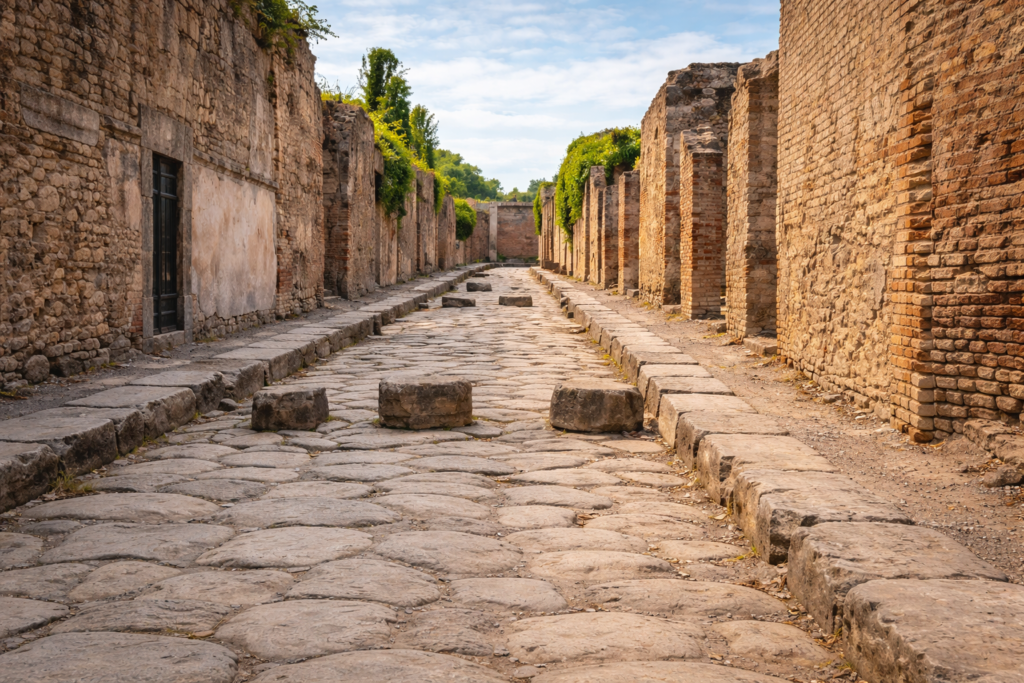
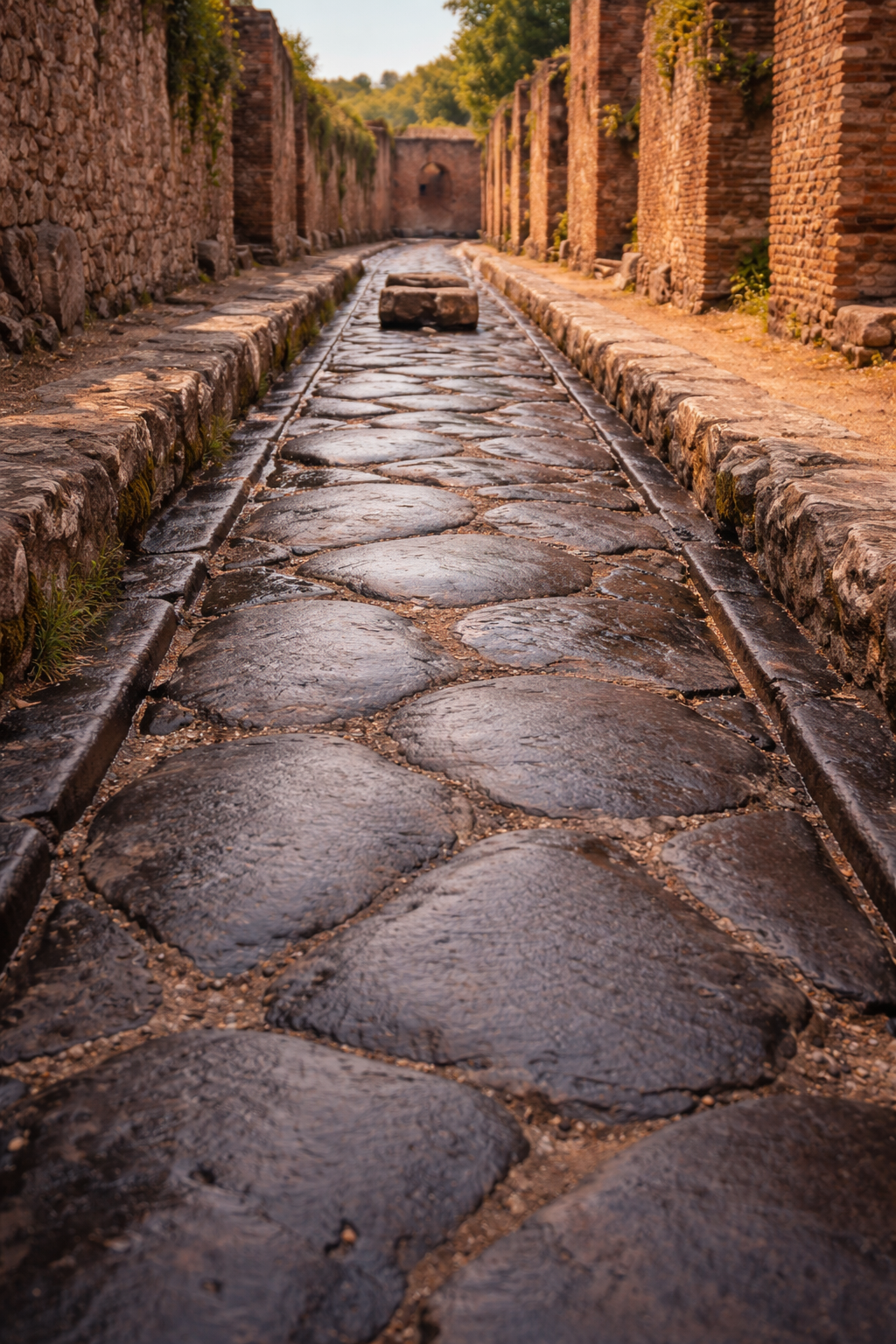
From the Forum, move east along Via dell’Abbondanza — the main street running the length of the city. Cart ruts are worn into the paving stones at regular intervals, the result of centuries of wheeled traffic before 79 AD. Stepping stones cross the road at intersections, raised above the water channels that ran along the street. The detail at ground level is as interesting as the large structures. Walking slowly here is where the city starts to feel inhabited rather than excavated.
Off the main street, the House of the Vettii is one of the best-preserved private residences. The garden has been partially restored with species identified in the original soil. The frescoes on the interior walls are among the most vivid surviving examples of Roman domestic painting. Nearby, the Lupanar draws large crowds but is genuinely interesting — it is evidence of daily life at a scale that most ancient sites do not preserve.
The amphitheatre
If time remains, the amphitheatre at the eastern end is worth reaching. Built in 70 BC, it is one of the oldest surviving stone amphitheatres in the Roman world. Its setting — grass inside, the city wall directly behind, Vesuvius in the distance — is one of the most composed views in the entire site.
Pompeii is not a collection of ruins in the usual sense. It is a city that stopped. Streets remain intact, cart ruts worn deep into the stone, doorways still at their original height, counters in the thermopolia still marked with the rings of ceramic pots. The silence — more than the scale, more than the famous casts of the dead — is what stays with you. You are walking in a place where ordinary life was happening at an ordinary hour, and then wasn’t. That weight accumulates differently from anything a museum can replicate.
What to skip if you only have 2 hours
With two hours rather than three, the amphitheatre is the first thing to leave out. It sits at the far end of the site, and reaching it involves significant walking that cuts into time better spent centrally. The outlying residential streets beyond the main east-west axis can also be skipped without losing the essence of the visit.
Focus on the Forum, Via dell’Abbondanza, and one or two significant houses — the House of the Vettii if it is open, or the House of the Faun for the Alexander mosaic reproduction. Allow time to simply stand in a street and absorb what you are looking at. Two hours of genuine attention is more valuable than three hours of coverage-focused walking.
03 — The Drive to Naples: 25km North
The drive from Pompeii to Naples is short — 25 kilometres, roughly 30 minutes on the A3 motorway. But the shift in atmosphere is immediate and complete. Pompeii is still and reflective. Naples is loud, compressed, and moving at its own speed in multiple directions simultaneously. It is entirely indifferent to whether you are ready for it.
This contrast is not incidental — it is part of what makes the day work. The stillness of the ruins makes the city feel more alive when you arrive. And the city reframes the ruins in return. You understand something about what was lost at Pompeii more clearly after spending an afternoon somewhere that has been continuously, chaotically alive for longer than most countries have existed.
Getting into Naples by car — where to park
Driving directly into the historic centre is technically possible and practically inadvisable. The streets in the centro storico are narrow. One-way systems change without obvious logic. Local drivers treat lane markings as suggestions. Parking within the historic area is severely limited and expensive when available.
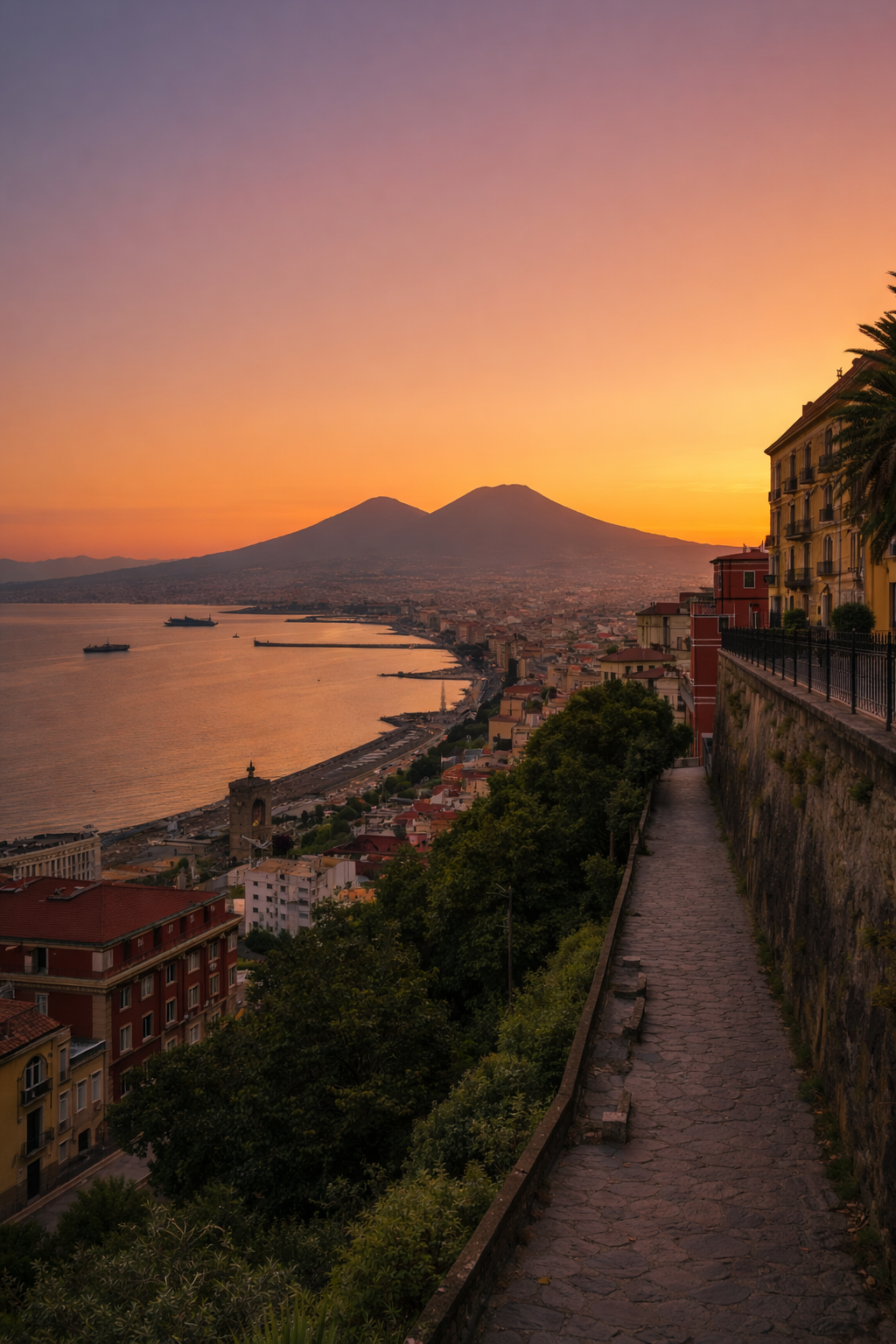
The straightforward solution is to park at a larger garage just outside the historic district and continue on foot. Parcheggio Brin, near the archaeological museum, is well-signposted from the motorway. It places you at a useful entry point to the city. Alternatively, parking near the Mergellina waterfront and walking east gives you the seafront approach — open, breezy, with Vesuvius visible across the bay — before the streets close in.
Budget approximately €5–10 for a few hours of parking depending on the garage. It is a straightforward cost that removes the most friction-producing element of arriving in Naples by car.
The part of the city worth walking first
From wherever you park, the destination is the same: the historic centre, specifically the Decumano Maggiore. This is the main east-west street of the ancient Greek and Roman city that Naples is built directly on top of. It has accumulated names over centuries — officially Via dei Tribunali, commonly referred to as part of the Spaccanapoli axis. Walking it from west to east takes you through the layers of Naples in a way that no other route does.
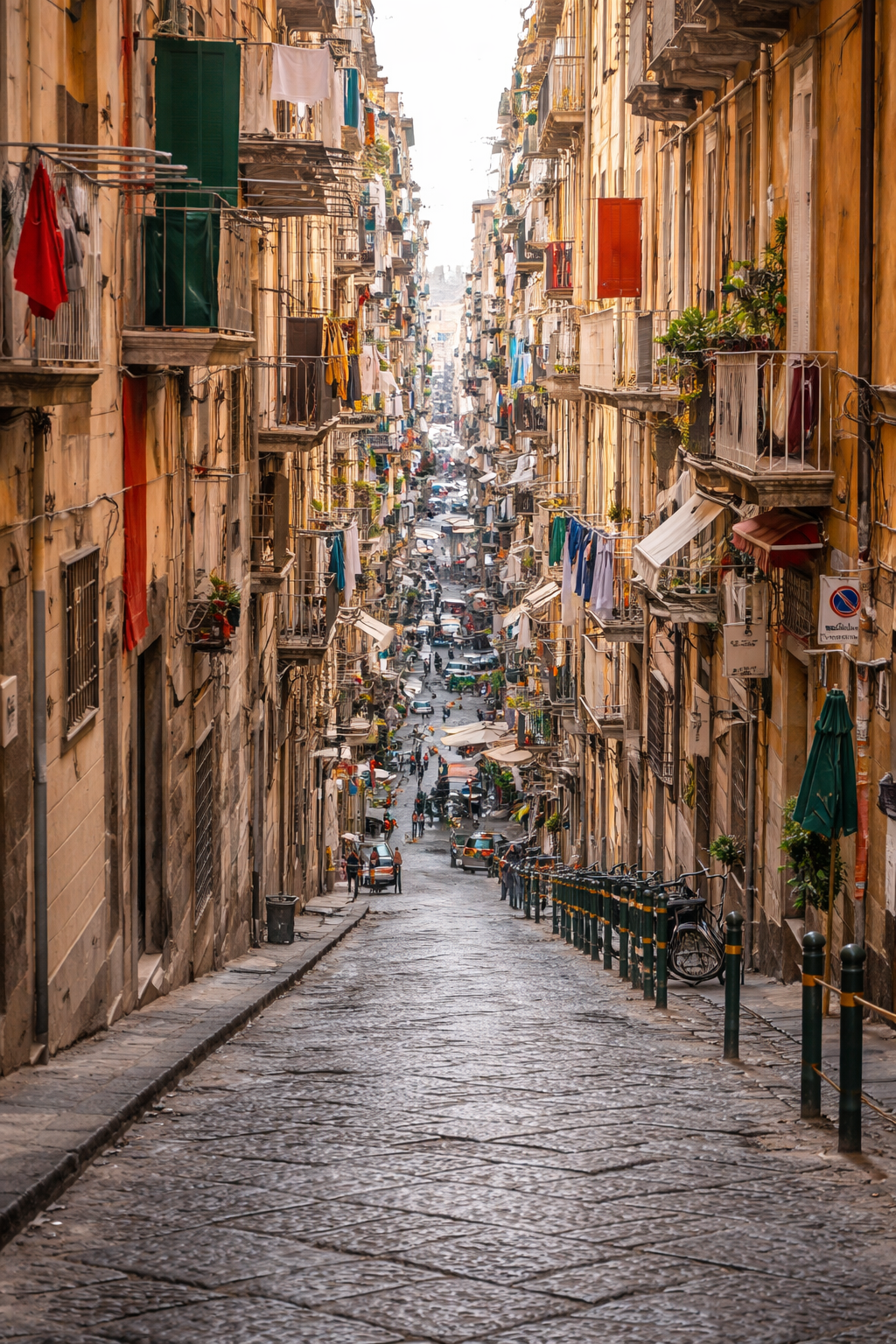
The streets here are narrow enough to feel enclosed. Buildings are tall enough that sunlight reaches the pavement only part of the day. Laundry hangs between windows. Street food vendors operate from carts and counter windows. Churches that would be major attractions in any other city are simply open doorways you pass. San Lorenzo Maggiore — with its excavated Greek and Roman market beneath the floor — is extraordinary and almost entirely unvisited by comparison to the famous sites. The density of what is on offer is unusual even by Italian standards. The correct approach is simply to walk slowly and pay attention.
04 — Naples on Foot: A Proper City, Not Just Pizza
Spaccanapoli and the historic centre
Spaccanapoli — literally “Naples-splitter” — is the straight line that bisects the historic centre from the Piazza del Gesù Nuovo in the west to the Piazza Garibaldi in the east. It is not a single street but a sequence of streets with different names. Walking its length is the most efficient way to understand how Naples is organised and how it feels to be inside it.
The western end, around the Piazza del Gesù Nuovo, is the most architecturally composed part of the route. The church facade of Gesù Nuovo — covered in diamond-point rustication — faces the church of Santa Chiara across a small square. Santa Chiara’s cloister, which most visitors miss entirely, is decorated with hand-painted majolica tiles across its benches and columns. The garden inside is one of the quietest spaces in the city. It costs a few euros to enter and is worth every cent for the contrast it provides with the noise outside.
Moving east along Via San Biagio dei Librai, the street becomes progressively more commercial and less composed. Shops selling religious iconography exist next to bars and alimentari and street food stands. The architecture ranges from baroque churches to buildings assembled from whatever materials were available. Naples does not curate itself for visitors. That quality distinguishes it from cities that do.
What makes Naples feel different from Rome
The comparison to Rome comes up repeatedly when people try to describe Naples. Usually it positions Rome as the composed, accessible version of Italy and Naples as the difficult, rewarding alternative. This is roughly accurate but misses some of the specific texture.
Rome feels like a city that has been carefully managing its own significance for a long time. The historic centre is preserved and navigable. Crowds are heavy but predictable. The tourist infrastructure is extensive and reliable. Naples has none of this managerial quality. It is a city fully occupied with being itself — scooters on the pavement, conversations at maximum volume, street food eaten standing against a wall. The experience has a directness that Rome rarely produces.
This difference makes pairing Naples with Pompeii so effective. Pompeii is contemplative in a way that few sites manage. Naples is the opposite. Moving between the two in a single day produces a contrast that neither experience provides alone. Each place makes you think differently about the other.
The Museo Archeologico Nazionale
Naples carries its history differently from Rome. The Museo Archeologico Nazionale holds the best collection of objects from Pompeii and Herculaneum in the world — the frescoes, the mosaics, the everyday objects preserved by the same disaster you walked through that morning. Even an hour there reframes the Pompeii visit significantly. The famous Alexander mosaic, which occupied the floor of the House of the Faun, is here in full. The collection of erotic art from Pompeii — long kept in a locked room and only recently opened — is unexpectedly interesting as evidence of how Roman sensibility worked.
05 — The Pizza: Where to Go and What to Order

The places worth queuing for
L’Antica Pizzeria da Michele on Via Cesare Sersale is the most frequently cited name in any discussion of Neapolitan pizza. The reputation is not undeserved. The menu is essentially two items: Margherita and Marinara. The simplicity is deliberate — pizza in its correct form requires no embellishment, and any addition distracts from the base ingredients. The queue outside extends along the street on most evenings, but the operation is efficient. The wait rarely exceeds 30–40 minutes, and the price is low enough to justify the experience regardless.
Sorbillo on Via dei Tribunali is the other name that comes up consistently. It operates on a larger scale than da Michele and has a broader menu. The pizza is excellent and the atmosphere inside is chaotic — which, in Naples, means it feels exactly right. A queue is standard in the evening, particularly on weekends.
Beyond these two, the honest reality is that Neapolitan pizza quality across the city is generally high. A smaller place two streets from a major landmark — handwritten menu on a chalkboard, four tables — is likely to produce something excellent at a price that makes tourist-adjacent restaurants look expensive. The main indicator of quality is the same in Naples as anywhere in Italy: find places where locals are eating, the menu is short, and no one is standing outside trying to attract you in.
What makes the pizza actually different
Neapolitan pizza operates under a set of technical specifications. The Associazione Verace Pizza Napoletana has codified the dough hydration, fermentation time, flour type, and cooking temperature in considerable detail. The practical experience of eating it is simpler than the regulatory framework suggests. The crust is soft and slightly charred at the edges from a wood-fired oven at around 485°C. The centre is thin and often slightly collapsed under the toppings. The mozzarella — fior di latte or buffalo from the surrounding Campania region — melts into the tomato rather than sitting on top of it.
The result requires a knife and fork in a way that Roman-style pizza — crispier, structurally more robust — does not. This surprises some visitors expecting a firmer base. The Neapolitan version is wet in the middle and yielding throughout. It is best eaten immediately. It does not improve with time, and takeaway boxes somewhat defeat the purpose.
What to order
Order the Margherita on your first visit. It is not the safe choice so much as the accurate one. The balance of three elements — dough, tomato, mozzarella — is what you are evaluating, and toppings make that harder. A glass of whatever the house has on tap is the correct accompaniment — typically a local lager or a simple red. Naples does not have a wine culture in the way Rome or Florence does. The beer is fine.
2.5 hours in Pompeii felt well-balanced. We covered the Forum, walked the main street in full, and spent real time in one of the better-preserved houses. Arriving at 9am made a significant difference — the first hour in the ruins had a quality of attention that the busier mid-morning could not match.
The transition to Naples was faster than expected. Thirty minutes on the motorway and you are in a completely different world. Parking outside the centre and walking in gave the city the correct first impression: on foot, at street level, with no plan.
The thing we would do differently: arrive in Naples earlier. We reached the city at 2pm, which was fine, but an earlier arrival would have allowed time for the Museo Archeologico Nazionale before it closed. The Pompeii collection there is the natural continuation of the morning. Missing it felt like leaving something unfinished.
On pizza: we went to a smaller place on a side street off Via dei Tribunali rather than the famous names. It was excellent. The lesson, probably, is that the quality floor in Naples is high enough that the decision matters less than the eating of it.
06 — Practical: Timing, Tickets, Driving Notes
What everything costs
Pompeii entry costs €16 for a standard adult ticket. The ticket covers access to the full site and is valid for one day. There is no additional charge for individual buildings within the site, though some sections are occasionally closed for restoration. Check the official Pompeii site for current closures before you go — the House of the Vettii and some other key interiors have been closed intermittently in recent years.
Book the Pompeii ticket online in advance. The booking fee is minimal. Walk-up queues at the ticket office can add 30–60 minutes to your morning — time better spent inside. The official booking site is pompeiitickets.it. Avoid third-party resellers charging a premium for the same ticket.
In Naples, most of the outdoor experience costs nothing. Walking Spaccanapoli, the Piazza del Gesù Nuovo, and the seafront is free. Santa Chiara’s cloister costs around €6. The Museo Archeologico Nazionale costs €12 and is worth it for the Pompeii collection alone — plan at least 90 minutes if you go. Pizza at the well-known places runs €7–12 for a Margherita. The tourist-adjacent restaurants around Piazza del Plebiscito charge noticeably more for equivalent food.
Petrol on the A3 between Pompeii and Naples is straightforward, with service stations at regular intervals. Toll charges are minimal — the short motorway stretch costs under €2.
Timing this within the wider road trip
The day works best when you leave the Amalfi Coast early — ideally by 7:30am to reach Pompeii close to the 9am opening. The coastal road from Positano or Praiano to the Pompeii exit takes 60–90 minutes depending on traffic. It is generally manageable in the early morning before the day’s tourist traffic builds.
Leaving Pompeii by noon puts you in Naples by 1pm. That gives the city a full afternoon and evening. If you are staying the night in Naples — which adds considerably to the experience — the evening extends naturally into the kind of wandering that only becomes possible when you are not watching the clock. Naples after 9pm is a different city from the afternoon version. The heat has lifted, and the streets shift from daytime commerce to evening sociability. It is worth experiencing.
If you are driving through rather than staying — continuing north toward Rome the following morning — park near the motorway exit to simplify the departure. Plan your dinner accordingly and aim for a 9–10pm exit to avoid the worst of the urban traffic.
What to book and what to show up for
Book Pompeii tickets in advance. That is the only non-negotiable advance booking the day requires. For Naples, the approach can be more flexible. The famous pizzerias do not take reservations — the queue is part of the deal. The Museo Archeologico Nazionale sells tickets at the door and rarely has significant wait times outside of peak summer weekends. Santa Chiara’s cloister is walk-up. Parking garages operate on a pay-on-exit basis with no advance booking needed.
Worth researching the evening before: which sections of Pompeii are currently open. The site does ongoing restoration work, and key houses sometimes close with limited notice. A quick check of the official site confirms the current status and prevents arriving to find a section you planned around is inaccessible.
Visiting Pompeii
Planning the combined day
07 — The Thing About the Contrast
By the time evening arrives in Naples, the morning in Pompeii already feels distant. Not in the way that forgettable things feel distant — in the way that something fully absorbed does, settling into the background while the present occupies the front.
The city around you is loud and alive. It is completely uninterested in being contemplated. Scooters move through gaps that do not appear to exist. Someone is having a conversation at a volume that suggests the other person is very far away. The pizza arrives quickly and is better than you expected, even though you expected it to be very good.
You walked through a city that stopped two thousand years ago. Now you are sitting in one that has not stopped since. The distance between those two things is 25 kilometres and an afternoon. Somehow that is enough to hold both of them clearly.
Pompeii teaches you to pay attention. Naples rewards it.
That is why the day works, and why it stays with you afterward.