
Every Town on the Amalfi Coast Road — and Which Ones Are Actually Worth Stopping For
The road between Sorrento and Salerno passes through thirteen towns. Most visitors stop at two or three. Here is an honest account of every single one — what each offers, whether it earns the stop, and what the ones nobody talks about are actually like.
Why most people miss the best Amalfi Coast towns
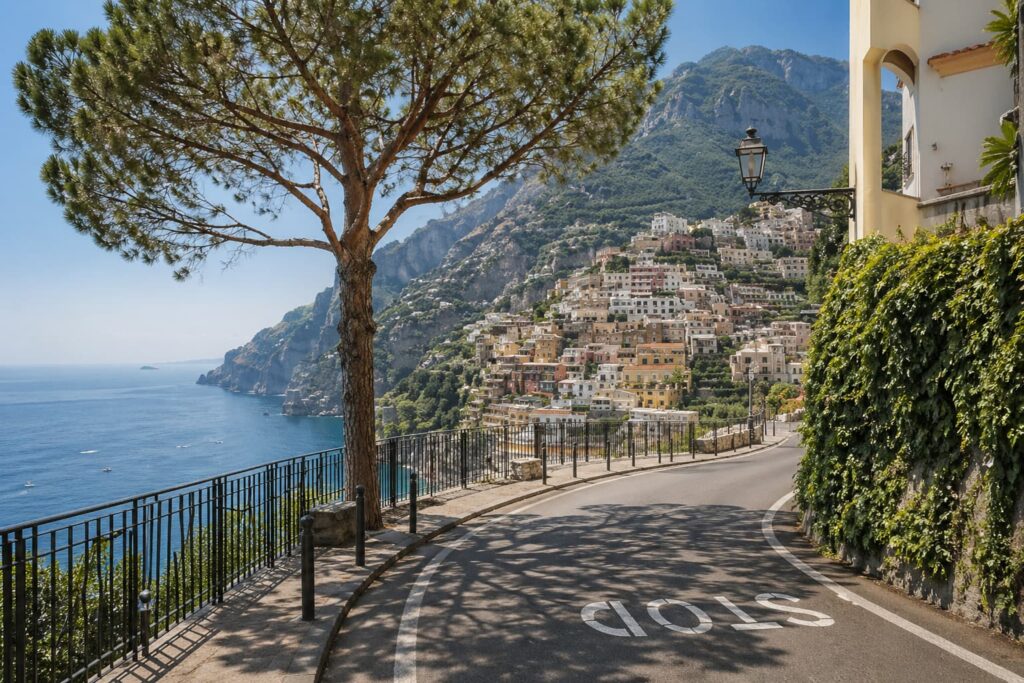
The Amalfi Coast towns along the Amalfitana — one of the most photographed stretches of tarmac in the world — deserve a more honest account than most guides provide. Carved into near-vertical limestone cliffs in the first half of the nineteenth century, the SS163 was never designed for the volume of traffic it now carries: tour buses, rental cars, scooters, and SITA buses all sharing a road where two vehicles sometimes cannot pass simultaneously without one reversing. Furthermore, it connects thirteen distinct municipalities, each with its own character, its own crowd level, and its own case for stopping.
Most visitors see Positano and Amalfi. Some manage Ravello. The remaining ten Amalfi Coast towns — including some of the most genuinely interesting and least crowded places on the entire route — get passed at 15km/h through a car window.
Current SITA Sud bus timetables for the full route are published on the SITA Sud website. Seasonal ferry schedules between the main towns are listed on the Coop Sant’Andrea ferry operator site.
This guide covers all thirteen, in order, west to east. Each town gets an honest verdict. Additionally, the practical information at the end covers the best time to go, parking strategy by section, and what to avoid so the drive goes the way it should.
01 — The Full Route, West to East
The official SS163 runs approximately 50km from Sorrento to Amalfi. The full coastal stretch to Salerno adds another 10–15km via connecting roads east of Amalfi town. Three municipalities — Ravello, Scala, and Tramonti — sit above the coast on mountain roads and are consequently not on the SS163 itself; all three require a detour. Every other Amalfi Coast town is directly on or immediately off the coastal road.
→
→
→
→
→
→
→
→
→
→
→
↑ Inland towns (Ravello, Scala, Tramonti) require a mountain road detour and are not shown in the route sequence above. All three are covered in their own section below.
02 — Western Amalfi Coast Towns: Positano to Amalfi
The four municipalities between Sorrento and Amalfi town carry most of the coast’s global reputation — and most of its tourist traffic. That said, not all of them deliver equally. One of them is the most overrated stop on the entire route; another is arguably the most underrated Amalfi Coast town of all thirteen.
Town 01 — Positano ✅ Stop
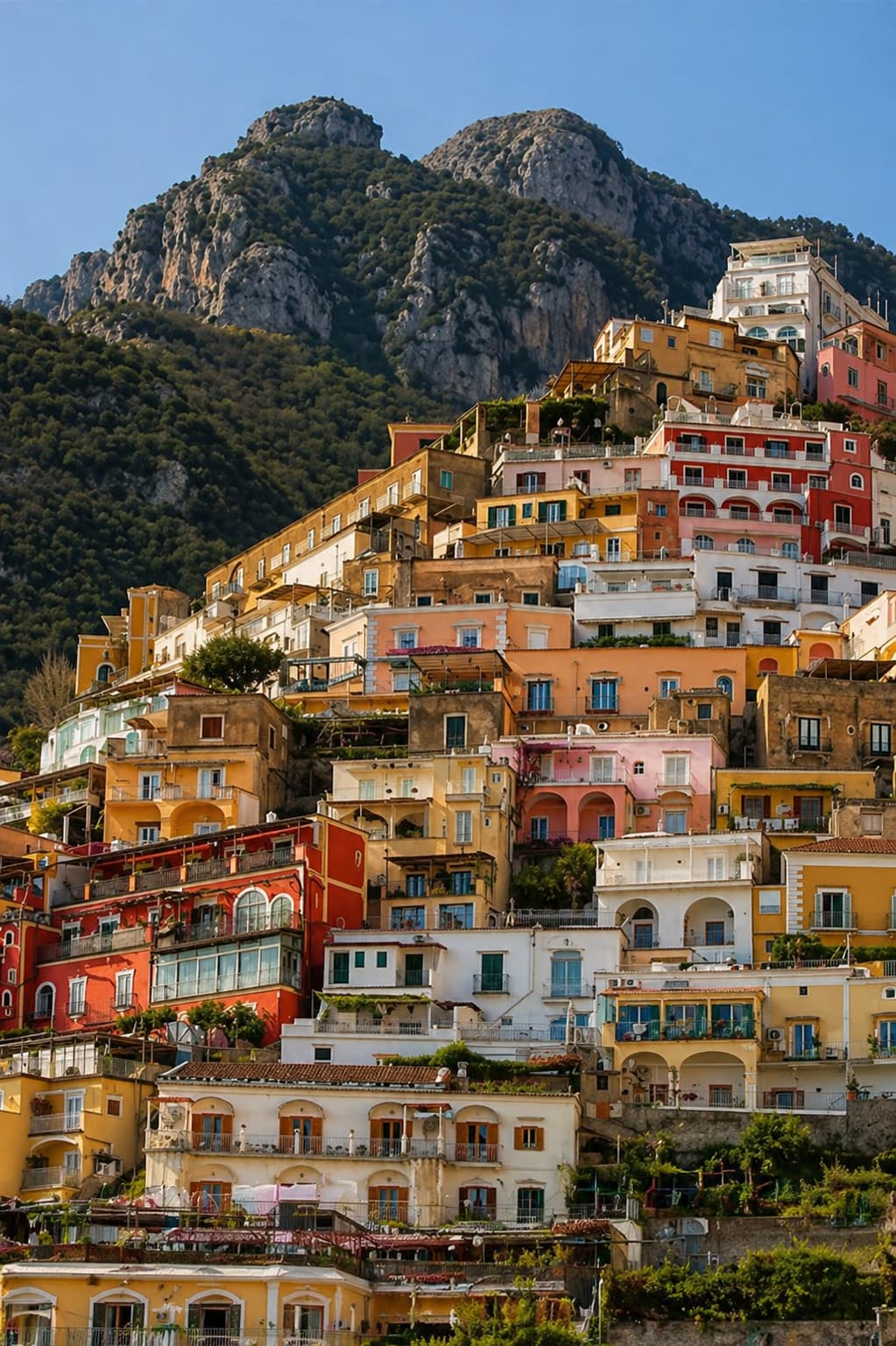
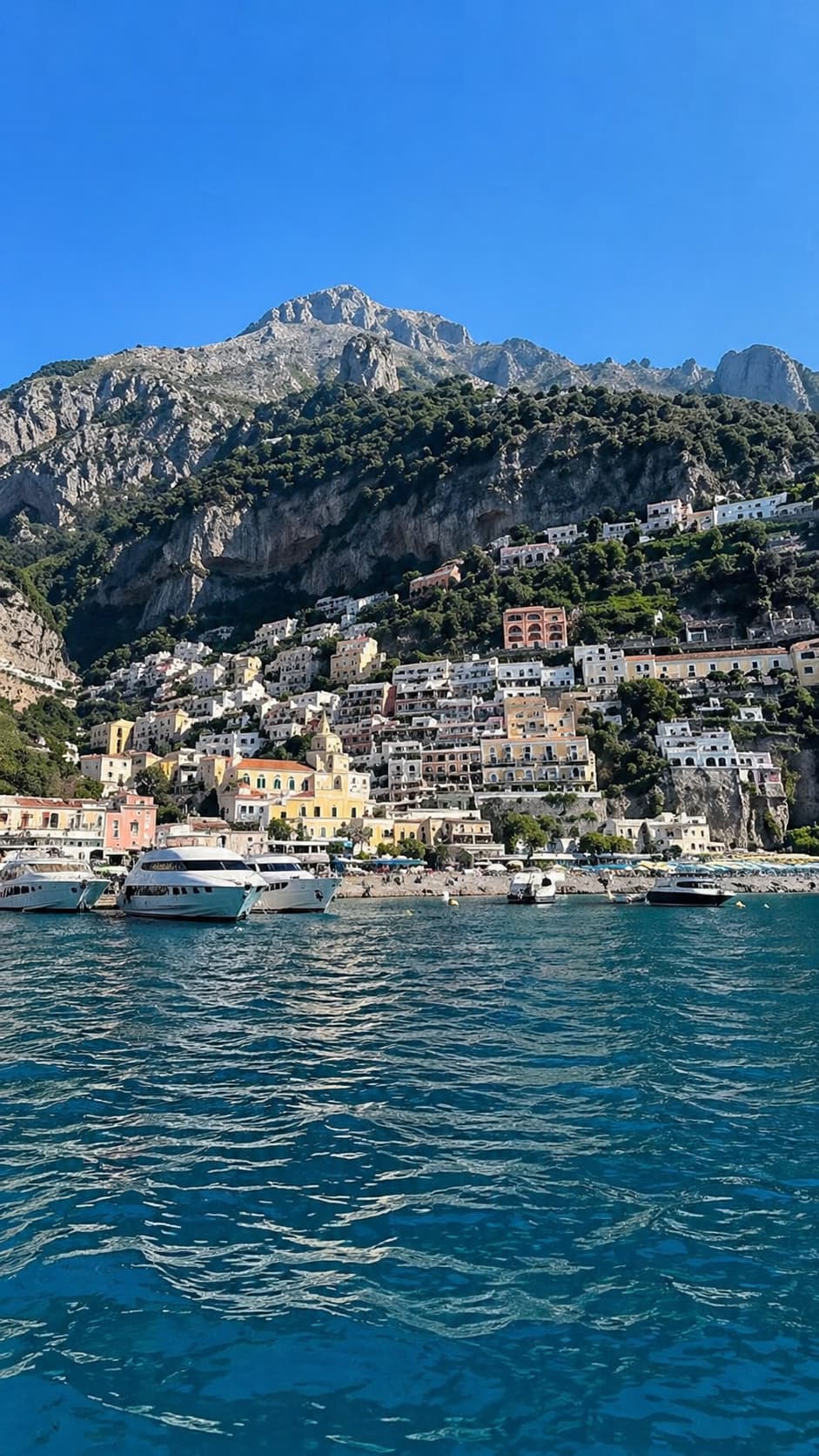
The most photographed of all the Amalfi Coast towns and, consequently, the most expensive. Houses cascade down the cliff in shades of terracotta and pale yellow to two beaches — Marina Grande and the smaller Fornillo. The majolica dome of Santa Maria Assunta catches the light from nearly every angle and earns every photograph taken of it. The ferry approach from the sea is one of the better arrivals on the coast — the town reveals itself gradually from the water in a way no road approach replicates. However, Positano in midsummer midday is genuinely overwhelming: narrow lanes, coach groups, and lido fees that reflect the address. Go early, arrive by boat if possible, and accept that the experience improves sharply before 9am. On a second visit, it gives you considerably less than almost any other town on this list.
Town 02 — Praiano ✅ Stop
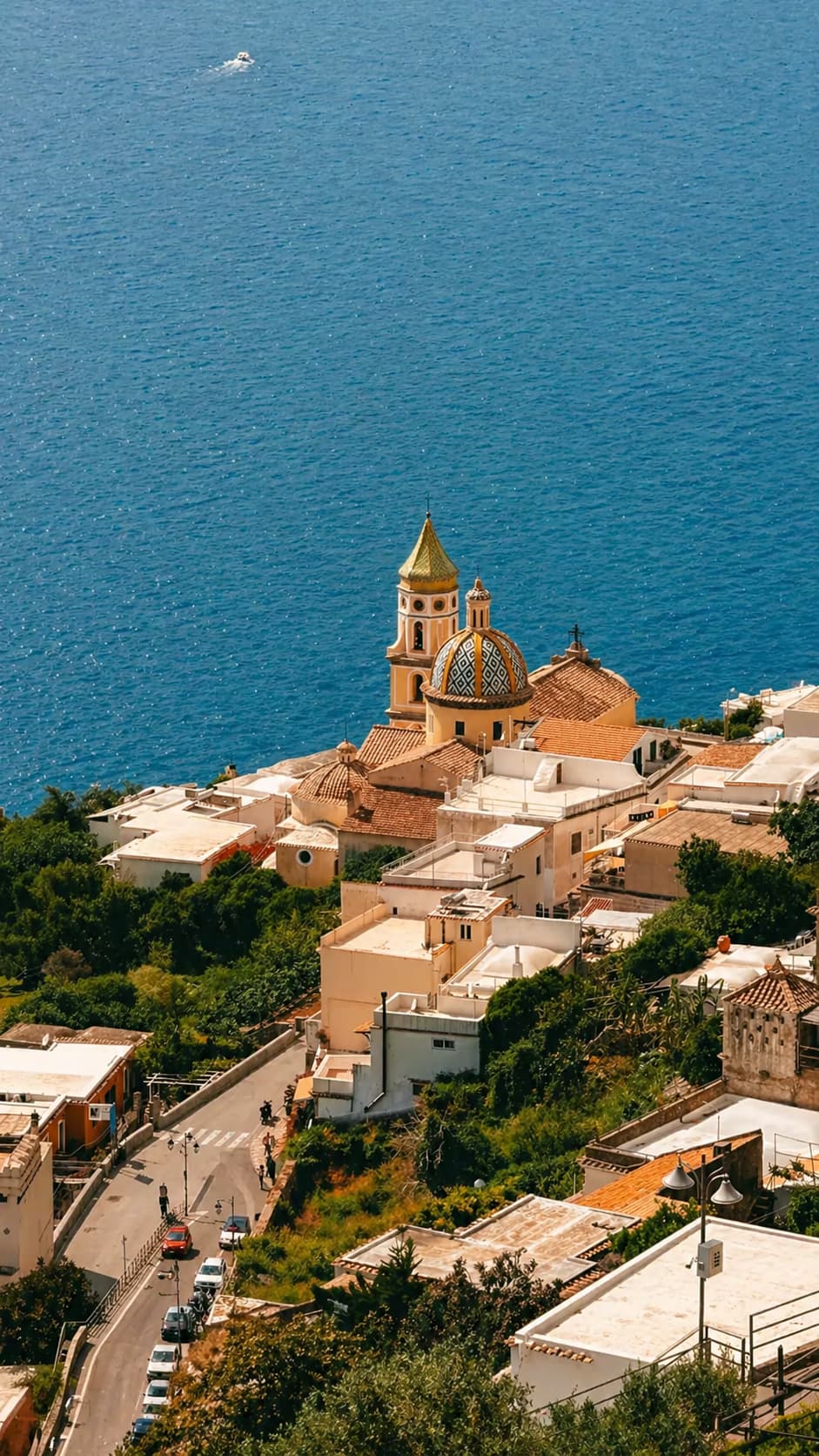
Seven kilometres east of Positano on a stretch of coast that receives a fraction of the foot traffic. Praiano is split between the upper town and Marina di Praia — a tiny cove with a small beach reached by a long staircase from the road above. The sunset from Praiano’s terraces hits the water and cliffs at an angle Positano does not replicate. Accommodation here costs meaningfully less than in its famous neighbour. Moreover, the restaurants serve local food without tourist pricing. Praiano retains its character precisely because it sits just far enough from Positano to be ignored by most itineraries — which makes it, in practice, one of the most rewarding Amalfi Coast towns for an overnight stay. Worth a full stop, lunch, and the walk down to the cove.
Town 03 — Furore 👁 Roadside Stop
Furore does not really have a centre. It is scattered across the cliffs in hamlets connected by staircases — a municipality that barely announces itself. The reason to stop is the Fiordo di Furore: a deep, narrow gorge where a mountain stream meets the sea between sheer rock walls. It is one of the most photographed spots on the entire coast, visible from a roadside pullout above and accessible by boat or long staircase from below. The beach at the base of the Fiordo is tiny, wild, and genuine. Stop at the viewpoint, take the photograph, and consider the staircase only if time and energy allow.
Town 04 — Conca dei Marini ✅ Stop
Conca dei Marini sits on panoramic terraces between Praiano and Amalfi — small, quiet, and largely ignored by travellers rushing between the more famous Amalfi Coast towns. The primary reason to stop is the Grotta dello Smeraldo: a sea cave where sunlight filters through an underwater fissure and colours the interior a luminous green. It costs around €5 and involves a short rowboat tour inside. It earns the visit. Additionally, Conca dei Marini is the birthplace of the sfogliatella Santa Rosa — a cream-and-cherry pastry born in the local convent. If you can add only one stop between Praiano and Amalfi, this is it.
Town 05 — Amalfi ✅ Stop — allow at least two hours
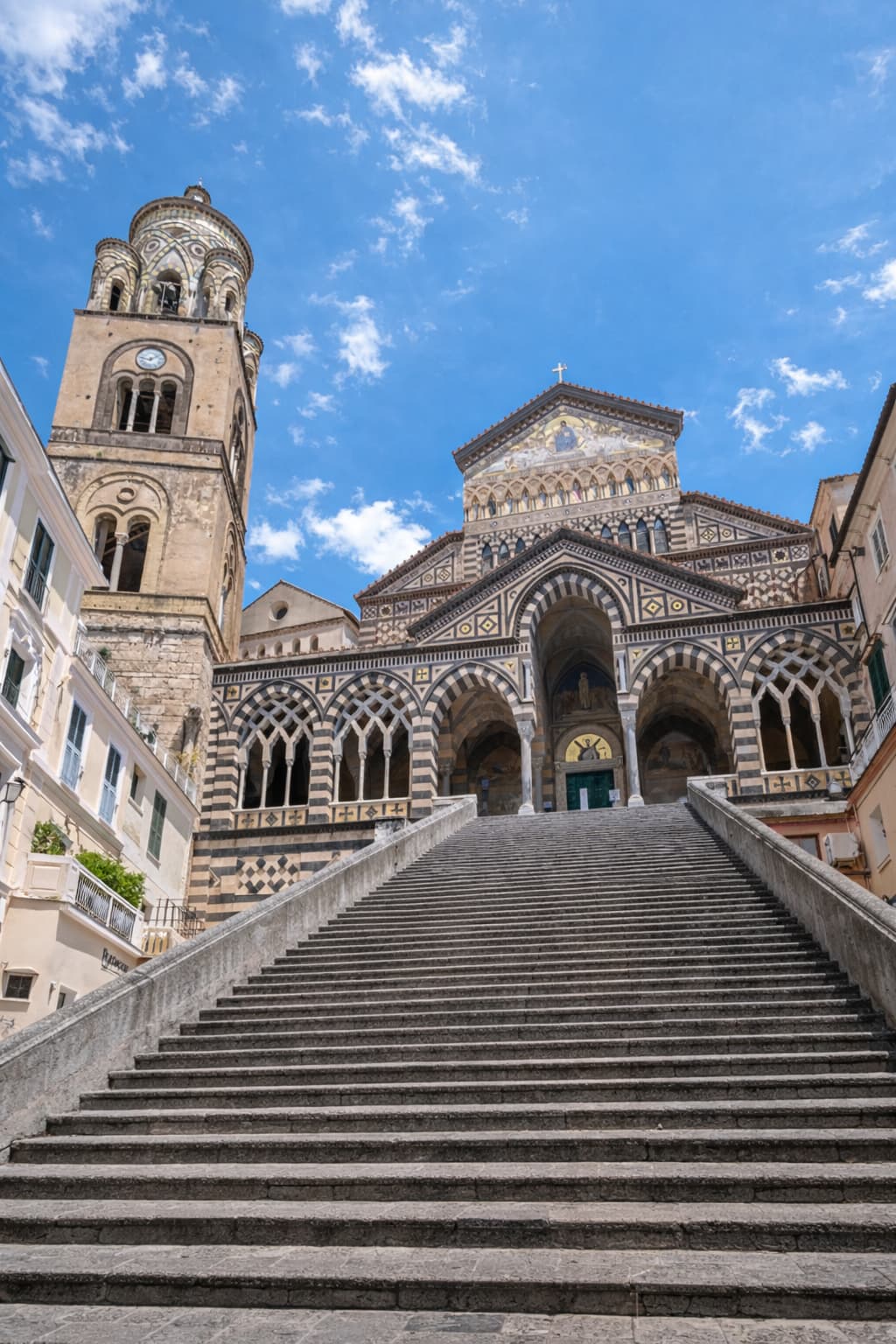
Amalfi sits at the geographic and historical centre of the coast that bears its name. In the tenth and eleventh centuries it was a maritime republic of genuine consequence — competing with Pisa, Genoa, and Venice, inventing the nautical compass needle, and codifying the first maritime laws in Europe. Today it is compact and tourist-dense, built around the Cathedral of Sant’Andrea: Arab-Norman-Byzantine facade, gold mosaics, wide steps rising from the main piazza. The Chiostro del Paradiso — a twelfth-century cloister of interlaced arches — is one of the finest architectural details on the coast. Moreover, Amalfi makes the most sensible base for the full Amalfi Coast towns itinerary: central location, ferry connections east and west, bus to Ravello, and accommodation that is expensive but not Positano-expensive.
03 — Eastern Amalfi Coast Towns: Atrani to Vietri sul Mare
East of Amalfi town, the coast changes character. The famous cliffside drama softens somewhat, the villages become less immediately photogenic, and — as a direct result — the visitor numbers drop sharply. This stretch of Amalfi Coast towns rewards slower travel more than any other part of the route. Cetara in particular is the most honest expression of what this coastline looked like before tourism arrived.
Town 06 — Atrani ✅ Stop — the best-kept secret on the coast
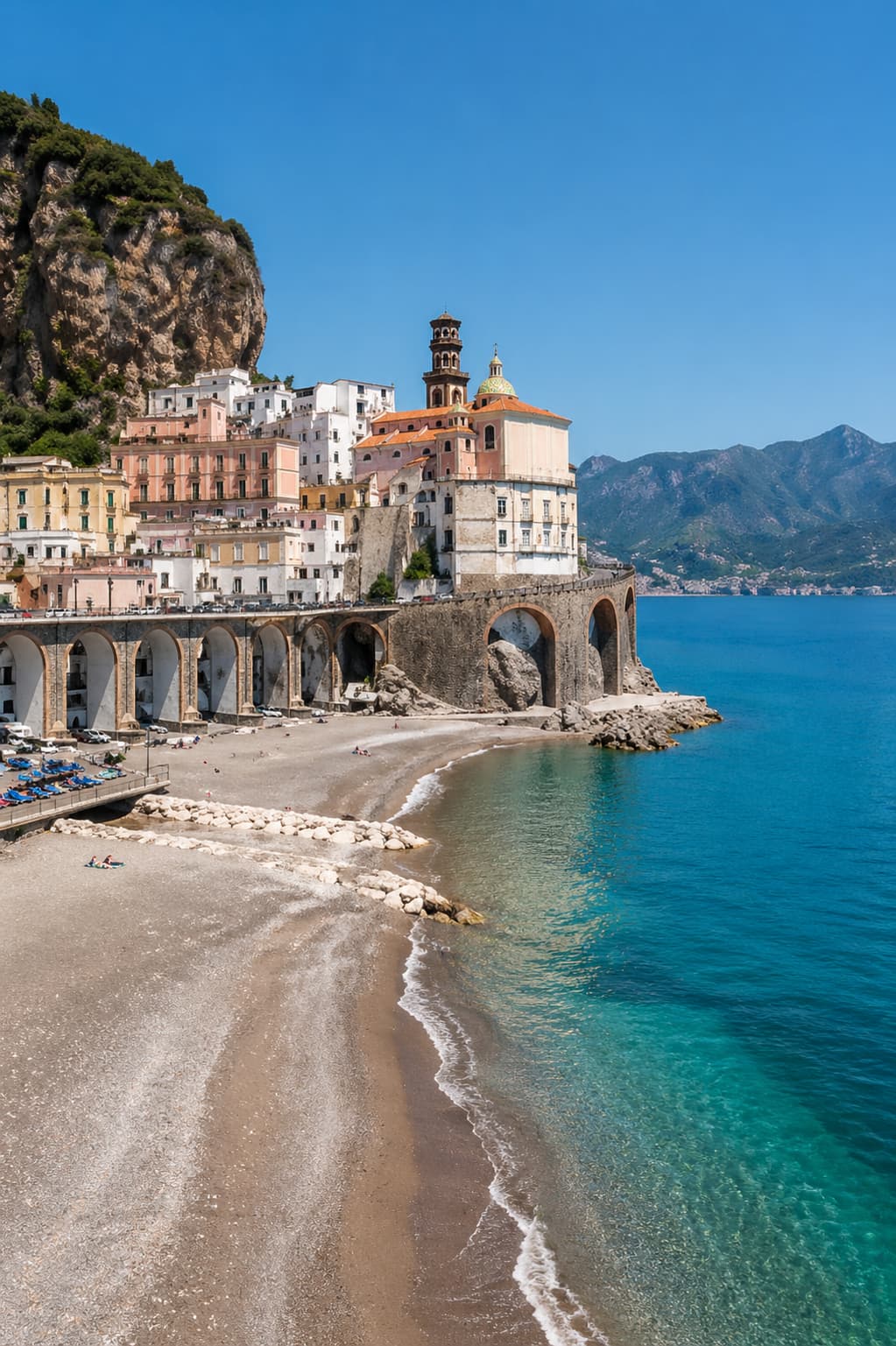
Atrani sits five minutes on foot from Amalfi town, around a bend in the coastline, and most drivers pass it without realising it is a separate municipality entirely. With fewer than 1,000 inhabitants across 0.12 square kilometres, it holds the title of smallest town in Italy. During the Amalfi Republic, it was where the Dukes were crowned at the Church of San Salvatore de’ Birecto. The beach is small, pebbly, and framed by colourful buildings on both sides. The bars and restaurants facing the water serve actual locals. Come in the morning before the day-trippers arrive from Amalfi town, walk the narrow lanes, climb the church stairs, and have coffee in the square. In short, Atrani is the easiest and most rewarding addition to any Amalfi Coast towns itinerary.
Town 07 — Minori 👁 Quick Stop
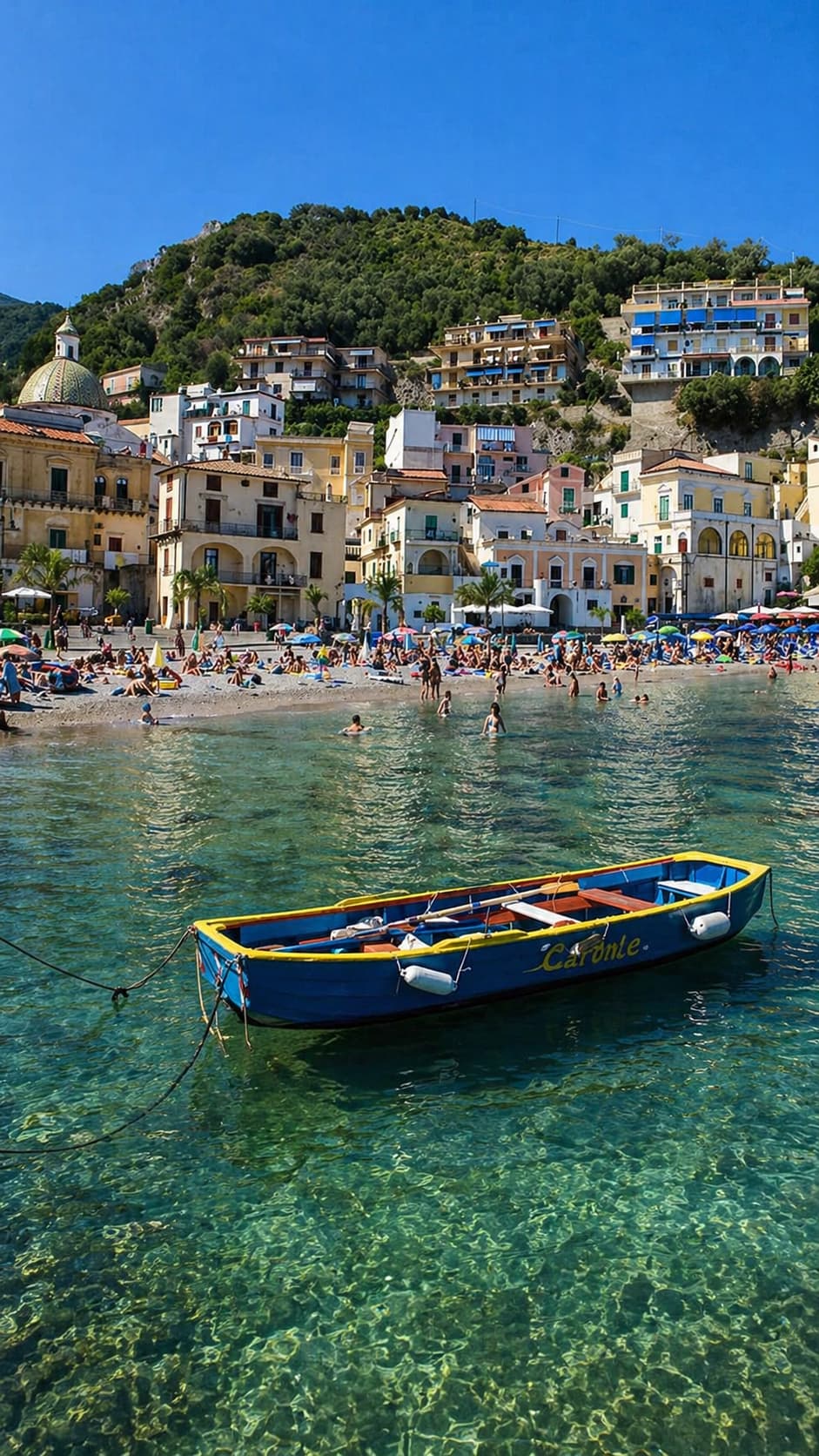
Minori calls itself the City of Taste, and the name is earned. The delizia al limone — a lemon cream sponge that originated here — subsequently spread across the entire coast. An ancient Roman villa (Villa Marittima Romana) demonstrates that wealthy Romans used this coastline for precisely the same purposes that wealthy tourists now do. The beach is one of the longer free beaches among the eastern Amalfi Coast towns. Overall, Minori is pleasant without being exceptional; it rewards a lunch stop and a pastry rather than a full afternoon.
Town 08 — Maiori 👁 Stop for the Beach
Maiori has the widest and longest sandy beach of all the Amalfi Coast towns — a fact that makes it considerably more practical as a beach day than the pebble coves further west. The town is less immediately beautiful than Positano or Atrani, and its development reflects decades of infrastructure building rather than organic coastal growth. That said, Maiori is cheaper, has better parking, and delivers the beach experience without the Positano pricing. For families or anyone whose priority is actually swimming, it makes more sense than anywhere on the western half.
Town 09 — Cetara ✅ Stop — the fishing village the coast forgot to ruin
Cetara is the most honest of all the Amalfi Coast towns. The fishing boats in the harbour are working boats — not decorative ones for tourist tours. The restaurants serve what came in that morning. The colatura di alici — a fermented anchovy extract descended from ancient Roman garum — is made here in the traditional way and served over spaghetti in a combination too simple to sound special until you taste it. Furthermore, Cetara receives a fraction of Positano’s visitors despite being the more authentic expression of what this coast was before tourism arrived. Come for lunch, walk the harbour, and leave before the road east feels like an obligation.
Town 10 — Vietri sul Mare 👁 Stop for Ceramics
Vietri sul Mare marks the practical eastern end of the Amalfi Coast towns before the road opens into Salerno. Known throughout Italy for its ceramic tradition — brightly coloured majolica that lines shop windows and coats the dome of the Church of San Giovanni Battista — the workshops here represent real craft production, not tourist replicas. Additionally, Vietri has a town beach larger and less crowded than anything on the western end of the coast. As a base for exploring the route, it is underrated: close to Salerno’s transport links and with better parking than anywhere west of it.
04 — Inland Towns: Ravello, Scala, and Tramonti
Three Amalfi Coast towns sit above the coastline rather than on it. Each requires a detour up mountain roads. Each rewards the effort differently — and Ravello, in particular, rewards it more than almost any other stop on the entire drive.
Town 11 — Ravello 🔼 Detour — the best view on the entire coast
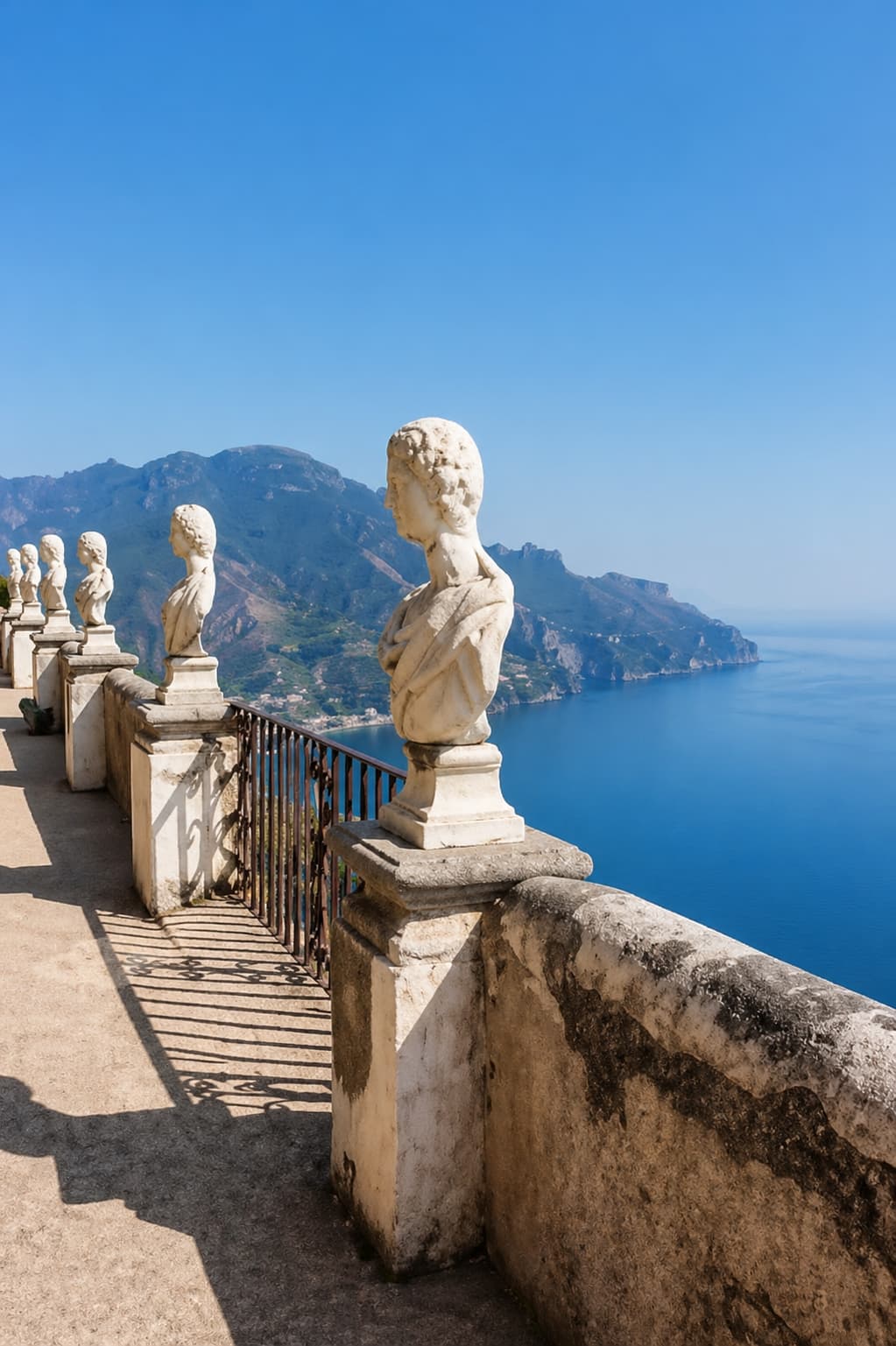
Ravello sits 365 metres above the sea on a promontory above Minori, accessible by bus from Amalfi town in about 25 minutes. The view from the Terrazza dell’Infinito at Villa Cimbrone — two rows of classical busts with the full Gulf of Salerno beyond — is the finest panoramic view of all the Amalfi Coast towns and their surroundings. It is, for once, not an overstatement. Villa Rufolo’s gardens host the Ravello Festival each summer, staging classical music with the cliff terrace as its backdrop. Moreover, Ravello is considerably quieter than the coastal towns even in August. For anyone whose interest in this coast extends beyond beaches and boat trips, Ravello is the essential addition to the itinerary.
Town 12 — Scala 🔼 Detour — oldest settlement, for serious explorers
Scala is the oldest settlement on the Amalfi Coast — for centuries the entire coastal infrastructure was governed from here rather than from Amalfi itself. Today it is a quiet hilltop village with a Romanesque cathedral and hiking trails through the Valle delle Ferriere nature reserve. Almost no visitors come on any given day. It suits the traveller who has already covered the main Amalfi Coast towns and wants to understand what this landscape looked like before the road arrived.
Town 13 — Tramonti 🔼 Detour — wine and landscape, not sightseeing
Tramonti is the green lung of the coast: vineyards, farmhouses, and wine grown on steep mountain terraces above the tourist road below. The Tramonti wines appear on restaurant menus throughout the Amalfi Coast towns without most diners knowing where they come from. A visit belongs on an extended stay rather than a one-day drive. For anyone interested in the agricultural life above the tourist coast, however, Tramonti is the honest answer.
05 — How to Drive Between the Amalfi Coast Towns
From mid-June through the end of September, the SS163 operates an alternating plate restriction on weekends and public holidays, between 10am and 6pm. Vehicles with plates ending in an even number cannot drive on even-numbered dates. Vehicles ending in odd numbers are restricted on odd-numbered dates in the same window. Rental cars are subject to the same rules — check the last digit of your plate before planning your drive day. The simplest solution: leave before 9am and you are off the road before the restriction activates, regardless of plate number.
Which direction to drive
Driving west to east — Sorrento toward Salerno — puts the sea on your right. As a result, the views fall to the passenger side while the driver watches the road, which is considerably more relaxed for anyone behind the wheel alone. Consequently, Sorrento to Salerno is the recommended direction for solo drivers or small groups where one person drives the full Amalfi Coast towns route. The reverse direction puts you on the inside lane closest to the cliff face, which some drivers find slightly less exposed. Both work; the direction mainly determines where the views land.
When to drive and how long to allow
Leave before 9am in summer. By 11am in July, the stretch between Positano and Amalfi reduces to walking pace behind buses. Before 9am, moreover, the light is extraordinary — low, golden, and angled across the cliff faces in a way that midday never replicates. Off-peak months — May, early June, September — give significantly better road conditions. In total, allow a full day for the complete Amalfi Coast towns route with stops; the road is only 60km but it does not drive like 60km of motorway.
What the road is actually like
The SS163 is a single-lane coastal road for much of its western stretch. Two cars can pass in most sections, but buses and trucks require one vehicle to reverse to the nearest pullout. Tunnels appear without warning and are wide enough for one vehicle at a time in several spots. That said, the road is manageable for most drivers who approach it calmly and at the right hour. Specifically, leaving early and avoiding July and August weekends eliminates most of the frustration that road trip accounts typically describe.
06 — Getting Around the Amalfi Coast Towns Without a Car
A car is not required for visiting the Amalfi Coast towns — and in peak summer, it can actively work against you. Two alternatives cover the full route effectively, and combining them gives a better journey than driving in one direction alone.
SITA Sud buses run the full length of the SS163 from Sorrento to Salerno, stopping at every coastal town. A single ticket costs around €2.50, bought at a tabaccheria before boarding — the driver does not always sell them, and inspectors do board. In summer the buses are crowded but frequent and genuinely used by locals. They work best for the western stretch where stops are close together and waiting times are short.
Seasonal ferries (roughly March through October) run between Positano, Amalfi, Minori, Maiori, Cetara, and Salerno. The Positano–Amalfi journey takes about 20 minutes and costs approximately €8. The ferry gives you the view each Amalfi Coast town was designed to present — approaching from the sea, looking up at the cliff face — which no bus window or road approach replicates. The best combination: ferry in one direction, bus in the other, so you never retrace the same road twice.
Choosing between bus and ferry
In practical terms, ferries are best for the western Amalfi Coast towns — Positano and Amalfi in particular — where the sea approach is most dramatic. Buses, meanwhile, are more useful for the eastern stretch, where the stops spread further apart and ferry services become less frequent. Additionally, buying bus tickets at a tabaccheria before boarding saves the frustration of travelling without a valid ticket. Taken together, the two modes complement each other naturally: arrive in Positano by ferry, work east along the coast by bus, and end in Salerno with easy onward train connections.
07 — Practical Notes: Visiting the Amalfi Coast Towns by Season and Transport
Best time to visit
May and early June offer the fewest crowds and no plate restrictions among all the Amalfi Coast towns. September brings warm weather with noticeably less pressure than July or August. Avoid August entirely if possible — Ferragosto (August 15) and the surrounding two weeks represent peak tourist density on the entire coast. The road in May belongs to a completely different version of the experience: quieter, more affordable, and with better access to morning light before the crowds arrive.
Parking strategy — western towns
Parking in the western Amalfi Coast towns is scarce and expensive. Positano charges up to €5 per hour in peak season. Amalfi has several car parks near the town entrance — arrive before 9am or expect to queue. Praiano has limited roadside parking. The best approach, therefore, is to park in Sorrento or Salerno and use ferries and buses for the western towns rather than driving into the congested zone. This eliminates the worst parking problem and, as a bonus, gives you the sea approach into Positano and Amalfi instead of the road approach.
Parking strategy — eastern towns
Parking east of Amalfi town is significantly more available. Atrani, Cetara, Maiori, and Vietri all have roadside or car park options that are easier and cheaper than the western towns. Starting from the Salerno end and working westward by ferry avoids the worst western parking problem entirely — and gives you the added advantage of approaching the most dramatic Amalfi Coast towns scenery with fresh eyes.
What to avoid
Avoid driving midday in July and August — the road between Positano and Amalfi reduces to a queue behind tour buses. Similarly, renting a large SUV is inadvisable: sections of the road barely accommodate standard cars side by side. Driving directly into the centre of towns like Positano is not possible in most cases — streets are car-inaccessible and wardens enforce this. Finally, do not rely solely on GPS: download offline maps before you go, as signal is inconsistent in parts of the route.
Fuel
Fill the tank in Sorrento or Salerno before joining the coastal road. Fuel stations on the SS163 are rare and sometimes physically inaccessible for larger vehicles, so running low between the Amalfi Coast towns is a genuine risk in the western section. In particular, the stretch between Positano and Amalfi has almost no practical fuel stops — plan accordingly before you start.
Getting to the coast
From Naples, the A3 motorway south to Vietri sul Mare takes about 60–75 minutes for the eastern approach, while the Circumvesuviana train to Sorrento covers the western approach in similar time. From Rome, the high-speed train to Naples runs in 70 minutes from Roma Termini, with onward connections by train or car. Overall, both directions are straightforward — the main decision is simply which end of the Amalfi Coast towns route you want to start from.
| Best months overall | May, early June, September — warm, manageable, no plate restrictions |
| Worst months | July and August, especially around Ferragosto (Aug 15) |
| Plate restriction | Mid-June through end of September, weekends + public holidays, 10am–6pm only |
| Western parking | Scarce and expensive — park in Sorrento or Salerno, use ferries into the coast |
| Eastern parking | Available in Atrani, Maiori, Cetara, Vietri — considerably easier than the west |
| Best base town | Amalfi (central, ferry connections, bus to Ravello); Praiano for a quieter alternative |
| From Naples | A3 to Vietri (eastern approach) or Circumvesuviana to Sorrento (western approach) — both ~60–75 min |
| From Rome | High-speed train to Naples (70 min), then car or train onward |
Planning Your Visit
Driving and Getting Around
Getting Around Without a Car
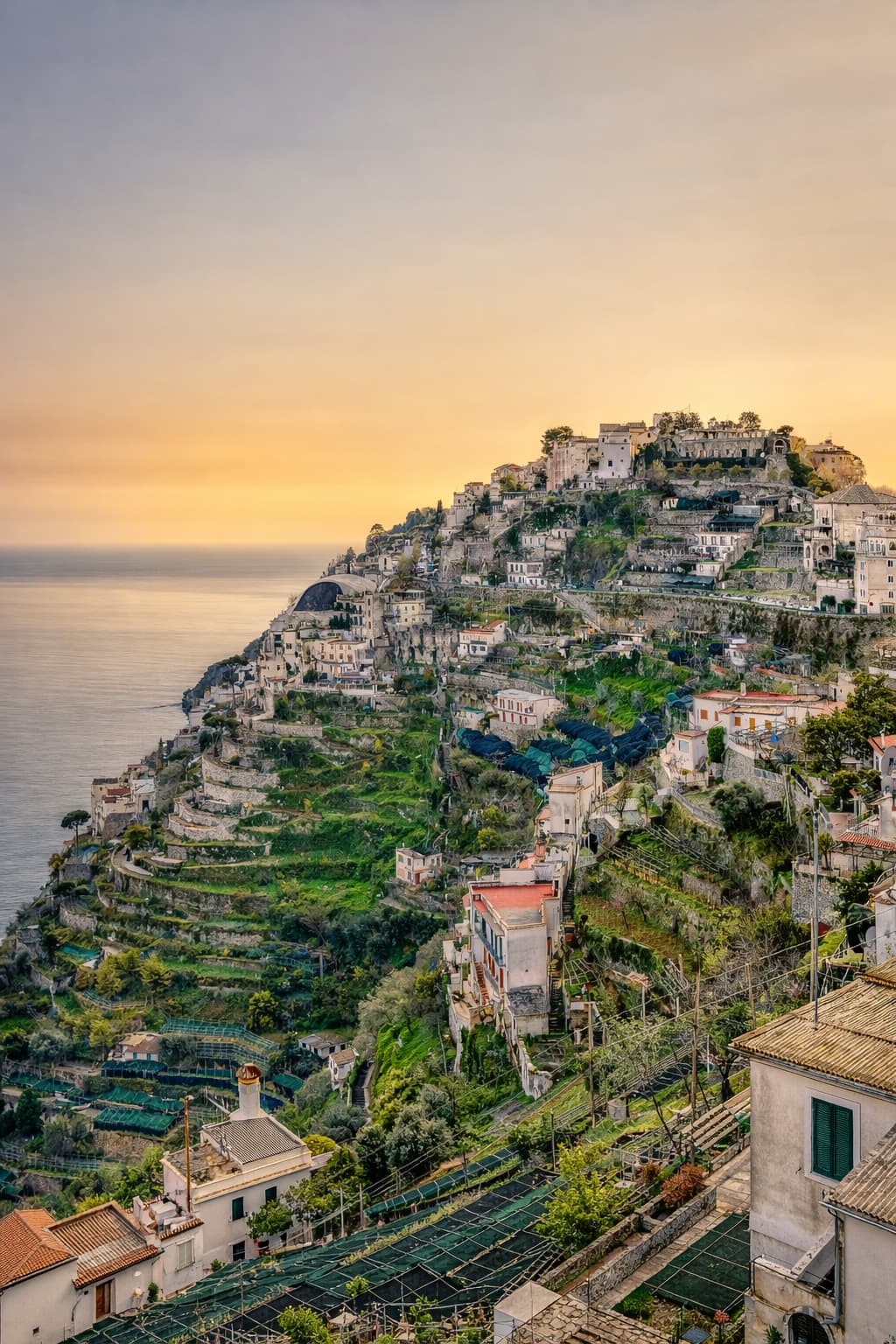
The road between Sorrento and Salerno is not a long one by any measure. But it contains more variety per kilometre than almost any other stretch of coast in Europe.
Drive it slowly, stop at the Amalfi Coast towns most people don’t, and save Atrani for a morning when you have nowhere to be afterwards.