
Seville Travel Guide: Andalusia’s Most Vibrant City of Culture, History & Flamenco
A practical, atmospheric guide to visiting Seville — from the Royal Alcázar and La Giralda to Plaza de España, flamenco, river walks, and the city’s unmistakable evening rhythm.
This Seville travel guide covers the city as it actually works — not as a highlight reel, but as a place with its own logic, pace, and weight. Some destinations arrive with a fully formed reputation. Others you think you understand until you get there. Seville belonged to the second category for me. It was meant to be one stop on a broader Andalusia route, but it became something much larger than that — a city that redefined the tone of the trip almost immediately.
What makes Seville different is not simply that it has major monuments, though it has plenty of those. It is that the city feels inhabited by its own culture in a way few places do. Flamenco is not decorative here. Evening life is not arranged for visitors. The architecture does not feel isolated from the city around it. Seville’s intensity comes from the fact that its historic image and its present-day life still overlap.
It is also one of the strongest solo-travel cities in Spain. The old town is walkable, the tapas culture makes eating alone feel entirely natural, and the city has enough movement in its streets and plazas that solitude rarely turns into isolation. Seville keeps you company without asking much of you.
01 — Getting to Seville
Seville is one of the easiest major cities in Andalusia to reach. If you are already traveling through the region, it works especially well after Córdoba thanks to the fast AVE rail connection. That short train ride changes the scale of the trip quickly: the smaller, quieter feel of Córdoba gives way to a city that is bigger, louder, and much more performative.
Arriving at Santa Justa station is straightforward, and from there the old town is easy to reach by taxi, bus, or a manageable walk depending on your luggage. That accessibility matters because Seville rewards staying central. The more walkable your base, the more naturally the city reveals itself over the course of the day.
| From Córdoba | Fastest and easiest by AVE train, roughly one hour. |
| From Madrid | A very practical high-speed rail route for travelers entering Andalusia from the capital. |
| By plane | Seville Airport makes the city a workable starting or ending point for a southern Spain trip. |
| By car | Useful if Seville is one stop on a larger road trip, though you will not want to rely on the car in the old town itself. |
Train is usually the smartest option if Seville is your main destination. A car only makes more sense if you are using the city as part of a wider Andalucía loop.
02 — Where to Stay in Seville
Where you stay in Seville shapes the entire experience of the city. The historic center is large by European standards, but it is also dense, and the difference between staying inside it and staying farther out is the difference between an effortless walking city and a more logistical one.
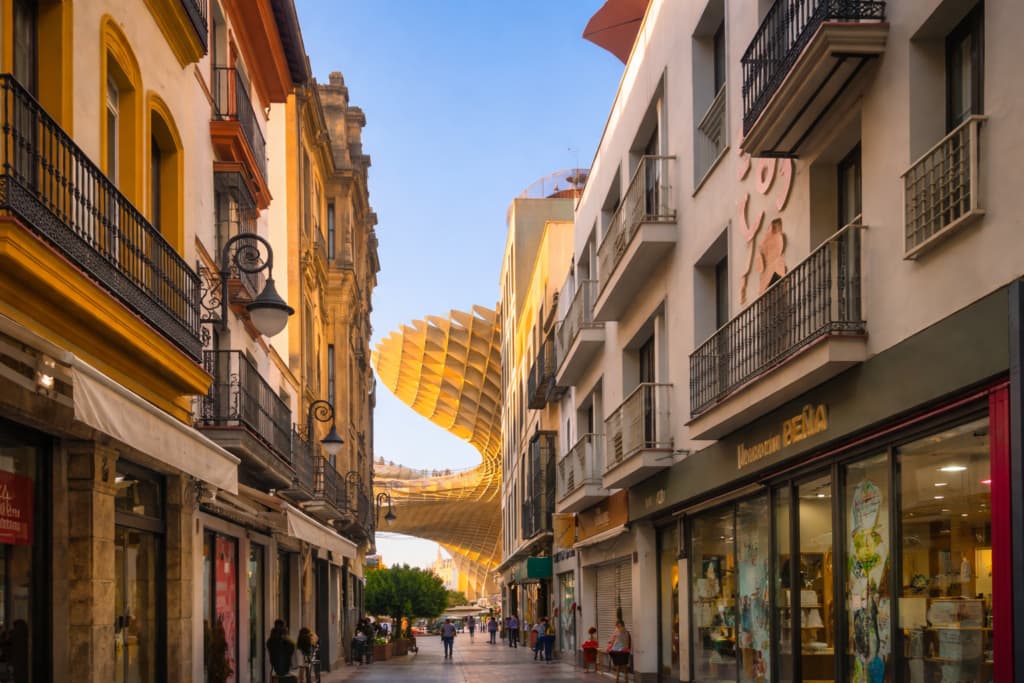
For me, staying close to the Royal Alcázar worked especially well. Reaching the accommodation meant moving through narrow old-town streets lined with white buildings, flowered balconies, cafés, and small bars — exactly the kind of arrival that makes you feel you have entered a place rather than simply checked into it.
The most atmospheric and central option, with the Alcázar and cathedral nearby. Beautiful, but often the busiest and most expensive.
Good for central access, riverside evenings, and slightly more breathing room than Santa Cruz.
Across the river, more local in feel, and strongly associated with flamenco and traditional Seville identity.
A better fit for slower stays, younger travelers, and those who want a more contemporary local atmosphere.
Stay in or near Santa Cruz or El Arenal if you want the easiest access to Seville’s major landmarks and evening atmosphere.
03 — La Giralda and Seville Cathedral
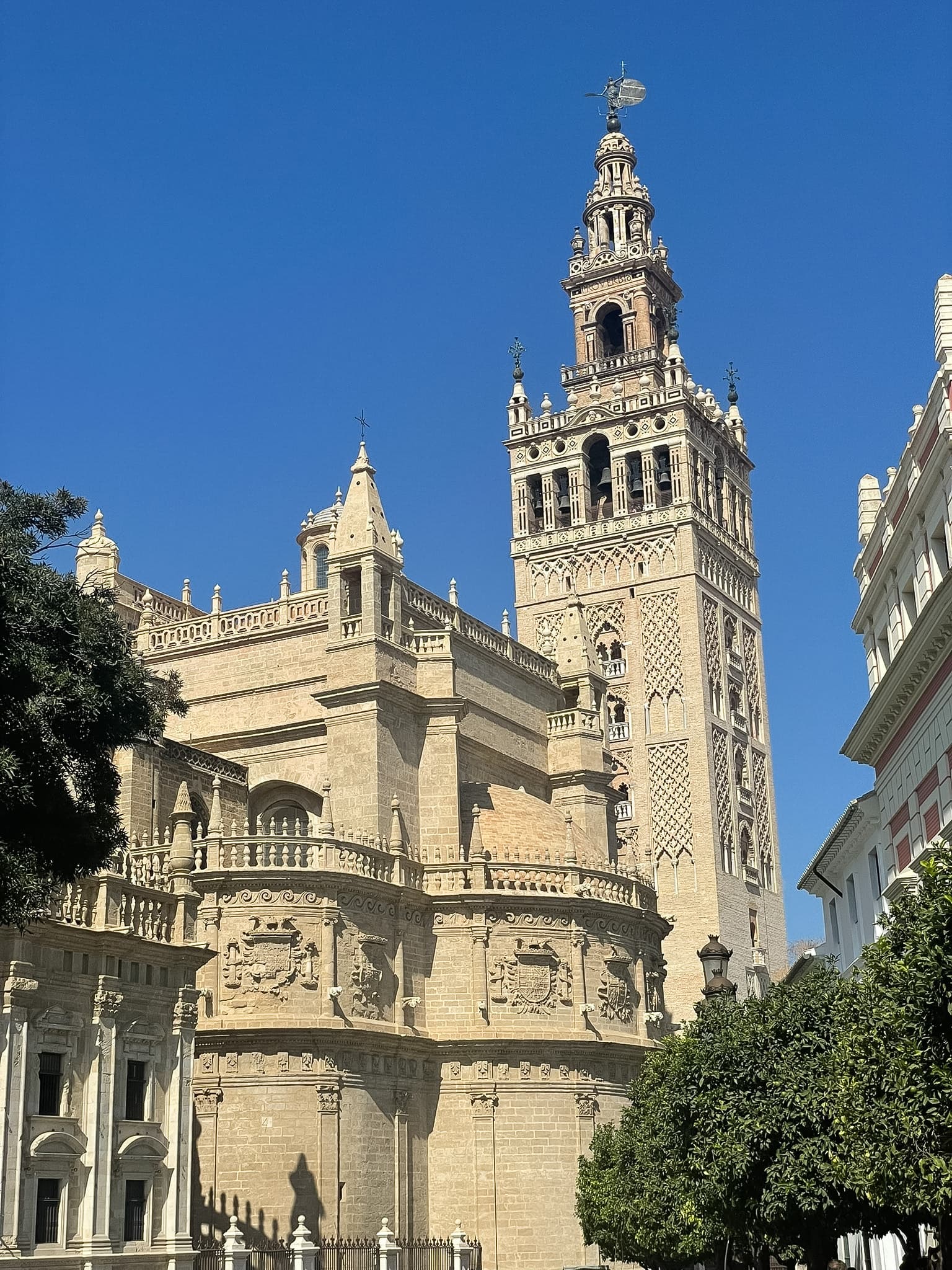
La Giralda is one of the clearest symbols of Seville’s layered history. From below, it dominates the skyline of the old town. Up close, it tells a more complex story: a former Almohad minaret transformed into the bell tower of one of the largest Gothic cathedrals in the world.
That transformation is part of what gives Seville so much of its architectural force. The city does not simply preserve one era. It keeps letting one era speak through another. La Giralda is one of the best places to feel that clearly — Islamic geometry at its core, Christian additions above it, and the city spread below as proof that these layers still structure Seville now.
Climbing it is also unusual in a way that makes the experience better. There are no narrow staircases. Instead, a system of ramps carries you upward, originally designed so the call to prayer could be delivered on horseback. That same gradual ascent gives the visit a calmer pace than most tower climbs.
More comfortable than most historic towers thanks to the internal ramps instead of stairs.
Massive in scale, and worth visiting together with the tower rather than as a separate afterthought.
One of the best ways to understand Seville’s urban form — church domes, rooftops, courtyards, and the wider old town laid out below you.
Book ahead if possible. Early morning gives you the most comfortable visit, especially in warmer months when Seville’s heat builds quickly.
04 — The Royal Alcázar of Seville
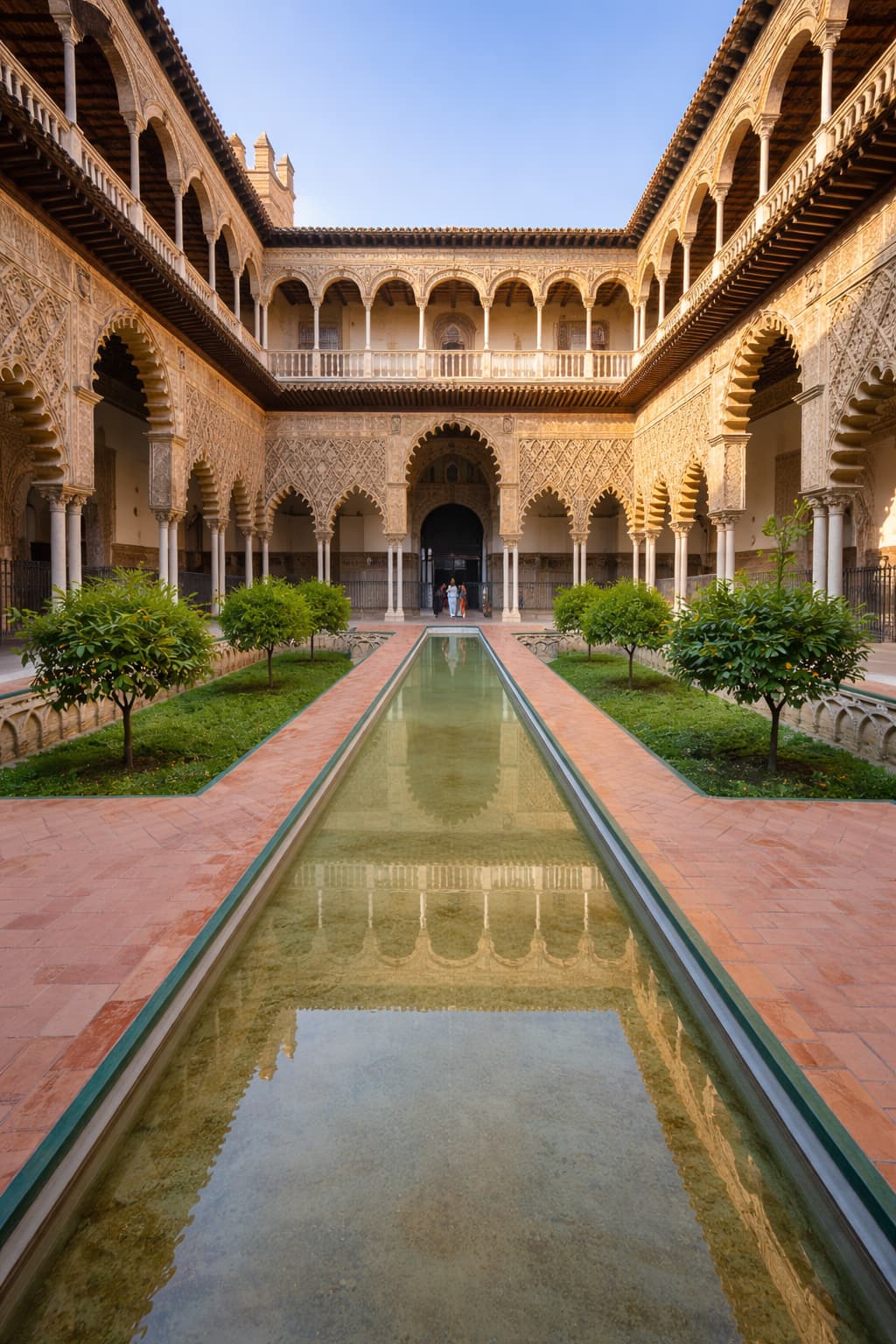
If there is one monument in Seville that justifies advance planning more than any other, it is the Royal Alcázar. The palace complex is one of the finest examples of Mudéjar architecture in Spain and one of the places where Andalusia’s long, interwoven cultural history becomes impossible to simplify.
Walking through it feels less like moving through a building and more like passing from one carefully composed atmosphere to another: tiled courtyards, carved arches, patterned walls, shadowed rooms, and then gardens opening out into water, greenery, and long paths that seem to pause the city outside. The Alcázar is royal in the obvious sense, but also contemplative. That balance is part of its power.
The gardens matter almost as much as the interiors. Give them time. They are not an optional extension after the palace. They are part of how the whole place settles in your memory.
The heart of the Alcázar — richly detailed without ever feeling visually static.
Essential to the experience, especially in spring when Seville’s softer side comes through most clearly.
Known to many through film and television, but far more impressive when encountered without that filter.
Book Alcázar tickets as early as you can. This is one of Seville’s most in-demand sites, especially in spring and early summer. Official tickets are available directly through the Alcázar’s website.
05 — Plaza de España
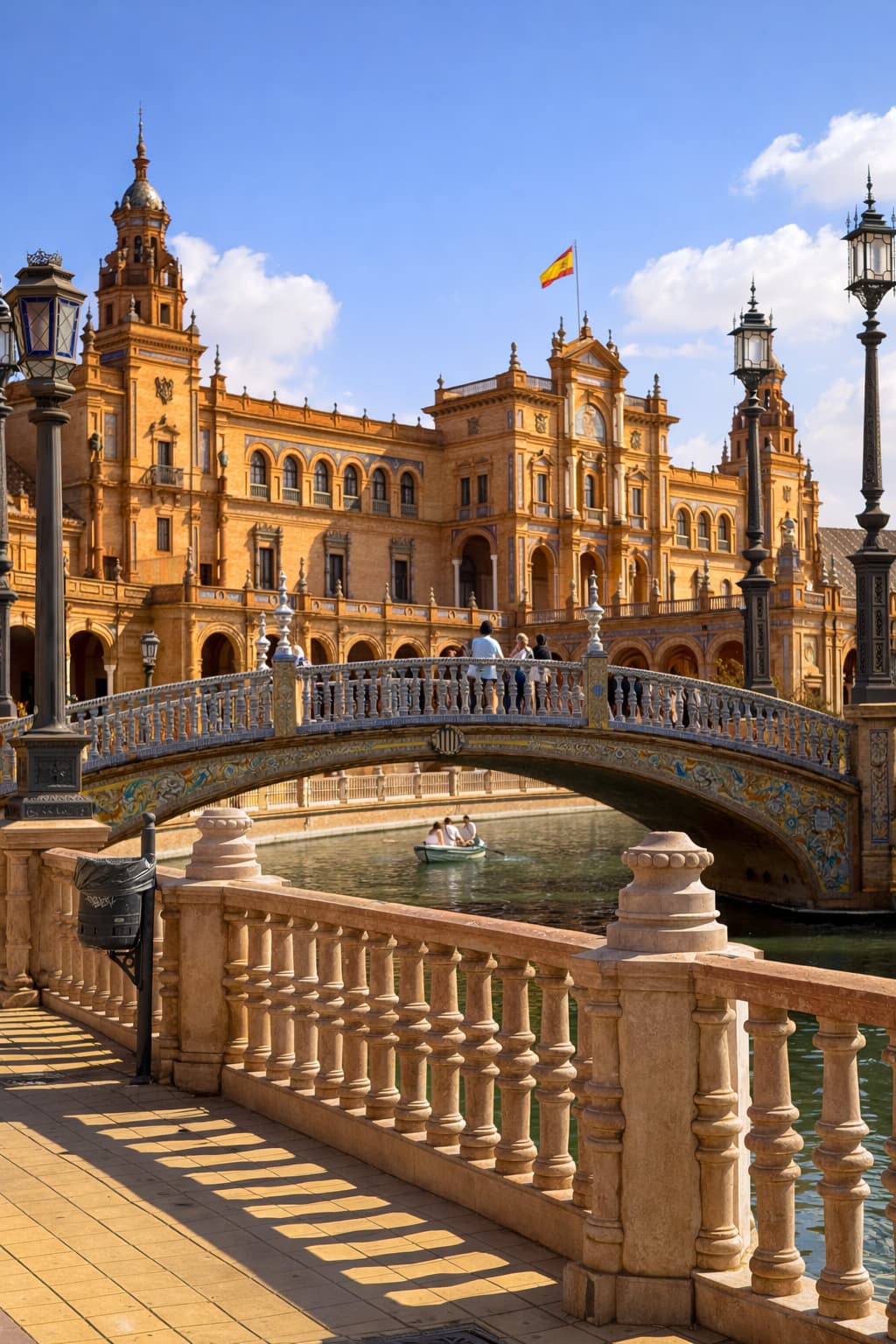
Plaza de España is Seville at its most theatrical. Where the Alcázar draws you inward, this plaza does the opposite — it opens outward in one broad, sweeping civic gesture. The scale is immediate, but what makes it memorable is not only size. It is the combination of terracotta, water, bridges, ceramic detail, and the sense that the whole place was designed to be experienced slowly rather than merely photographed.
The setting beside María Luisa Park strengthens that effect. You approach through greenery, then emerge into one of the most dramatic public spaces in Spain. It is one of those places that can easily become a cliché in advance, and then still feel fully earned in person.
The defining visual element, especially when the light warms and the plaza begins to glow.
A detail that could feel gimmicky elsewhere, but here adds to the plaza’s theatrical calm.
An easy detail to overlook if you rush, but one of the plaza’s most thoughtful and distinctly Spanish elements.
Golden hour is the strongest moment here. Early morning is quieter, but late afternoon gives the architecture its richest color and depth.
06 — Las Setas at Sunset
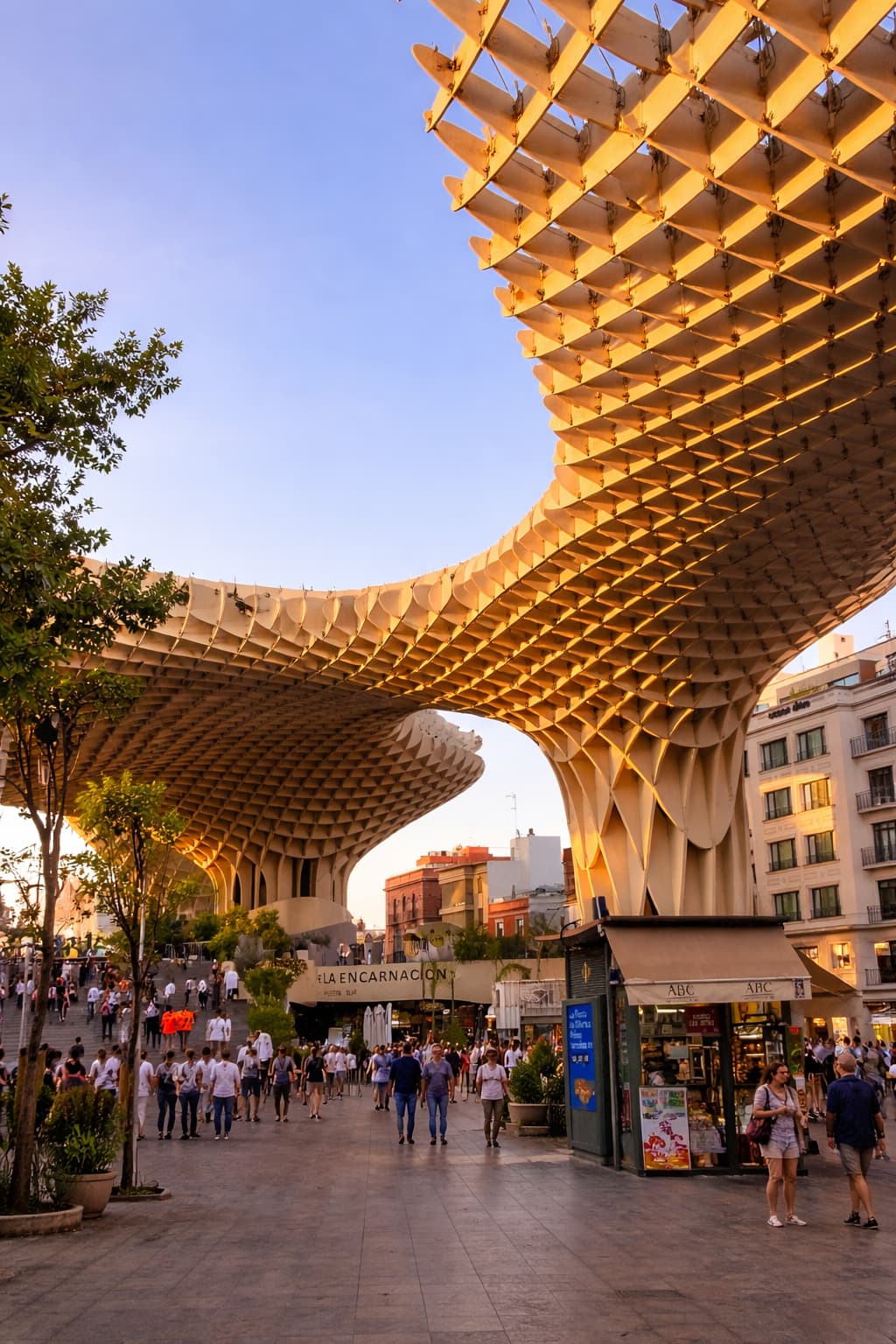
Las Setas, or Metropol Parasol, introduces a very different Seville. After so much history, this large contemporary structure above Plaza de la Encarnación can feel almost abrupt — but that contrast is exactly why it works. It proves the city is not only a preserved historic stage set. It still permits itself modern interventions, even dramatic ones.
The rooftop walkway is one of the best places to catch Seville transitioning into evening. From above, the city’s older forms — church towers, rooflines, courtyards, domes — look calmer and more coherent. Sunset is the obvious time to go, and in this case the obvious choice is the right one.
One of the cleanest perspectives on Seville’s skyline as the light begins to drop.
A fitting reminder that even Seville’s modern interventions keep uncovering older worlds beneath them.
The square below becomes social and lively after dark, making this a good lead-in to the night rather than a final stop.
07 — Walking the Guadalquivir at Night
One of Seville’s most satisfying shifts happens after dark along the Guadalquivir. The city relaxes into itself. Heat drops. People move more slowly. The riverfront fills with walkers, conversations, small performances, and the kind of evening life that feels local before it feels touristic.
This is one of the strongest parts of Seville for solo travelers. It asks very little. You can walk between Torre del Oro and the Triana bridge, stop where the atmosphere feels right, and let the city provide the rest. Some of the best travel moments in Seville are exactly this unstructured.
| Torre del Oro | A 13th-century riverside tower and one of Seville’s most recognizable historic markers. |
| Triana Bridge | The crossing that opens the city into Triana and one of the best ways to transition into a more local-feeling evening. |
| Best stretch | The walk between Torre del Oro and Triana is the most atmospheric and easiest to fit into any evening. |
08 — Flamenco in Seville
Flamenco is one of the deepest parts of Seville’s cultural identity. It does not feel imported into the city as entertainment. It feels native to it — rooted in its neighborhoods, its rhythms, and its emotional vocabulary. That matters, because flamenco is easy to flatten into a tourist image from the outside. In Seville, it becomes much harder to misunderstand.
At its strongest, flamenco does not feel like performance in the ordinary sense. It feels like a compact form of emotional communication — between singer, guitarist, dancer, and audience, but also between the present and a much older Andalusian inheritance. Even a short show can make that clear if the venue is intimate enough.
The voice, and often the emotional center of the whole performance.
The guitar — rhythmic, responsive, and often more structurally important than first-time viewers expect.
The dance, where precision and emotional force meet in the body.
Choose a smaller venue if possible. Intimate settings in Santa Cruz or a night in Triana usually create a much better memory than a larger, more theatrical tourist production.
09 — Bullfighting Heritage
Bullfighting remains one of the most debated parts of Spanish culture, and Seville is one of the places where its historical and symbolic importance is still most strongly felt. Whether or not you engage with it personally, understanding its role helps explain something essential about the city’s cultural world — its relationship to spectacle, ritual, beauty, and danger.
The Maestranza bullring is central to that history. Architecturally, it belongs to Seville. Culturally, it still carries weight. Even visitors who have no interest in attending a corrida often find the building and museum clarifying, because they frame bullfighting as Seville itself understands it: not as entertainment alone, but as a tradition tied to identity, performance, and public memory.
You can visit the bullring and museum without attending a corrida. For many travelers, that is the best way to understand the tradition historically without participating in it directly.
| Name | Plaza de Toros de la Real Maestranza de Caballería de Sevilla |
| Why it matters | One of the most historically important bullrings in Spain, and deeply tied to Seville’s cultural image. |
| Good for | Architecture, historical context, and understanding a controversial but central local tradition. |
10 — Tapas, Sherry, and the Sevillano Table
Seville’s food culture is one of the easiest to inhabit as a traveler. Tapas make meals flexible, affordable, and social. For solo visitors especially, this is ideal: you can sit at a bar, order lightly, move on, and never feel out of place. The city is built for that kind of eating.
Part of the pleasure is not just what you eat, but how. Small plates. Cold beer or fino sherry. A short pause that becomes a longer one. Then another stop elsewhere. Seville’s evening food culture works because it assumes time is elastic.
One of the clearest local classics, and a good reminder of how visible Moorish influence remains in Andalusian food.
Drier and lighter than many first-timers expect, and one of the most natural drinks to have in Seville.
Comforting, rich, and appropriately named for this city.
A classic small fried dish that fits the city’s bar-hopping eating style perfectly.
Triana, El Arenal, and quieter corners of Santa Cruz are the best places to start. Seville rewards wandering a little before choosing where to sit.
11 — What Every Seville Travel Guide Gets Wrong
Some cities impress you with architecture. Others win you over through atmosphere. Seville does both, but what really sets it apart is the force of its cultural continuity. The city still seems to believe in itself. That is rarer than it sounds.
Its monuments are major, but they are not detached from the life around them. The Alcázar is not isolated from gardens and orange trees. Flamenco is not confined to a museum. Evening along the river is not an event staged for outsiders. The city’s traditions still circulate through ordinary life, and that is what gives Seville its unusual depth.
If you are deciding how much time to give Seville, the answer is more than seems necessary on paper. The city’s best moments are often the unplanned ones: a rooftop at sunset, a bridge after dark, a guitar from somewhere above the street, a tapas stop that becomes the whole evening.
Seville feels larger than its monuments.
It is the city’s rhythm, not just its landmarks, that stays with you.