
Montreux Christmas Market 2026: An Honest Guide to Europe’s Most Photogenic Market
The lake is real. The Alps are real. The crowds are real too. Here is what to expect, when to go, and whether the Montreux Christmas market is actually worth the trip.
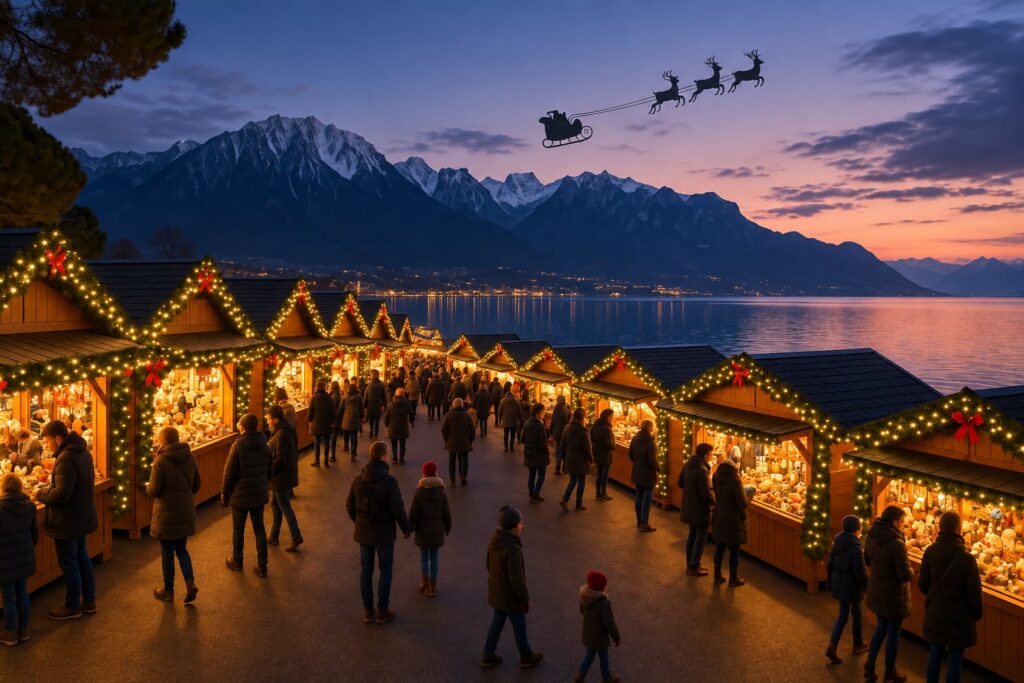
The Montreux Christmas market is one of those places that almost everyone has seen in a photograph and not quite believed. Everything looks improbably perfect: the lake is too still, the lights too warm, the Alps in the background almost painted on. When you arrive and find that all of it is exactly as advertised — the lake does sit that still, the lights do reflect that way, and yes, the mountains really are right there — it takes a moment to calibrate.
That said, the honest version of this guide involves a few things the photographs consistently don’t show. Specifically: the Saturday afternoon crowd, the price of a cup of mulled wine, and the fact that the market itself — while lovely — is commercially polished in a way that Basel’s, for instance, is not. The setting earns the visit. Whether the market alone earns it depends considerably on when you go and what you’re expecting to find.
This is an honest guide to the Montreux Christmas market 2026, with verified dates, practical timing advice, and a real answer to the question everyone is actually searching: is it worth it?
- Is the Montreux Christmas Market Worth Visiting?
- What Makes It Different from Other Christmas Markets?
- Dates, Hours & Practical Details for 2026
- The Flying Santa — What It Is and Whether to Stay For It
- The Best Time of Day to Visit
- What to Eat and Drink
- Getting to Montreux — Day Trip from Geneva or Lausanne
- What Else Is There to Do Near Montreux at Christmas?
- FAQ
- The Honest Verdict
01 — Is the Montreux Christmas Market Worth Visiting?
Yes — but conditionally, and it matters which condition applies to you.
If what you want is a backdrop unlike anything else on the continent, Montreux delivers. The kilometre-long stretch of illuminated chalets running along the shores of Lake Geneva, with the French Alps rising across the water, is a genuinely singular setting. No other Christmas market in Europe looks quite like this. The setting alone justifies the journey for most people, and the photographs — which you will have seen before you arrive — are not misleading.
On the other hand, if you’re looking for an artisan market with the kind of craft culture that feels rooted in a specific place, Montreux is not that. The selection leans commercial. You will find the usual Christmas ornaments, mulled wine, and fondue alongside some genuinely local products, but the market does not have the depth of a Basel or a Strasbourg when it comes to traditional craftsmanship. Montreux is built around spectacle — the lakeside setting, the lights, the Flying Santa — rather than around the stalls themselves. That’s not a criticism so much as a calibration.
Worth it for: the setting, the atmosphere at dusk, the Flying Santa experience, and as part of a broader Switzerland winter trip. Less worth it for: serious artisan shopping, quiet contemplation, or specifically weekend visits when the crowds are significant.
If you’re planning a wider Swiss winter trip alongside your market visit, Switzerland in winter without skiing covers the full picture of what the country offers beyond the slopes.
02 — What Makes Montreux Different from Other Christmas Markets?
The honest answer is: the water and the mountains. Those two facts explain everything else about this market’s reputation.
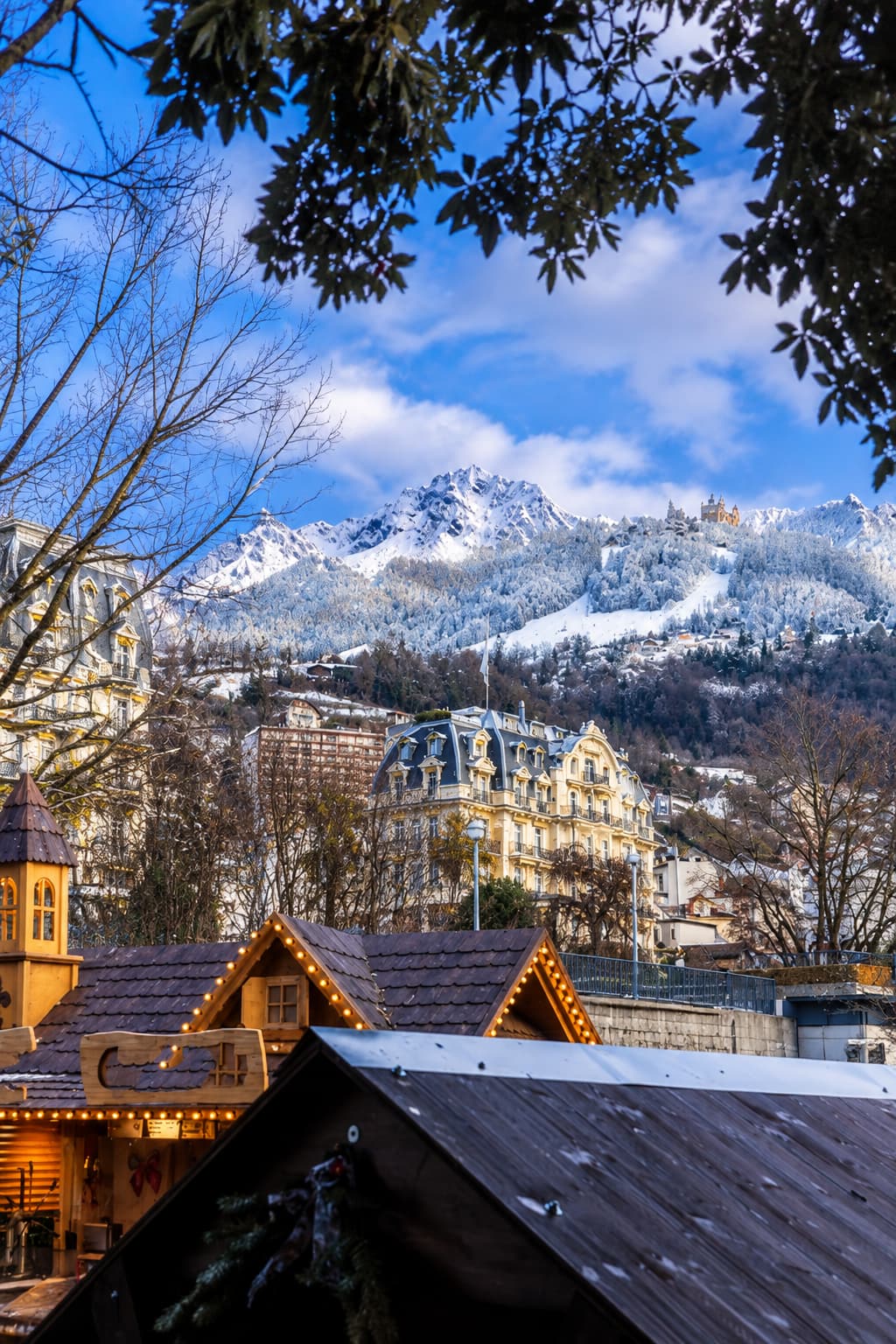
Most European Christmas markets occupy a town square. Cologne’s wraps around its cathedral. Vienna’s fills the Rathausplatz. Prague’s centers on the Old Town Square. Montreux’s stretches along a lakeside promenade for roughly a kilometre, which means you are walking beside Lake Geneva for the entire length of it. The water reflects the market lights. Across the lake — on clear days and most December evenings — the French Alps sit in silhouette. That combination produces a photograph that circulates endlessly on Pinterest, and the photograph is accurate.
Additionally, the market runs the full length of the Montreux waterfront — from the covered market hall near the train station down to the quieter far end of the promenade — which means there is always a less crowded section to find if you keep walking. That density thins significantly at the southern end, and that is where the view of the lake is at its clearest.
Beyond the setting, the market also features a guest country pavilion each year, a Ferris wheel over the promenade, and the Flying Santa tradition that is entirely unique to Montreux (more on that below). Together these make it feel more like a winter festival than a straightforward market — which explains why it draws visitors who have already been to Christmas markets elsewhere and still want to come here specifically.
03 — Montreux Christmas Market 2026: Dates, Hours & Practical Details
Confirmed 2026 dates
The Montreux Christmas market opens on November 20, 2026 and runs through December 24, 2026. It closes on Christmas Eve — a tradition in Switzerland, where Christmas Day is observed quietly as a family occasion. There is no December 31 closing date for Montreux as sometimes listed elsewhere; the market ends with Christmas Eve.
Opening hours
| Monday – Tuesday | 11:00am – 9:00pm (market stalls) · 11:00am – midnight (restaurants) |
| Wednesday – Thursday | 11:00am – 9:00pm (market stalls) · 11:00am – midnight (restaurants) |
| Friday | 11:00am – 10:00pm (market stalls) · 11:00am – midnight (restaurants) |
| Saturday | 10:00am – 10:00pm (market stalls) · 11:00am – midnight (restaurants) |
| Sunday | 10:00am – 8:00pm (market stalls) |
| December 24 | 11:00am – 5:00pm only |
| Entry | Free — no ticket required. Full programme on the official Montreux Noël website. |
Layout and navigation
The market runs across three connected areas. Specifically, the main lakeside promenade — the Grand-Rue — is the longest section and the most photographed. The covered market hall (Marché Couvert) provides shelter and hosts several of the larger food and drink areas, which matters on a cold or wet December day. A third section extends further along the quay toward the quieter end of the promenade. In total the market spans roughly 170 chalets.
The Ferris wheel is the most useful landmark for orientation — it sits near the centre of the main promenade section. Meanwhile, the Flying Santa show takes place above the open promenade toward the train station end, so arriving early and positioning yourself on the waterside of the walkway gives the best view of the spectacle.
04 — The Flying Santa: What It Is and Whether It’s Worth Staying For
Among Montreux’s many traditions, the Flying Santa is the most peculiar. Each evening during the market, Father Christmas is suspended on cables above the crowds along the lakefront and launched across the sky — above the promenade, above the market, above the lake — with festive music playing below. He flies three times each evening: at 5pm, 6pm, and 7pm. On Saturdays there is also a 4pm show.
The Flying Santa is not a long performance. Each appearance lasts a few minutes. He soars overhead, stops briefly to wave and, according to those who have watched closely, occasionally plays the guitar — before disappearing back the way he came. The crowd stops, everyone looks up, and then the market continues as before.
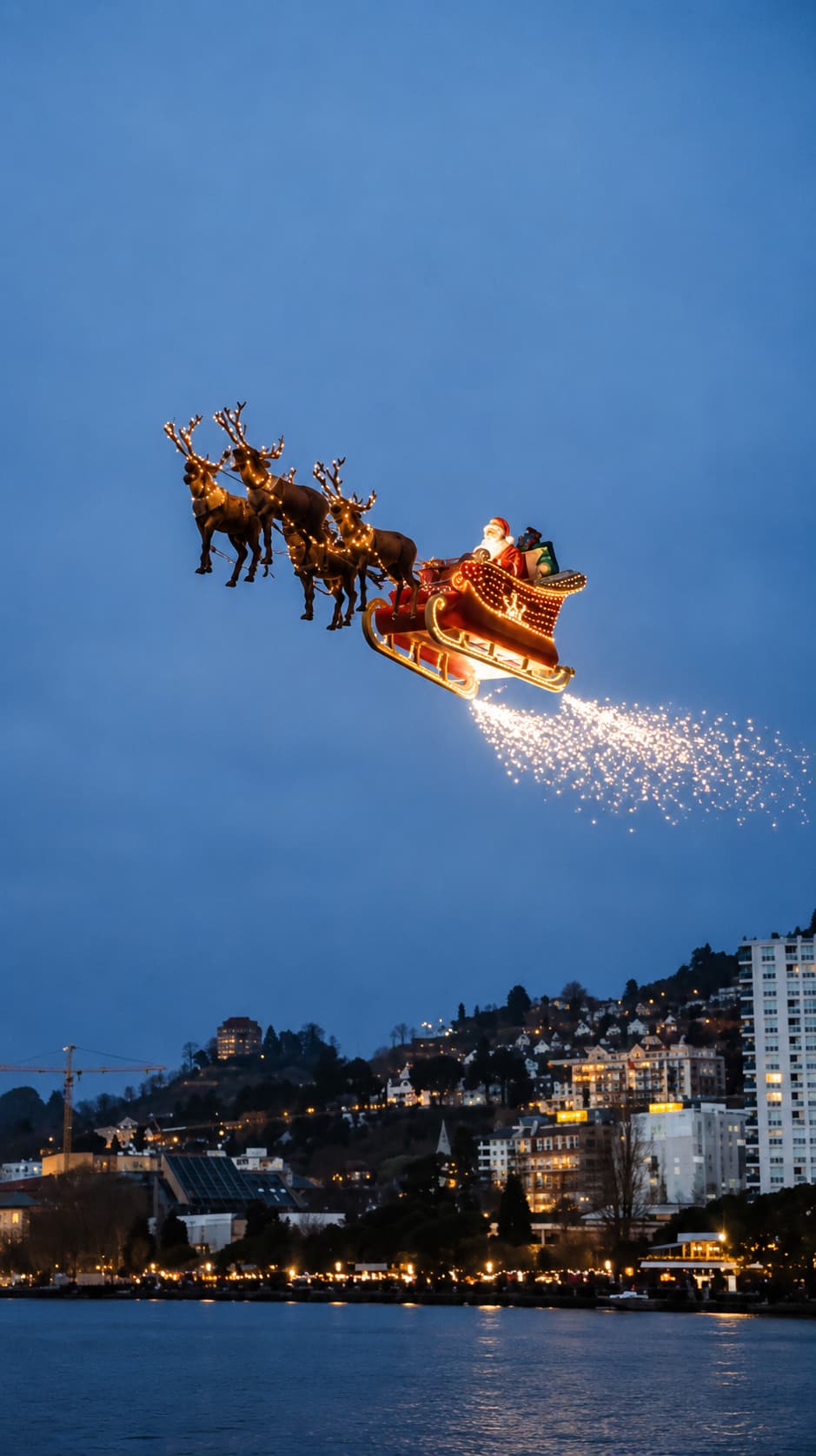
Is it worth engineering your entire visit around? Probably not. Worth staying for if you’re already there at dusk? Absolutely — and the 5pm or 6pm show is the easiest to build a visit around without needing to stay late — the market is lit and atmospheric by then, the lake is darkening, and the Alps are still faintly visible in the fading light. That combination makes it the best window of the day.
For context: the Flying Santa also operates on a Lake Geneva boat cruise on certain dates. If the market visit happens to coincide with one of those evenings, watching from the water instead of the promenade is worth considering for a completely different perspective — check the official Montreux Noël calendar for scheduled cruise dates.
05 — The Best Time of Day (and Week) to Visit
Timing a Montreux Christmas market visit is probably the most useful single piece of advice in this post, because the difference between a weekday morning and a Saturday afternoon is the difference between a pleasant winter walk and something that feels closer to a crowded train platform.
Best days
Weekdays — particularly Tuesday through Thursday — are significantly quieter than weekends. The market still operates at full capacity, the chalets are all open, and the Flying Santa still flies; however, the density of people is a fraction of what it becomes on Saturdays. Consequently, if you have any flexibility at all, a weekday visit is always the right call.
Within the December calendar, the first full week after opening (late November) is the quietest period. The second and third weekends of December — roughly December 6–7 and December 12–13 — are the most crowded, as day-trippers from Geneva, Lausanne, and Zurich all converge during school holiday weekends. Similarly, the final few days before Christmas Eve (December 20–23) are extremely busy.
Best times of day
| 11am – 1pm (weekdays) | Quietest window. All stalls open, almost no crowds. Best for browsing and photography in natural light. |
| 2pm – 4pm | The Alpine afternoon light hits the lake at a low angle — this is the best window for photography of the water and mountains before dark. |
| 5pm – 7pm | The ideal window: market fully lit, Flying Santa at 5pm and 6pm, atmosphere at its most photogenic. Accept that it will be busy. |
| After 7pm | Crowds thin slightly on weekdays. The market is at its most atmospheric but the stalls begin closing earlier on Sunday and Monday. |
06 — What to Eat and Drink at the Montreux Christmas Market
Switzerland does not do budget food, and the market reflects that fully. Go in with realistic expectations on price, and you will enjoy it considerably more for having done so.
What to order
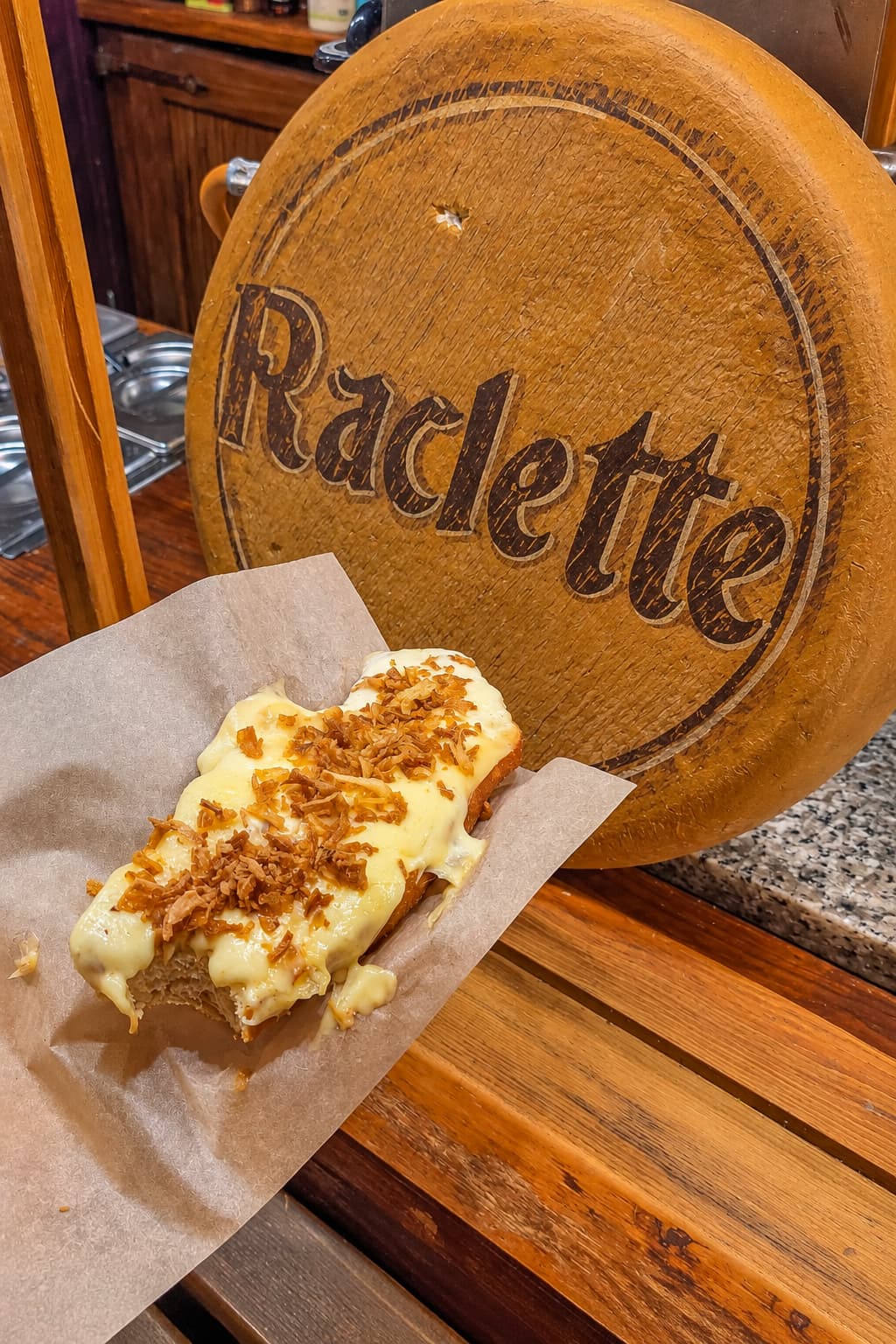
The best thing to eat here, and the most Swiss. Melted raclette cheese scraped over potatoes, cornichons, and pickled onions. Usually served as a portion from a dedicated stand. Budget CHF 15–20 for a plate — it is worth every franc.
Available at the sit-down restaurant sections of the market — particularly in the Village des Bûcherons (Lumberjack Village), which is the best area for a proper meal. The Lumberjack Village clusters around a rustic log cabin and is organised for groups as well as solo visitors.
Arguably the most atmospheric purchase at the market — paper cone, warm hands, walking the promenade. Usually CHF 5–7. Frankly, the smell is half the experience.
CHF 6–8 per cup, served in disposable cups rather than the souvenir mugs found at German markets. A few stalls do offer a Montreux souvenir mug — worth seeking out if you want the keepsake. Unlike German Glühwein, Swiss vin chaud tends toward local wine with lighter spicing.
Switzerland takes chocolate seriously even at a Christmas market. Multiple chocolate stalls operate across the promenade, and crêpe stands are scattered throughout. Both are considerably better here than at equivalent markets in France or Germany — this is, after all, one of the world’s more serious chocolate countries.
For a full meal, the Village des Bûcherons is the best area to head to. Several restaurants serve proper menus with seating — fondue, raclette, and seasonal Swiss dishes — and the atmosphere there is substantially calmer than the main promenade at peak hours.
07 — Getting to Montreux: Day Trip from Geneva or Lausanne
In practical terms, Montreux is exceptionally easy to reach by train, and this is the recommended way to arrive — not because driving is impossible, but because parking in Montreux on a weekend is a genuine problem, and the train station exits directly onto the market. You are, quite literally, on the promenade the moment you leave the station.
-
From Geneva: Direct train, approximately 1 hour. The journey follows the curve of Lake Geneva through the Lavaux vineyard terraces — one of the more scenic hour-long train rides in Europe. Trains run frequently throughout the day. -
From Lausanne: Direct train, approximately 20 minutes. The easiest day trip in Switzerland — realistic as a late-afternoon visit if you’re already based in Lausanne. -
From Zurich: Direct train, approximately 2.5 hours. Longer but manageable as a day trip — leave by 9am, arrive mid-morning, depart after the 7pm Flying Santa show. -
From Bern: Direct train, approximately 1.5 hours via Lausanne. Straightforward and fast. -
Swiss Travel Pass: Covers all standard train journeys to Montreux, as well as local buses within Montreux. Worth calculating if you’re visiting multiple Swiss destinations. -
By car: Possible but complicated on weekends. Montreux has limited parking downtown; most drivers park at the Chailly or Saussaz park-and-ride lots and take a shuttle bus (CHF 8 at Saussaz). On a weekday this is entirely manageable — on a Saturday it is not worth the stress.
One practical note: on weekends after 1pm, local VMCV bus lines 201 and 204 are typically free — useful for getting between Montreux, Chillon, and Villeneuve without additional cost. Line 201 runs along the lake shore in both directions.
08 — What Else Is There to Do Near Montreux at Christmas?
The market alone is two to three hours comfortably. Combined with a visit to Château de Chillon, a full day becomes genuinely easy to fill — and considerably more worthwhile than the market alone for visitors who have already seen several Christmas markets elsewhere. If you’re comparing Montreux against the rest of the country’s options, our guide to Switzerland’s Christmas markets puts them all side by side.
Château de Chillon
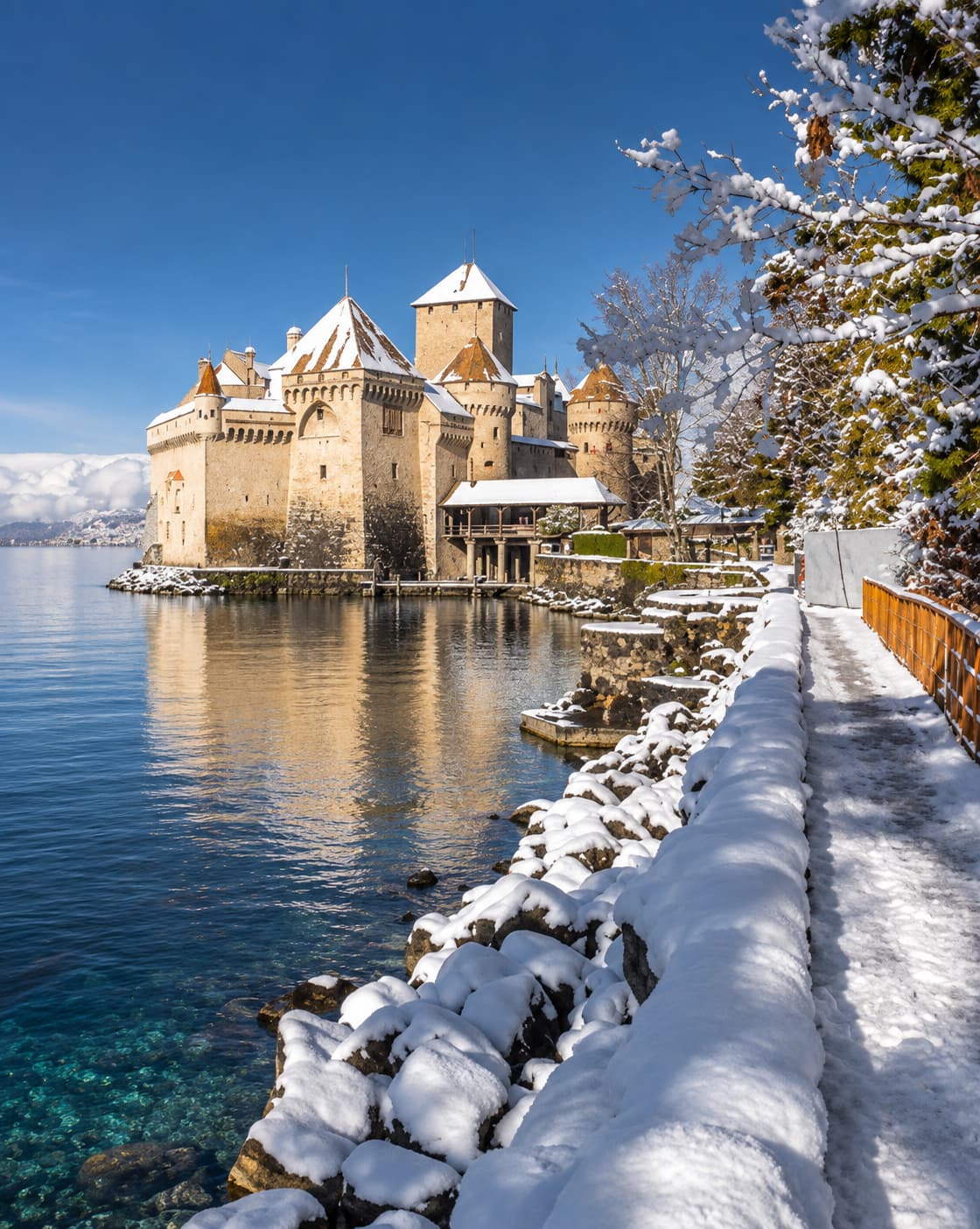
Château de Chillon sits 3 kilometres south of the market along the lakeshore road — a pleasant walk if the weather holds, or a short bus or train ride (line 201 or one stop by train from Montreux to Veytaux-Chillon). Notably, it is the most-visited historic monument in Switzerland, and more to the point, it is genuinely excellent — one of the best-preserved medieval castles in Europe, with its feet in the lake and its towers rising directly from the water.
During the Christmas market season, Château de Chillon hosts a medieval festival on select weekends: November 28–29, December 5–6, and December 12–13, 2026, running 10am–5pm. Admission is CHF 19 adults, CHF 16 students and seniors, CHF 11 for children. Reservations are recommended for the festival weekends — book via the official Château de Chillon website under “events” rather than standard tickets.
Even without the medieval festival, the castle is worth 1.5–2 hours inside. The Great Halls, the dungeon that inspired Byron’s poem, and the lake views from the ramparts are all worthwhile. Combining Chillon in the morning with the Christmas market in the afternoon — finishing with the Flying Santa at 5pm — makes a very complete Swiss December day.
Rochers-de-Naye
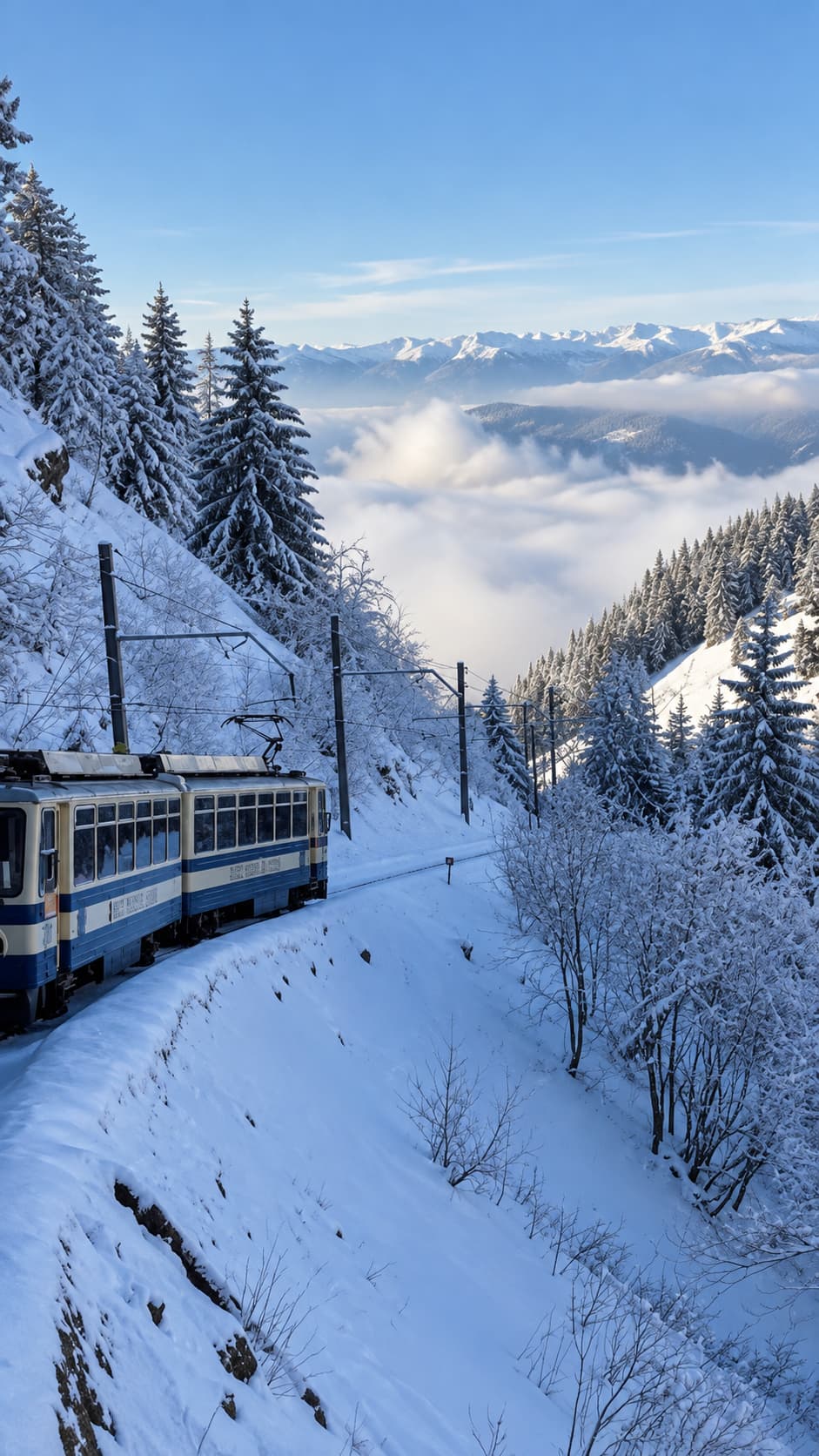
Rochers-de-Naye is a 2,042-metre Alpine peak accessed by a cogwheel train from Montreux station. During the Christmas market season — specifically Wednesdays through Sundays — Santa’s workshop operates at the summit, an experience primarily aimed at families with children. Seat reservations on the MOB GoldenPass train are essential and should be made well in advance; they open from mid-September and sell out quickly for weekends. The train ride itself takes approximately one hour and offers views across the lake and into the Alps that are worth the journey even without the Santa attraction.
The Lavaux wine villages
If you arrive from Geneva by train and have time before the market opens, the Lavaux UNESCO wine terraces — the villages of Cully, Rivaz, and St-Saphorin between Lausanne and Montreux — are quiet and beautiful in winter. A brief stop between trains gives a completely different experience of the lake region beyond the market.
09 — The Honest Verdict
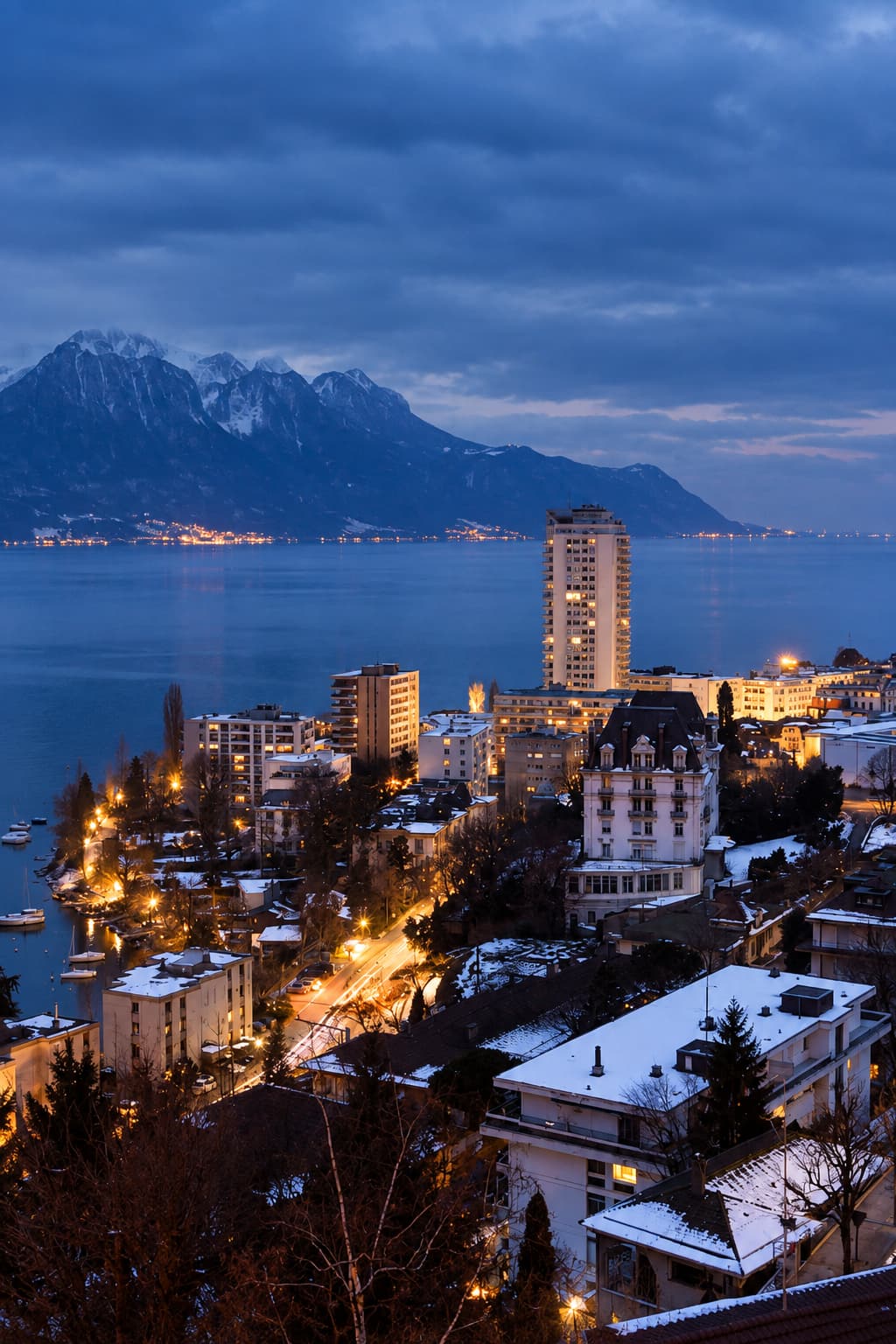
The photographs are accurate. That is the most useful thing to know before you go. The lake really does sit that still, the lights really do reflect across the water that way, and at dusk on a clear December evening, the Alps really are visible across the lake in fading light. Some places earn their reputation through accumulated exaggeration. Montreux earns it through the view.
What the photographs don’t show is a Saturday afternoon in the second week of December, when the promenade fills to a density that makes walking difficult and every food stand has a queue. On those days the market becomes something to be endured rather than enjoyed. As a result, when you go matters enormously — arguably more than where you stay or what you order.
Go on a weekday. Go at dusk. Stay for the 5pm Flying Santa — it is brief and a little theatrical, but there is something genuinely strange and delightful about watching Father Christmas soar above a Swiss lake on cables while the Alps dim in the background. Walk the full kilometre of the promenade to the quieter far end and back, rather than concentrating at the centre near the Ferris wheel. Combine it with Château de Chillon if the season aligns. Order the raclette.
On honest terms, the Montreux Christmas market earns its visit. Those terms, however, matter. And if December pulls you further into Switzerland — toward the valleys, the thermal spas, the mountain towns that don’t involve skis — there is more to find than the Christmas circuit alone.
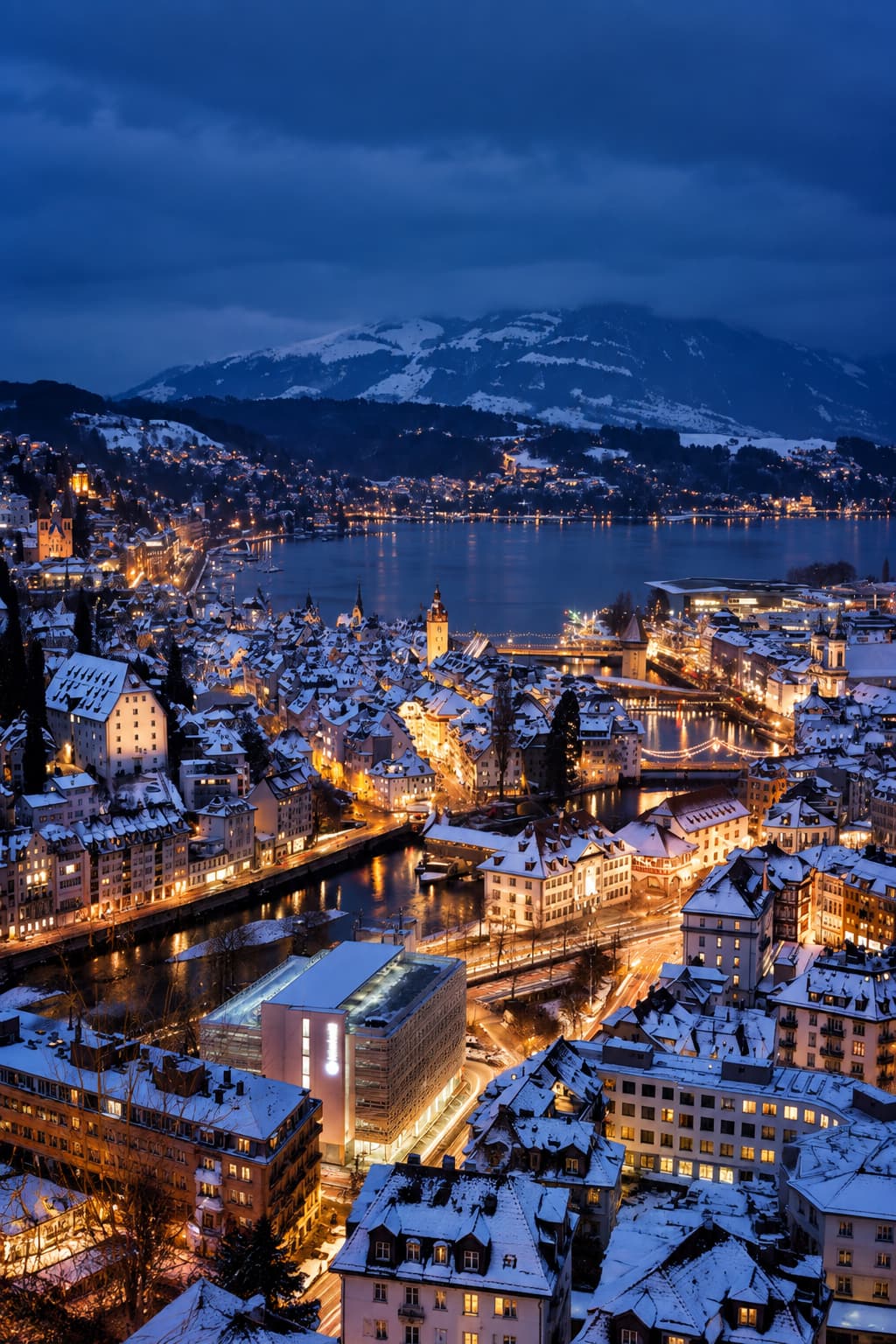
The Alps were still visible at 5:03pm, which is about two minutes after the Flying Santa disappears back into the mechanism.
That is when the lake is at its best — dark enough for the lights, light enough for the mountains.