Switzerland Christmas Markets: Which One Is Actually Worth Your Time
Zurich, Basel, Montreux, and Bern — Switzerland Christmas markets each offer something completely different. Here’s the honest guide to which one suits your trip — and what it’ll actually cost you.
Switzerland Christmas markets operate on a different premise from Germany’s. There are fewer of them, they’re not as large, and they cost more — sometimes considerably more. What they offer in return is a level of setting that nowhere else in Europe can quite replicate: a train station roofed with Swarovski crystals, a lake framed by the Alps, medieval squares that look like stage sets for a film nobody could afford to make. The question isn’t whether they’re beautiful. It’s whether they’re worth the money, and which one is actually right for you.
If you’re still deciding between Switzerland and its neighbours, the Germany vs Austria Christmas markets guide works through that comparison. This post assumes you’re going to Switzerland — and answers the only question that remains: which market, and why.
- When Do Swiss Christmas Markets Open in 2026?
- Zurich — Two Markets, One Unmissable Train Station
- Basel — The Most Local of the Big Four
- Montreux — The View Nobody Can Argue With
- Bern — The Quiet Capital Nobody Books
- Lesser-Known Markets Worth the Detour
- How Expensive Are Swiss Christmas Markets?
- Can You Combine Multiple Markets in One Trip?
- Is Switzerland Worth Visiting Just for Christmas Markets?
- FAQ
01 — When Do Switzerland Christmas Markets Open in 2026?
Most Switzerland Christmas markets open in the last week of November and run through December 24. A handful begin slightly earlier; Montreux is traditionally the first major market to open, usually in the third week of November. The table below gives confirmed or strongly anticipated dates for 2026.
| Montreux | 20 November – 24 December 2026 (confirmed) |
| Zurich | 19 November – 23 December 2026 (confirmed across most sites) |
| Basel | 26 November – 23 December 2026 (confirmed) |
| Bern | Late November – 24 December 2026 (dates typically finalised in September) |
| Lucerne | Late November – 23 December 2026 (consistent with prior years) |
| Gruyères | Selected weekends in December — check the castle website |
Opening hours vary by market and day. Most run from around 11:00 to 21:00 on weekdays, with extended hours on Fridays and Saturdays. The final week before Christmas tends to see the largest crowds — beautiful and hectic in equal measure. Weekday evenings, particularly Tuesday through Thursday, offer noticeably lighter foot traffic at every market.
02 — Zurich Switzerland Christmas Markets: Two Markets, One Unmissable Train Station
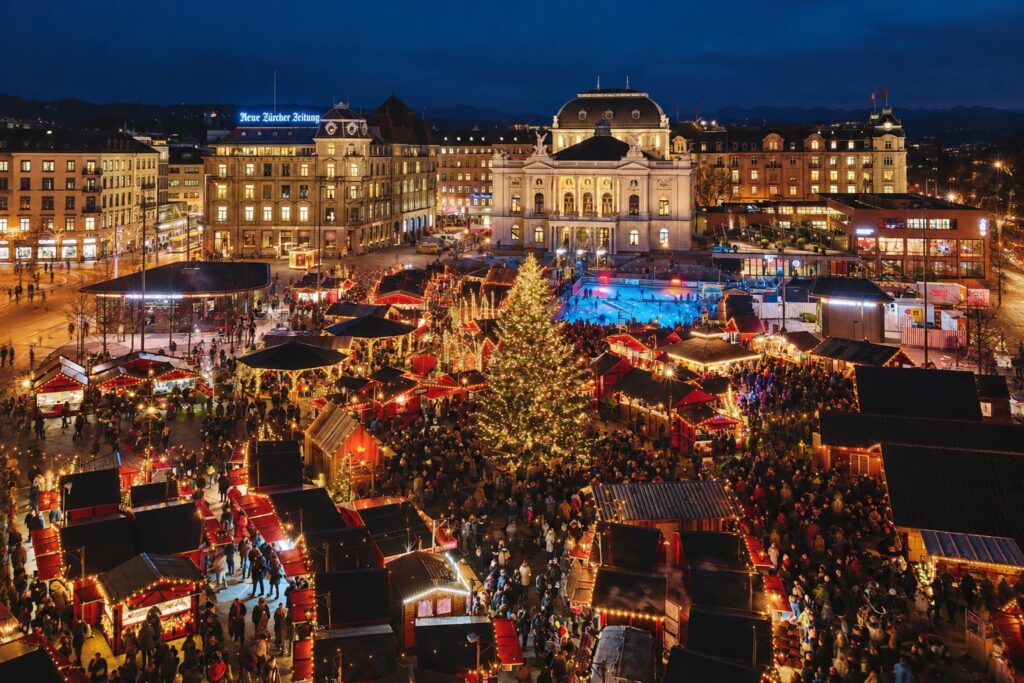
Zurich runs several Christmas markets simultaneously across the city, but two are worth your time: the Christkindlimarkt inside the Hauptbahnhof, and the Wienachtsdorf at Sechseläutenplatz beside the Opera House. Both open from around November 19 and run into late December.
The Hauptbahnhof Market — The One You’ve Seen in Photos
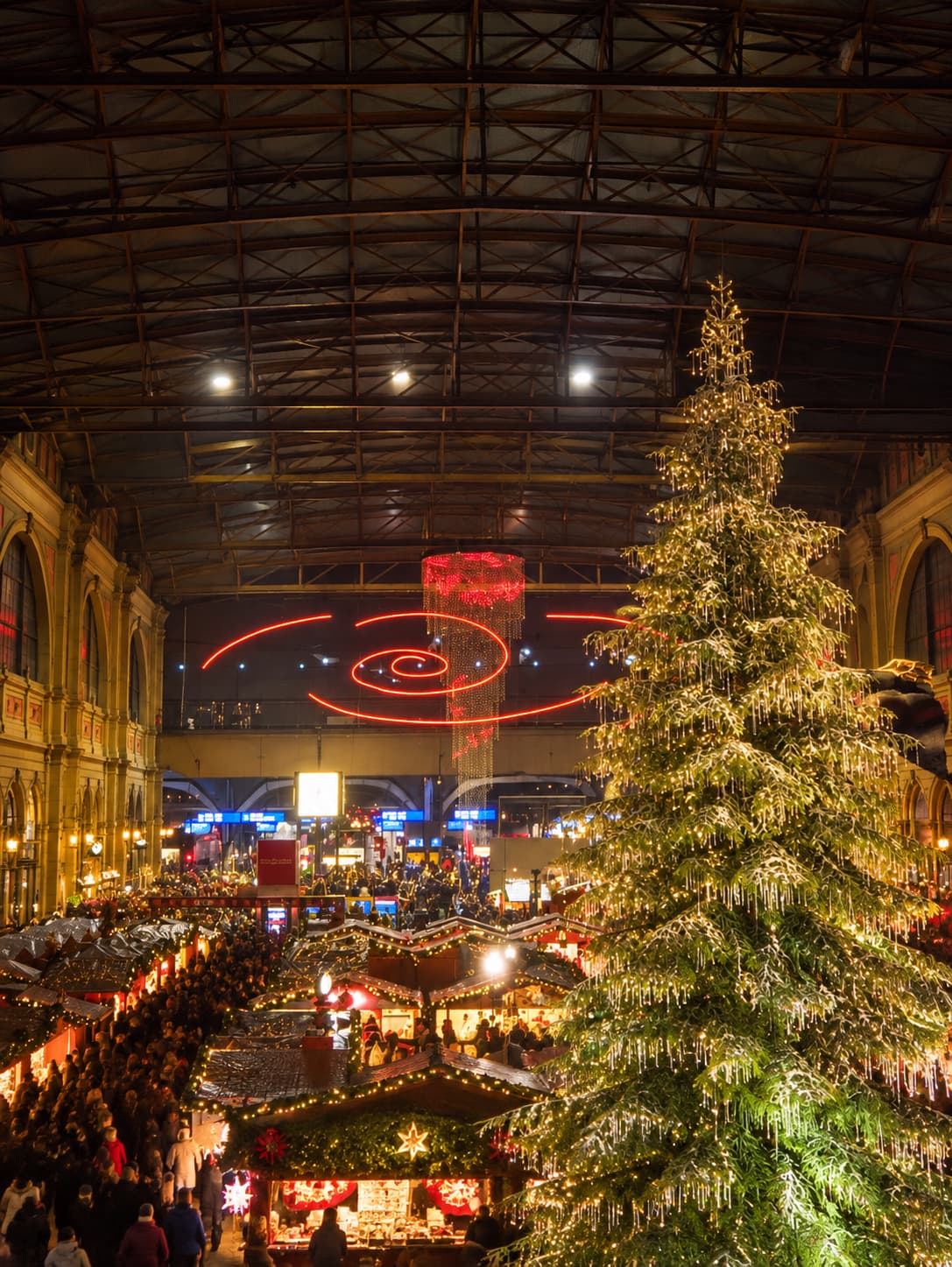
The indoor market at Zurich’s central train station is, by some measures, one of the largest covered Christmas markets in Europe. Its centrepiece is a 15-metre Christmas tree constructed from thousands of Swarovski crystals — a chandelier-like structure suspended in the grand concourse that greets every arriving train passenger from the moment they step off the platform. The effect is genuinely theatrical. Even in a country where architectural drama is standard, this one lands.
That said, the market itself is commercial. Many of the 140-odd stalls sell mass-produced goods rather than handmade crafts, and the constant flow of commuters passing through creates an atmosphere that never quite settles into the contemplative mood you find elsewhere. It’s worth seeing, absolutely — but as a visual spectacle rather than a shopping destination. Budget 45 minutes and arrive early in the day when the crowds are thinner. Note also that the Hauptbahnhof market is largely cashless, so bring a card.
Wienachtsdorf at Sechseläutenplatz — The Better Market for Atmosphere
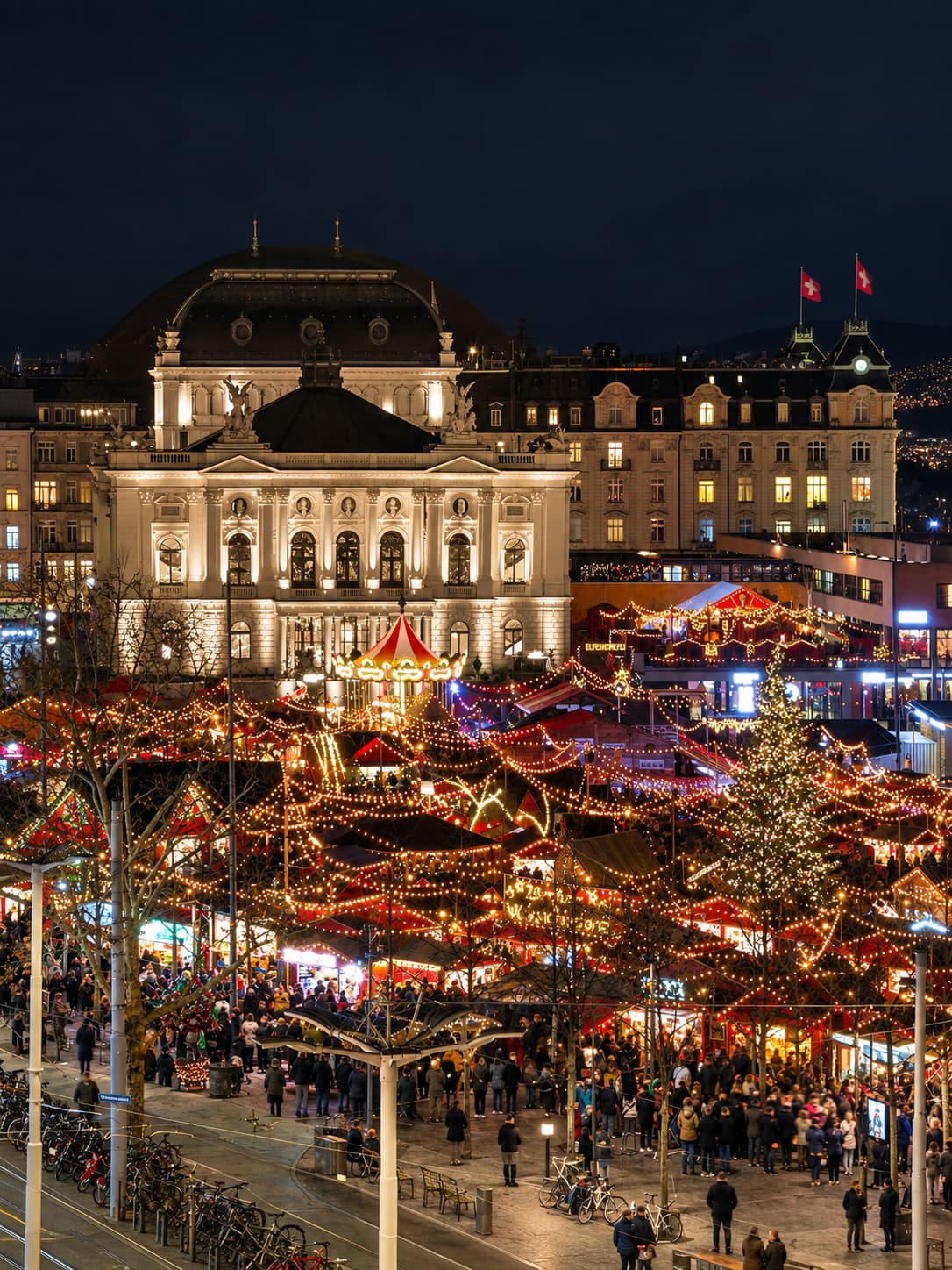
The outdoor Christmas village at Sechseläutenplatz, beside the Opera House and close to Lake Zurich, runs a Designer Market alongside the standard stalls — making it the better option for anyone interested in buying something genuinely local. There’s also an ice rink, a carousel, and a cluster of fondue chalets that fill up fast on weekends. After dark, with the Opera House lit and the lake a strip of darkness behind the chalets, it’s one of the more beautiful market settings in Switzerland.
Best for: First-timers, anyone arriving by train (you’ll pass the station market on the way into the city anyway), and travellers who want the full Zurich Christmas experience across an evening. Zurich is also the most connected city in Switzerland, making it the logical starting point for a multi-market trip.
03 — Basel: The Most Local of the Big Four
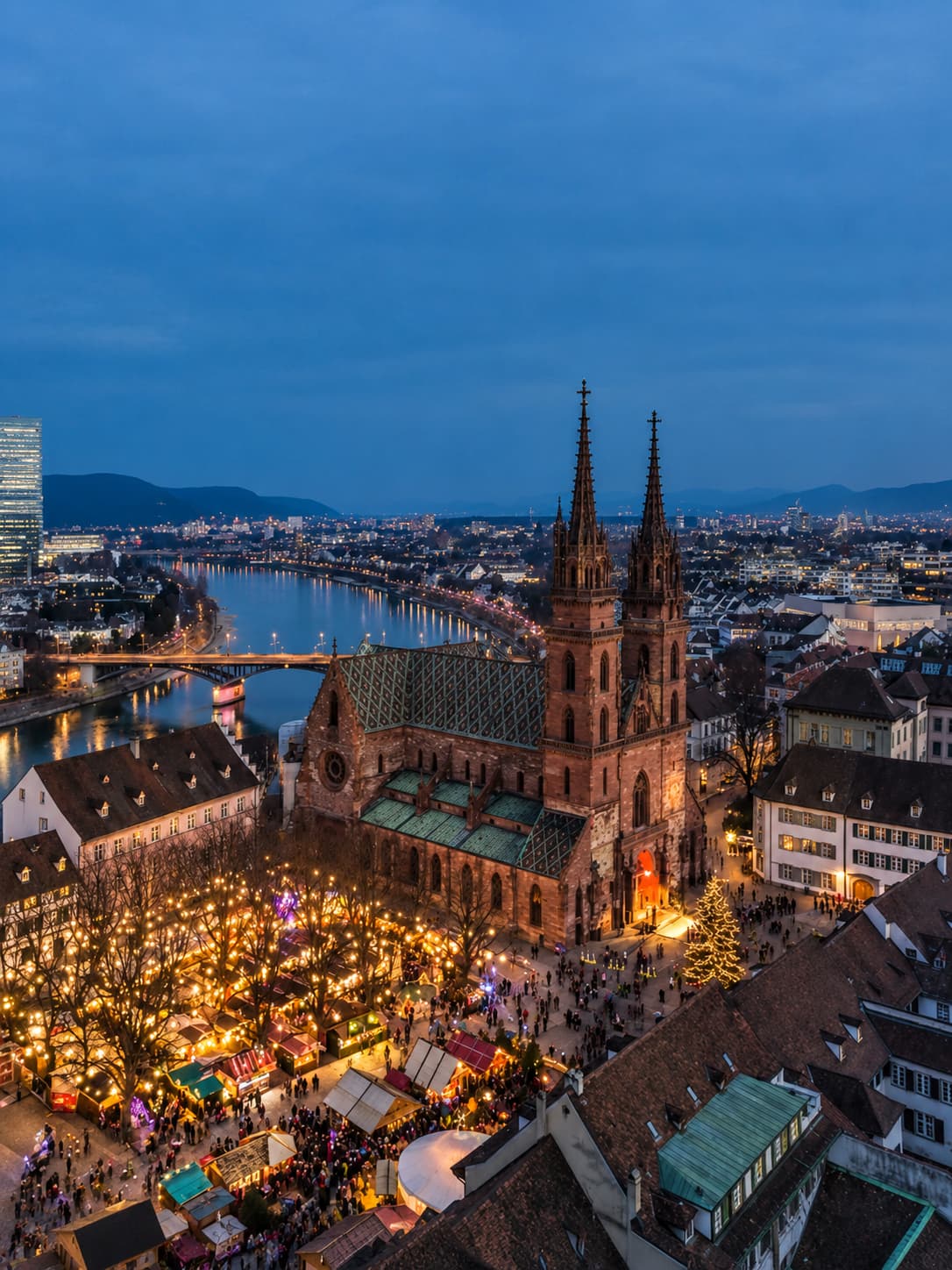
Basel’s Christmas market spreads across three medieval squares in the old town — Barfüsserplatz, Münsterplatz beside the red-sandstone cathedral, and the streets connecting them. Together, they form the largest Christmas market in Switzerland by stall count, with more than 180 chalets. More significantly, Basel draws a noticeably higher proportion of local Swiss visitors than either Zurich or Montreux. This is where Swiss families come for the market, not just where tourists pass through.
What Makes Basel Different
The character of the Basel market is shaped by its squares rather than any single showpiece. Barfüsserplatz holds the main market, including the famous 13-metre Christmas pyramid and the Feuerzangenbowle stand where a rum-soaked sugarloaf is set alight and drips into mulled wine — a ritual worth watching at least once. Münsterplatz, in the shadow of the cathedral, runs quieter and more upscale, with artisan goods and the giant tree decorated by local artist Johann Wanner using hand-blown, hand-painted ornaments. The entire old town is illuminated after dark, and the effect of walking those medieval streets under lights is as good as anything Switzerland produces at Christmas.
Basel also has a strong geographic argument for practicality. Strasbourg is 30 minutes by train — meaning a Basel weekend can extend into Alsace with almost no planning effort. For travellers combining Swiss and French Christmas markets, Basel is the obvious hub. Additionally, Basel’s market consistently attracts praise from residents of the wider region as the most genuinely Swiss in character of the major markets — lower tourist-to-local ratio, more regional products, more recognisably Swiss atmosphere.
Basel was voted Best Christmas Market in Europe in 2021, and while that kind of award always carries caveats, the market genuinely earns its reputation. For official visitor information, Basel Tourism’s Christmas market page confirms current dates and hours each season.
Best for: Travellers who want atmosphere over spectacle; anyone combining Switzerland with Alsace or France; slow travellers who want to spend a full day in one place rather than racing between sites.
04 — Montreux: The View Nobody Can Argue With
Montreux’s Marché de Noël stretches for more than a kilometre along the shores of Lake Geneva, from the town centre promenade to the edge of Château de Chillon. On one side, 150-plus decorated chalets selling everything from raclette to ornaments; on the other, Lake Geneva in its full winter stillness, and directly across the water, the Swiss Alps rising in sharp silhouette against the winter sky. No other Christmas market in Europe offers a backdrop quite like this one. The reputation is earned. For a deeper look at this specific market — what it’s like at different times of day, where to eat, and whether the crowds are manageable — the full Montreux Christmas market guide covers it in detail.
The Honest Trade-off
Montreux is also very touristy and can feel it. The market runs from November 20 to December 24 — one of the earliest opening dates in Switzerland — giving it the longest season, the most visitors, and the highest commercial orientation of the four major markets. Many of the stalls sell the kind of Christmas decorations you could find anywhere in Europe; the genuinely local or artisan finds require more searching than in Basel or Bern.
However, the setting makes almost everything else secondary. Watching the evening light fade over the lake, with the market lights coming up one by one along the promenade and the Alps holding their silhouette against the sky, is one of those travel moments that doesn’t require any justification. An evening visit at Montreux specifically — after dark, with a warm mug in hand, facing the lake — is simply one of the better things Switzerland offers in December.
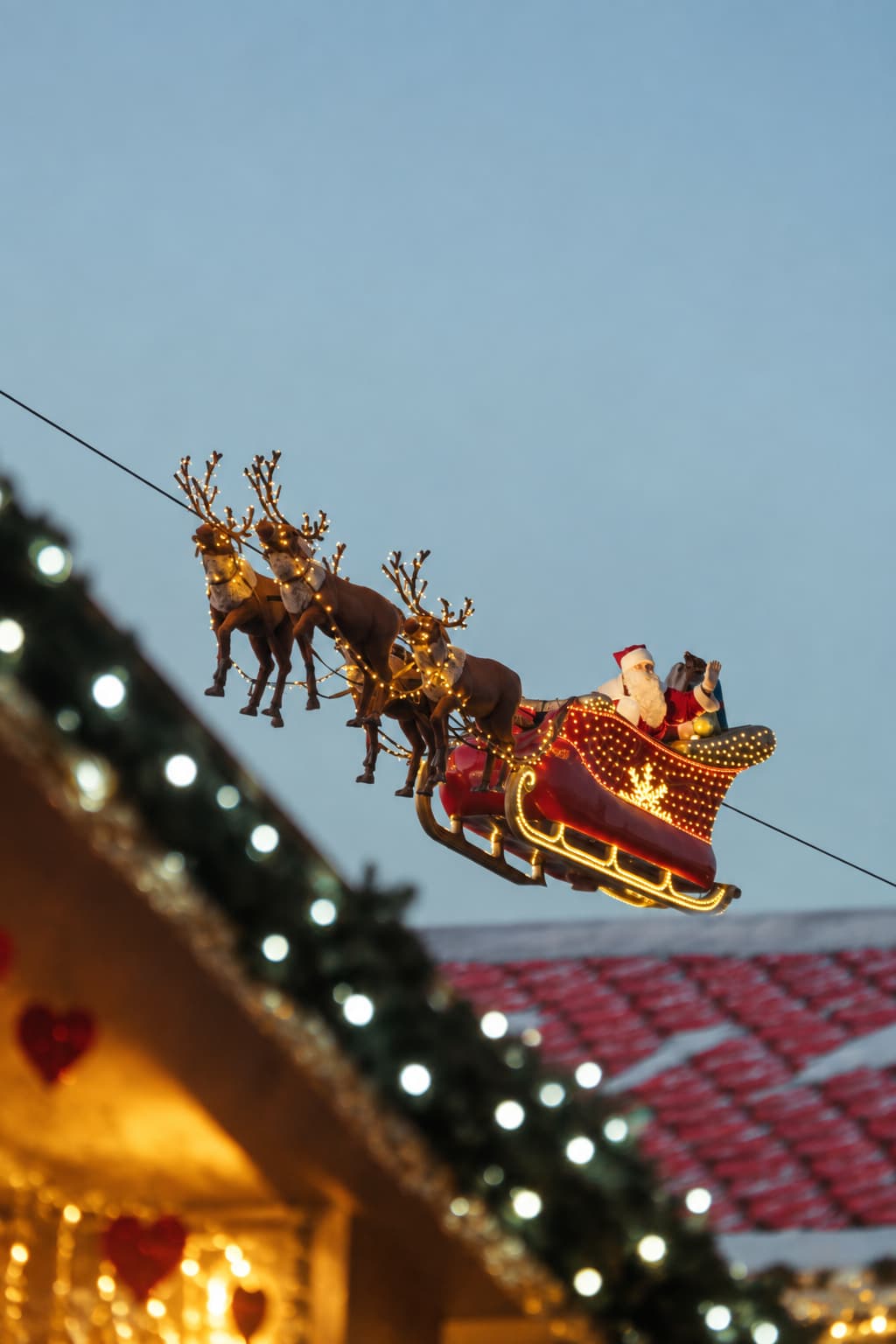
Each evening, there’s also a spectacle where Santa appears to fly across the sky above the market — theatrical and worth seeing if you’re there with children. The Château de Chillon castle hosts additional medieval festival events at weekends.
Best for: The photograph you came for; short visits where you want maximum visual impact in minimum time; travellers for whom the lake-and-Alps setting is the whole point; families with children who will appreciate the evening Santa spectacle.
05 — Bern: The Quiet Capital Nobody Books
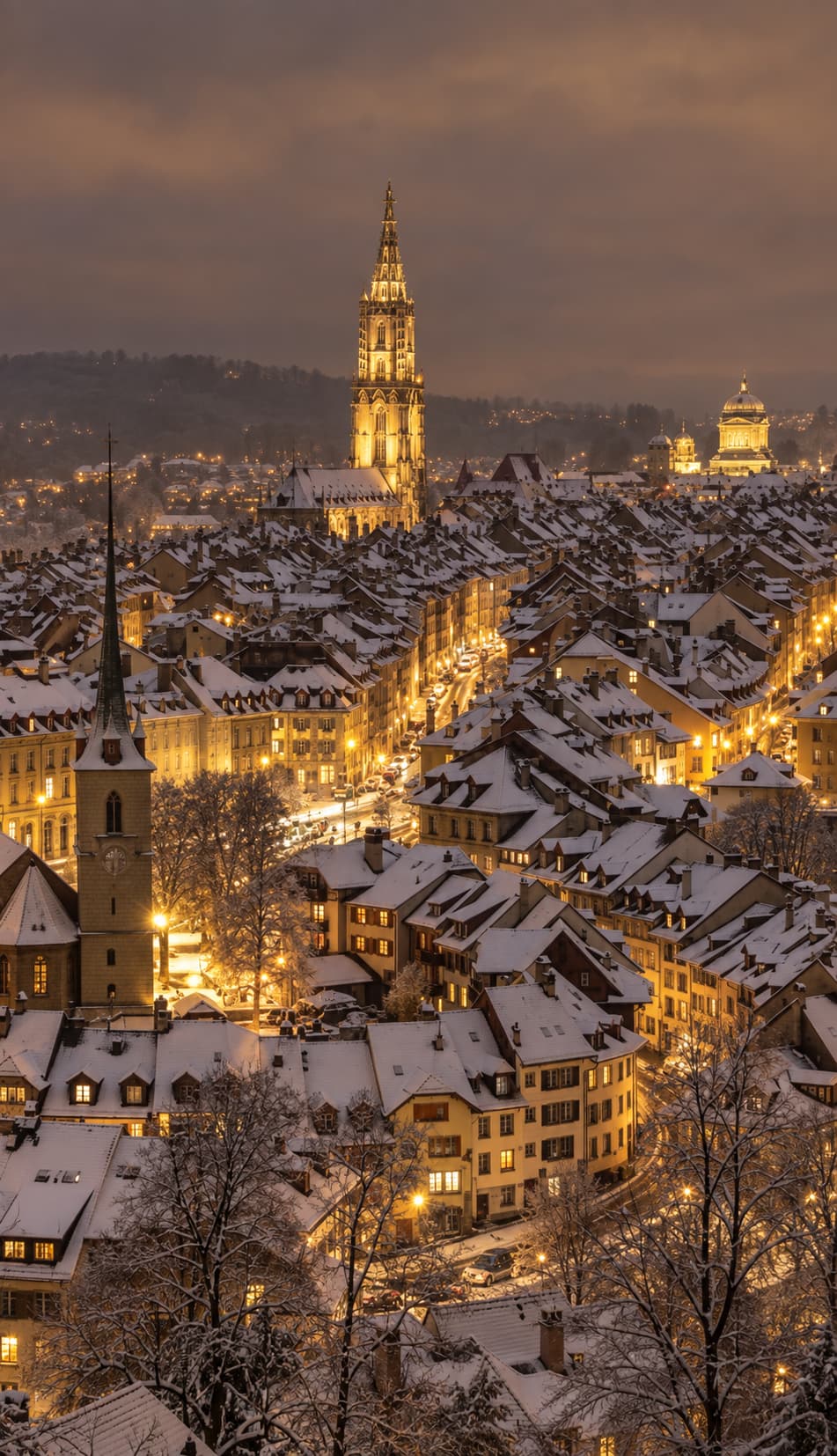
Bern runs two Christmas markets that most international visitors somehow overlook entirely. The Waisenhausplatz market occupies a large square in the city centre with the full range of seasonal goods and food stalls. Set in the forecourt of Bern’s Gothic cathedral and dedicated exclusively to handcrafted and artisan goods — no mass-produced stock — the Münsterplatz market is smaller but genuinely lovely. Both sit in Bern’s UNESCO World Heritage old town, with its distinctive covered arcades and medieval towers. The city’s UNESCO listing covers the entire old town — the same streets the market occupies — which gives some sense of the setting you’re walking through.
Why Bern Rewards the Detour
The pace in Bern is perceptibly different from Zurich or Montreux. Fewer international visitors, a city that doesn’t register on most “best of” Christmas market lists despite having the infrastructure and setting to deserve it, and an old town that looks particularly well at Christmas under the arcade lights. The Münsterplatz artisan market has a specific character — it operates on the principle that only items made by the stallholder themselves can be sold, which results in a genuinely curated experience rather than the usual mix of handmade and mass-produced you find elsewhere.
Bern is also 50 minutes from Montreux by direct train, making the two an obvious pairing for a weekend. Furthermore, it’s the Swiss federal capital — so the city itself, beyond the markets, is worth time. The Zytglogge clocktower, the Bern Minster interior, the Rose Garden in winter — these earn Bern a day in their own right. If you’re thinking about extending the trip into autumn rather than Christmas, the Switzerland in autumn guide covers the wider seasonal picture.
Best for: Travellers who want a Swiss Christmas market without the tourist concentration; those pairing markets with a wider Bern city visit; slow travellers who value genuinely handcrafted goods over commercial volume.
06 — Lesser-Known Swiss Christmas Markets Worth the Detour
Three Markets That Reward the Extra Journey
Beyond the four major markets, a handful of smaller Switzerland Christmas markets offer something the main cities can’t: intimacy, authenticity, and the kind of setting that makes you wonder why everyone isn’t here.
Gruyères — Fairytale Castle Market
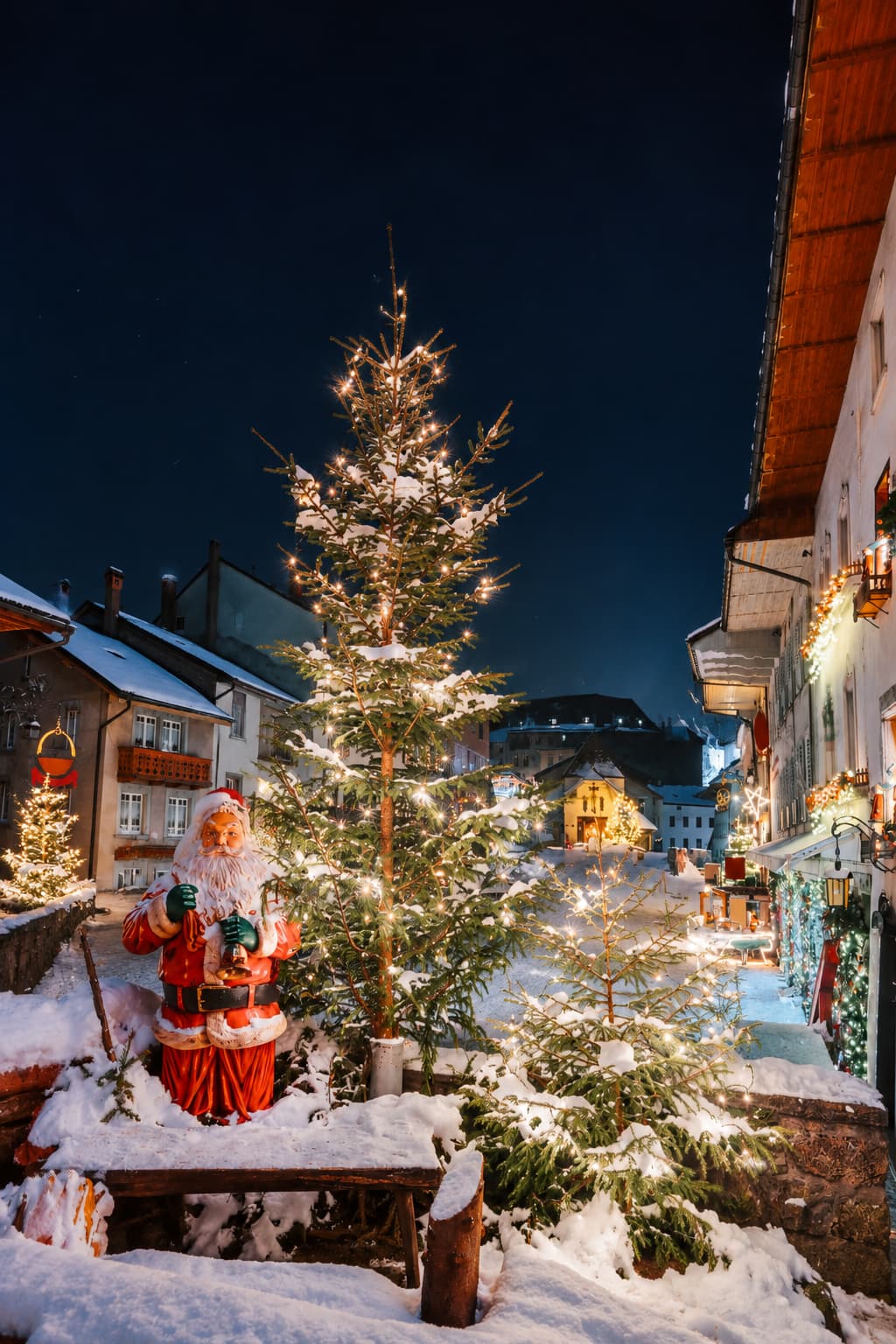
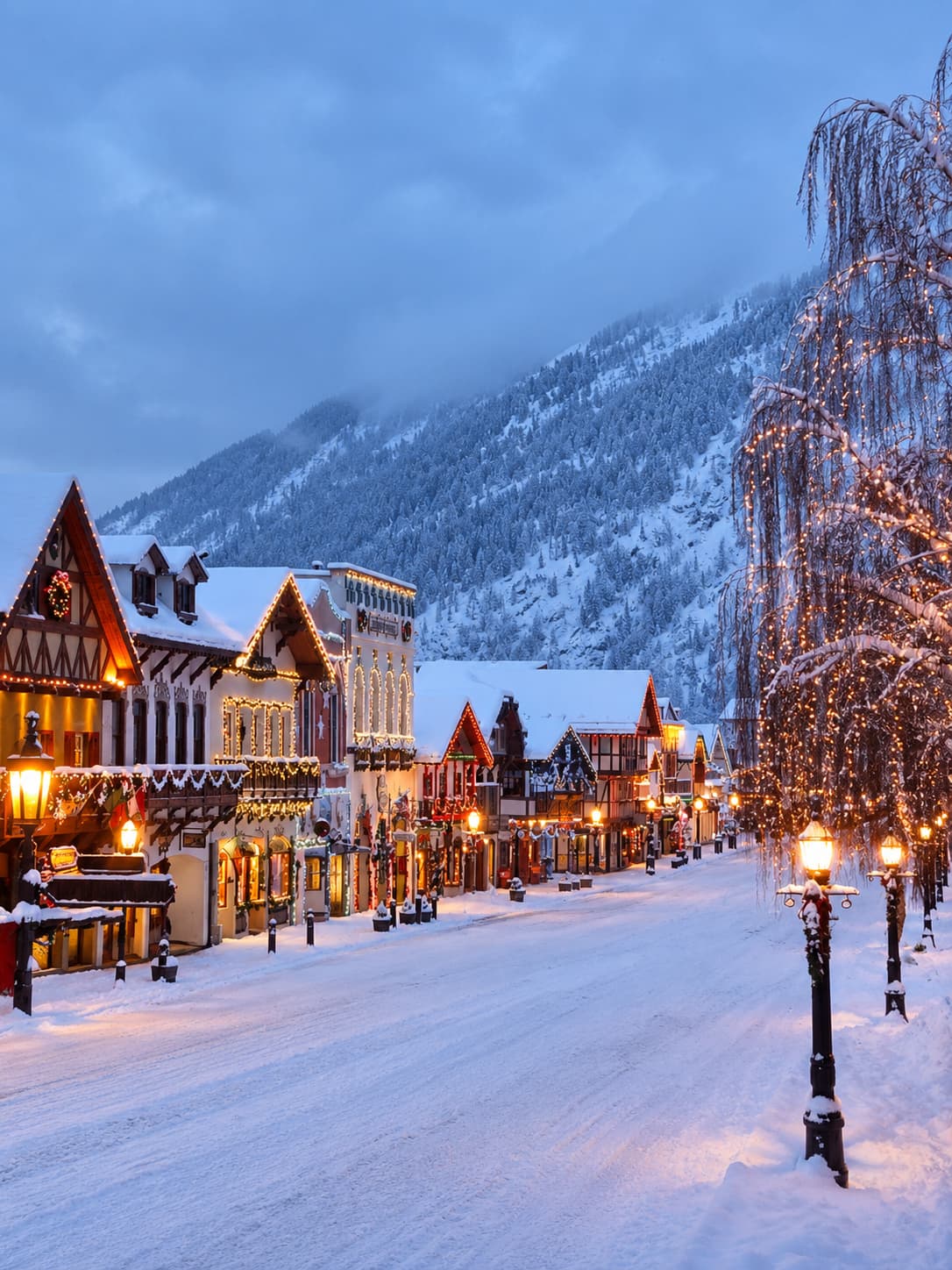
A tiny medieval hilltop village hosting a Christmas market inside and around the castle grounds. The combination of cobblestone streets, castle ramparts, and market stalls is unlike anything the major cities offer. It runs on selected December weekends only — check the château website before travelling. Worth combining with a visit to the Gruyère cheese factory below the village.
Appenzell — The Most Authentically Swiss
A small town in eastern Switzerland with hand-painted facades on every building and a market that draws almost no international tourists. Appenzell is the Switzerland of Swiss imagination — traditional, linguistically distinct (the dialect here is noticeably older than elsewhere), and genuinely oriented toward local visitors rather than outsiders. Consequently, it’s one of the more honest market experiences in the country.
Lucerne — Medieval Setting, Manageable Scale
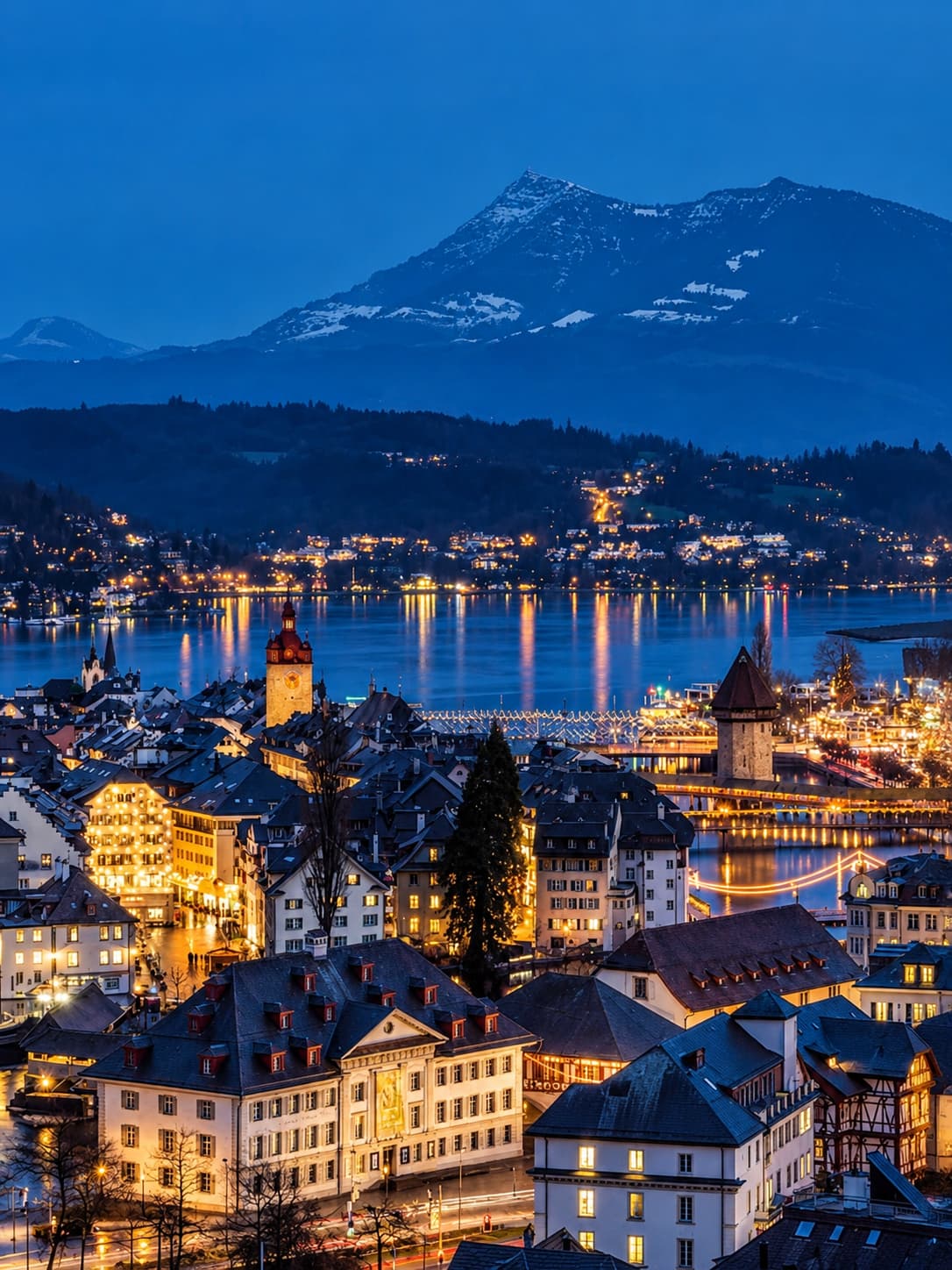
Lucerne’s Christmas market spreads through the old town streets near the Chapel Bridge, the famous 14th-century covered wooden bridge. The market is smaller than Basel or Zurich but the setting is strong — medieval stone towers, the river, the bridge itself lit for December. Lucerne also sits conveniently between Zurich and Basel, making it a natural addition to a multi-city trip without significant detour.
These smaller markets suit slow travellers more than those working through a tightly scheduled itinerary. Given that one trip to Switzerland is rarely enough to cover everything, treating Gruyères or Appenzell as a secondary stop — rather than the main event — tends to work better logistically. If you’re drawn to the quieter, less-visited side of the country, the Ticino in autumn guide covers another off-the-radar Swiss region worth adding to the itinerary.
07 — How Expensive Are Swiss Christmas Markets?
Switzerland Christmas markets are free to enter. Every major market — Zurich, Basel, Montreux, Bern — charges no admission. What costs money is everything inside them, and here Switzerland lives up to its reputation.
What Things Actually Cost
| Glühwein | CHF 5–8 per mug, plus a refundable mug deposit of CHF 3–5 (returned when you hand the mug back — or keep it as a souvenir) |
| Raclette | CHF 8–14 per portion (cheese scraped from the wheel onto potatoes, served with cornichons) |
| Fondue (chalet) | CHF 25–35 per person for sit-down fondue in a market chalet |
| Roasted chestnuts (maroni) | CHF 6–8 per bag |
| Swiss hot chocolate | CHF 7–10 |
| Bratwurst | CHF 8–12 |
A realistic budget for an afternoon at a Swiss Christmas market — one hot drink, a raclette portion, perhaps a small purchase — runs to CHF 40–60 per person before you buy anything to take home. That’s meaningfully more expensive than Germany’s markets, where the same afternoon runs to roughly €20–30. The difference is real and worth factoring into your plans.
In practice, however, the comparison requires context. Switzerland’s markets attract artisan producers who can charge Swiss prices for Swiss-quality goods. The raclette served in Basel is Gruyère; the Glühwein in Zurich is made with local wine rather than anonymous blends. You’re paying for quality as much as for setting. Overall, the honest case is this: Switzerland costs more, and the experience is also in a different category. Those two things are connected.
Additionally, the Swiss rail network — covered by the Swiss Travel Pass — means you don’t need to rent a car to visit multiple markets, which saves significantly on transport costs compared to driving.
08 — Can You Combine Multiple Swiss Christmas Markets in One Trip?
Yes, easily — and this is genuinely the best way to approach Switzerland at Christmas. The country’s rail network is fast, reliable, and connects every market city to every other. A weekend covering two markets is very manageable; three days can include four markets without excessive rushing.
The Best Combinations
Basel is 55 minutes from Zurich by direct train. A Friday evening in Zurich (station market + Wienachtsdorf), a Saturday in Basel for the full day across both squares, and a Sunday return covers both markets without any rushing. Lucerne adds a third option at 50 minutes from Zurich if you want a third city on a slightly longer trip.
Montreux to Bern runs in roughly 50 minutes by direct train. An evening at Montreux for the lake and the lights, then a full day in Bern for the old town and artisan market, is a logical pairing that covers both the visual spectacle and the quieter, more local market in one trip.
Strasbourg is 30 minutes from Basel by direct train, making this one of the most efficient cross-border Christmas market pairings in Europe. Basel for the Swiss experience, Strasbourg for France’s most celebrated Alsatian market — different in every way, covering two countries in a weekend.
One practical note: the two main geographic clusters — the Zurich/Basel/Lucerne triangle in the north, and the Montreux/Bern/Geneva grouping on Lake Geneva — are about two hours apart by train. Trying to combine both regions in a single weekend means spending more time on trains than in markets. For a three-day trip, choose one cluster; for five days or more, combining both is realistic and rewarding.
09 — Is Switzerland Worth Visiting Just for Christmas Markets?
The Honest Answer
Probably not, if the markets are the only reason you’re going and budget is tight. Germany and Austria offer more markets, more variety, and significantly lower costs. If the honest question is “where should I go for Christmas markets in Europe,” Switzerland ranks below Germany and Austria on pure market density and affordability.
However, the framing shifts entirely when Switzerland is part of a broader trip, or when you’ve already seen the major German and Austrian options. The Hauptbahnhof crystal tree in Zurich, the Lake Geneva backdrop at Montreux, and a quiet afternoon in Basel’s medieval squares are three experiences that no other country in Europe offers in combination. Furthermore, Switzerland at Christmas isn’t only about the markets — the country itself in late November and December, with snow on the mountains and the cities lit for the season, makes a compelling case on its own terms. If the idea of Switzerland in winter without the market crowds appeals, the Switzerland in winter without skiing guide is worth reading alongside this one.
When Switzerland Christmas Markets Make Sense
For a broader look at the best Christmas markets across Europe, that guide covers the continent’s full range. Those specifically interested in Swiss winter beyond the markets will find the Alpine destinations guide useful for the wider winter appeal of the region.
The honest verdict is this: Switzerland rewards those who go in with calibrated expectations. Expect to spend more, see fewer markets in total, and encounter crowds at the main ones. In return, you get settings that are genuinely world-class and a quality of product — food, craft, atmosphere — that reflects the country producing it. On that basis, Switzerland earns its place.
Choosing the Best Swiss Christmas Market
Food, Drinks, and the Best Time to Visit
The Swarovski tree at Zurich station, the lake at Montreux after dark, a cup of Glühwein in Basel’s cathedral square — none of these require a verdict. Switzerland at Christmas is expensive, occasionally very crowded, and completely itself.