
Split, Croatia: The Honest City Guide (And Why It Beats Dubrovnik for Most People)
Split Croatia isn’t a monument you visit and leave. It’s a functioning Mediterranean city of 180,000 people — and its Roman palace is where they go for coffee.
Why Split Feels Different From Other Croatian Cities
Most people arrive in Split, Croatia with a mental image pulled from a travel article: cobblestones, Roman columns, the Adriatic glittering in the background. That image is accurate. What those articles don’t prepare you for is the atmosphere that surrounds it.
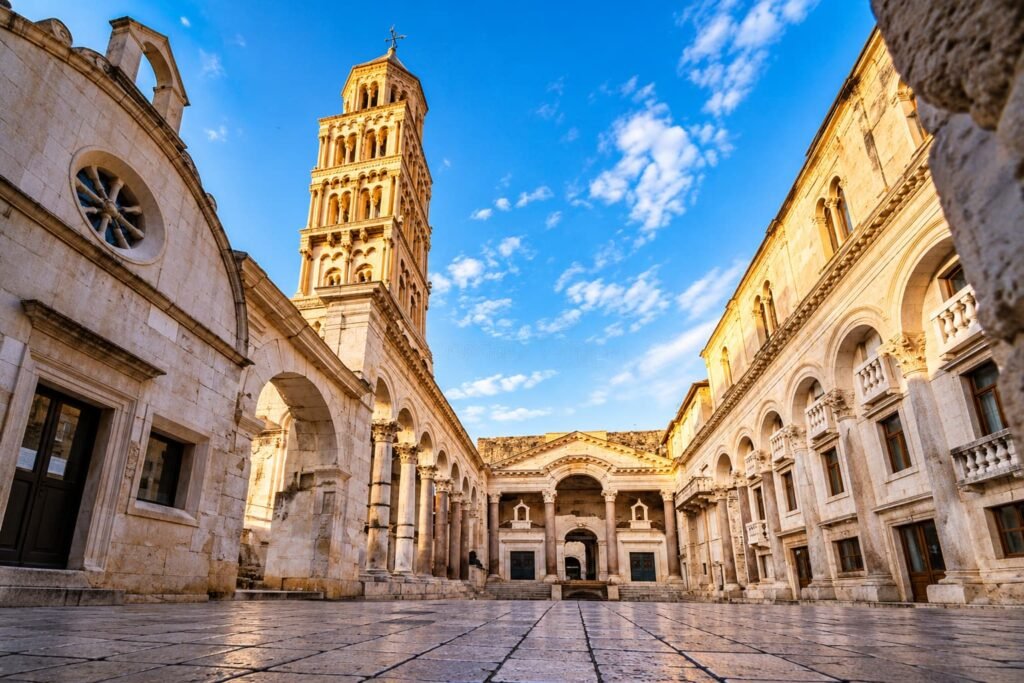
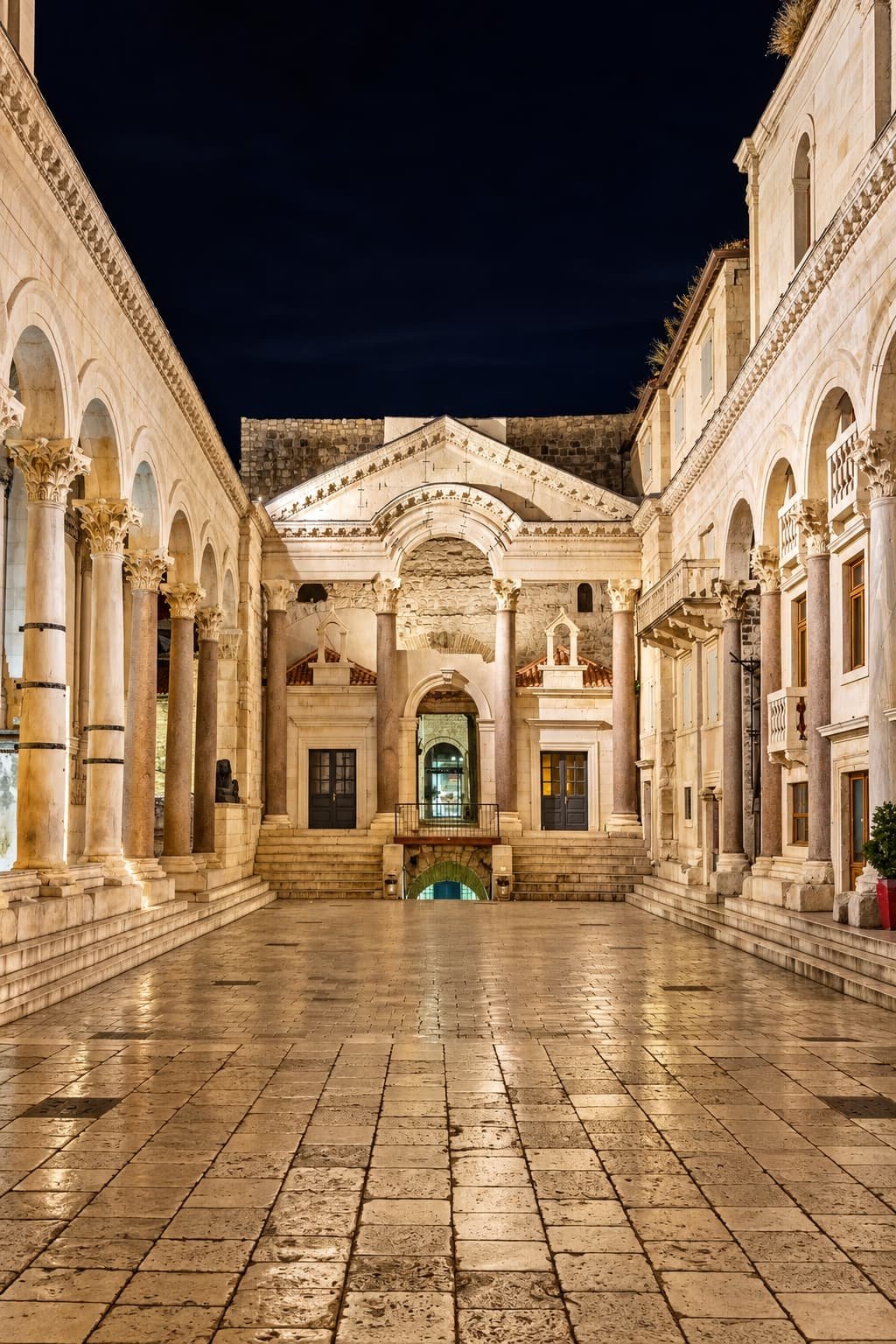
Split Croatia is not a museum town. It’s not a preserved historic quarter surrounded by a modern city that carries on separately. The palace and the city are the same thing — entirely continuous, impossible to separate. The laundry hanging between columns is not charming local colour staged for tourists. It belongs to someone. The coffee bar wedged into a Roman archway is someone’s regular morning stop, not a theme café. The Peristyle square fills with school groups in the morning and locals with wine glasses in the evening.
That’s the thing most guides about Split miss. They describe it accurately and convey it poorly — because the interesting thing about Split isn’t any individual sight. It’s the texture of the whole. A 1,700-year-old Roman palace repurposed as a working neighbourhood, and the neighbourhood so absorbed into the palace that neither one remembers where the other ends.
01 — Is Split, Croatia Worth Visiting, and What Kind of Traveller Does It Suit?
The short answer: yes, and emphatically so — but with a clear-eyed sense of what you’re getting. Split Croatia rewards a specific disposition. If you want a place you can understand through a checklist — see the Palace, photograph the Riva, tick the box — you’ll have a fine day and leave slightly underwhelmed, wondering what the fuss was about.
If you’re the kind of person who sits with a coffee in the middle of an ancient square and just watches the city happen around you, Split will be one of the best places you’ve been.
You want a real Mediterranean city, not a resort. Using Split as a base for island day trips works especially well. You want somewhere cheaper, less crowded, and more connected than Dubrovnik. You find inhabited ancient architecture more interesting than perfectly preserved ruins.
You want a polished, curated old-town experience where every angle has been designed for photography. That’s Dubrovnik’s strength. Split is messier, louder, and considerably more interesting — but it doesn’t offer Dubrovnik’s visual drama on arrival.
Split is Croatia’s second city — population 180,000, working port, university town. It has a functioning economy that has nothing to do with tourism. Supermarkets, traffic, teenagers on scooters, workers eating lunch in plastic chairs. This ordinariness is exactly what makes it compelling. The Romans built Diocletian’s Palace as a retirement complex for an emperor in around 295 AD. The people who moved in after the empire collapsed didn’t preserve it — they just lived in it. They’ve been doing so ever since.

02 — Diocletian’s Palace: What It Actually Is
Most guides describe Diocletian’s Palace as a “must-see attraction.” This is technically accurate and completely misleading, because the Palace is not a place you visit — it’s a neighbourhood you walk through.
The complex was built between 295 and 305 AD as a retirement compound for the Roman Emperor Diocletian — half fortified garrison, half imperial luxury residence. When Rome fell and the emperor was long dead, the people of the nearby city of Salona, fleeing from invaders, moved into the ruins. They filled the halls, built homes inside the towers, repurposed the mausoleums. The process was not planned or orderly. It was simply survival, and it worked. Today, around 3,000 people still live within the palace walls. The cathedral you see on the Peristyle was once Diocletian’s tomb.
What to actually do in the Palace
The colonnaded court at the centre of the palace complex is now Split’s main public square. Locals sit here in the evenings. Coffee bars operate under the columns. Come in the morning to avoid the tour groups. Come in the evening to see what it actually is — a living piazza that has been one for more than a thousand years.
Beneath the Peristyle are the underground service corridors and storage chambers of the original palace — essentially the foundations that supported the imperial apartments above. They give the best sense of the Palace’s actual scale. Entry around €10. Worth it. This is where you understand what you’re standing in.
The Golden Gate (north, most ornate, tourist-facing), the Bronze Gate (south, sea-facing, opens onto the Riva — the best approach from the water), the Silver Gate (east, less visited, leads into the local market), and the Iron Gate (west, faces the main city square). All free. Enter through the Bronze Gate from the Riva for the best first impression.
Diocletian’s mausoleum, converted to a cathedral in the 7th century — the oldest cathedral in the world still in use. The bell tower is climbable and gives the best elevated view of the Palace roofline. Shared entry ticket with the Baptistery: around €10.
Palace Tickets and Visiting Tips
- All four gates and the streets inside are completely free — you only pay for the Substructures and the Cathedral/Bell Tower
- Morning (before 9am) or evening (after 6pm) are when the Palace is bearable in summer — midday is genuinely unpleasant in July/August
- Get lost deliberately. The alleys between the main streets contain the best restaurants, the quietest corners, and the clearest sense of the inhabited palace
- The Silver Gate (east) opens directly onto the daily market — produce, cheese, lavender, olive oil. Go on a weekday morning.
03 — How Many Days Do You Need in Split, Croatia?
Here’s the honest breakdown, without padding:
Covers the Palace core (Peristyle, Substructures, Riva), a walk through Varoš, and a climb up Marjan Hill for sunset. You will see the essential Split — but you’ll be moving quickly and the day trips are off the table. Viable if Split is a stop, not a destination.
The minimum comfortable version. Day one: the Palace, Riva, evening in the old town. On day two, make it a water day — the Blue Lagoon by boat tour, or a catamaran to Hvar. Day three (or morning of): Marjan Hill, the market, a slow departure. This is what most people should plan for.
One city day, one water/island day, one land day trip (Trogir or Krka). You get the Palace properly, you get the Adriatic properly, you have time to eat well and sit still. If Split is your main destination on a Croatia trip, this is the right amount.
Adds a second island day (Vis or Korčula), a morning at Bačvice Beach, and the kind of unhurried pace that lets the city settle on you. The pace becomes right, not just correct. Four nights is the version where Split converts people who weren’t expecting to love it.
04 — Beyond the Palace — What Else Split Actually Delivers
Marjan Hill

The forested limestone peninsula that rises directly west of the old town is free to walk, takes 20 minutes to reach the first proper viewpoint (Prva Vidilica), and delivers the best panorama of Split, the Adriatic, and the islands of Brač and Hvar. It is mentioned in every guide about Split. It is bypassed by a meaningful proportion of visitors who fill up on the Palace and leave without climbing it.
Don’t make that mistake. The walk through pine forest behind the city — quiet, shaded, ten minutes from the Peristyle — is the best antidote to the crowds below. From the top, the view reframes everything you’ve seen: the Palace you’ve been walking through for two hours suddenly looks exactly like what it is, a Roman emperor’s compound dropped into a Mediterranean coastline, the city spreading around it like an afterthought that became the point.
The Meštrović Gallery is on the approach to Marjan Hill — the former studio-home of Ivan Meštrović, Croatia’s greatest sculptor. If you have any interest in twentieth-century figurative sculpture, it’s worth an hour. If you don’t, the walk past the exterior and the sea views from this stretch of coast are worth the detour on their own.
The Riva Promenade
The broad waterfront boulevard that runs along the south wall of the Palace is not a tourist construction — it’s where the city lives. Morning coffee and boats give way to aperitivo, families walking, and restaurants beginning to fill — two different experiences of the same place. Sit here twice: once before the afternoon and once as the light drops. The contrast between the old sea gate rising behind you and the palm trees lining the harbour is the central image of Split, the one that makes people understand why the city works.
Varoš — the neighbourhood most guides leave out

The old fishermen’s quarter climbing the hill behind the western Palace walls is quieter than the Palace, more residential, and — crucially — where to find a lunch that doesn’t have an English-only menu. Konoba restaurants tucked into alleyways. Locals who use the streets to get from one place to another, not to be photographed in. This is where you go when the Palace starts feeling performative.
Bačvice Beach
A 15-minute walk south of the old town brings you to the city’s most famous beach — sandy, which is rare on the Dalmatian coast, and populated by locals playing picigin, a paddling game unique to Split that involves keeping a small ball airborne in ankle-deep water. It’s played with considerable seriousness. It looks completely absurd from the shore. The evening waterfront at Bačvice — the cafes, the noise, the people — is more genuinely local than anything on the Riva, and worth the walk.
05 — Is Split Better Than Dubrovnik?
For most travellers: yes. Here’s the honest version.
Dubrovnik is the right choice if visual drama on arrival is what you’re looking for, if you want to walk city walls above the sea, or if the southern islands (Mljet, Korčula from the south) are your priority. The price and the crowds are the trade-off, and they’re significant.
Split wins on everything else: price, liveability, ferry access, the quality of the Palace as an experience (you move through it rather than around it), and the honest texture of a city that hasn’t arranged itself for your visit.
If you’re planning the full comparison before you book — the deeper analysis, the side-by-side on specific itinerary decisions — that’s in the Dubrovnik vs Split Croatia guide. And if you’re visiting Dubrovnik after Split, Dubrovnik in autumn covers what the city is like once the cruise ship season winds down — a genuinely different trip.
06 — The Best Day Trips from Split, Croatia
Split’s structural advantage over most Croatian cities is ferry access. The main ferry terminal is on the Riva, and from it you can reach every significant Dalmatian island directly. Combined with buses and short road trips, this makes Split one of the best-connected day-trip bases in the Mediterranean.

Trogir — 30 Minutes West
A UNESCO-listed medieval city on a small island connected to the mainland by bridge. The Romanesque portal of the Cathedral of St Lawrence stops people mid-step — it is one of the finest pieces of medieval stonework in the Adriatic. Bus 37 from Split runs regularly. Half a day is enough. Trogir combined with the Blue Lagoon (the bay on nearby Čiovo island) as a boat tour is the most popular and most justified day trip from Split.
Krka National Park — 90 minutes north
The honest alternative to Plitvice Lakes if you’re based in Split — similar visual impact (travertine waterfalls, canyon boat trips, turquoise water) at a fraction of the distance. The island monastery of Visovac is an unexpected highlight. Book entry in advance through the official Krka National Park site — it fills quickly in summer. In October, Krka is significantly less crowded and the morning mist on the canyon is worth waking up early for.
Hvar — by catamaran, 1 hour
The island most people add and most people don’t regret. Catamaran from the Riva takes about an hour to Hvar Town. Lavender fields in the interior, a Venetian fortress above the harbour, some of the best restaurants on the coast. In October it’s quiet, atmospheric, and most restaurants are still open in the first half of the month. The summer version — packed, expensive, centred on nightlife — is a different trip entirely.
Blue Lagoon (by boat tour)
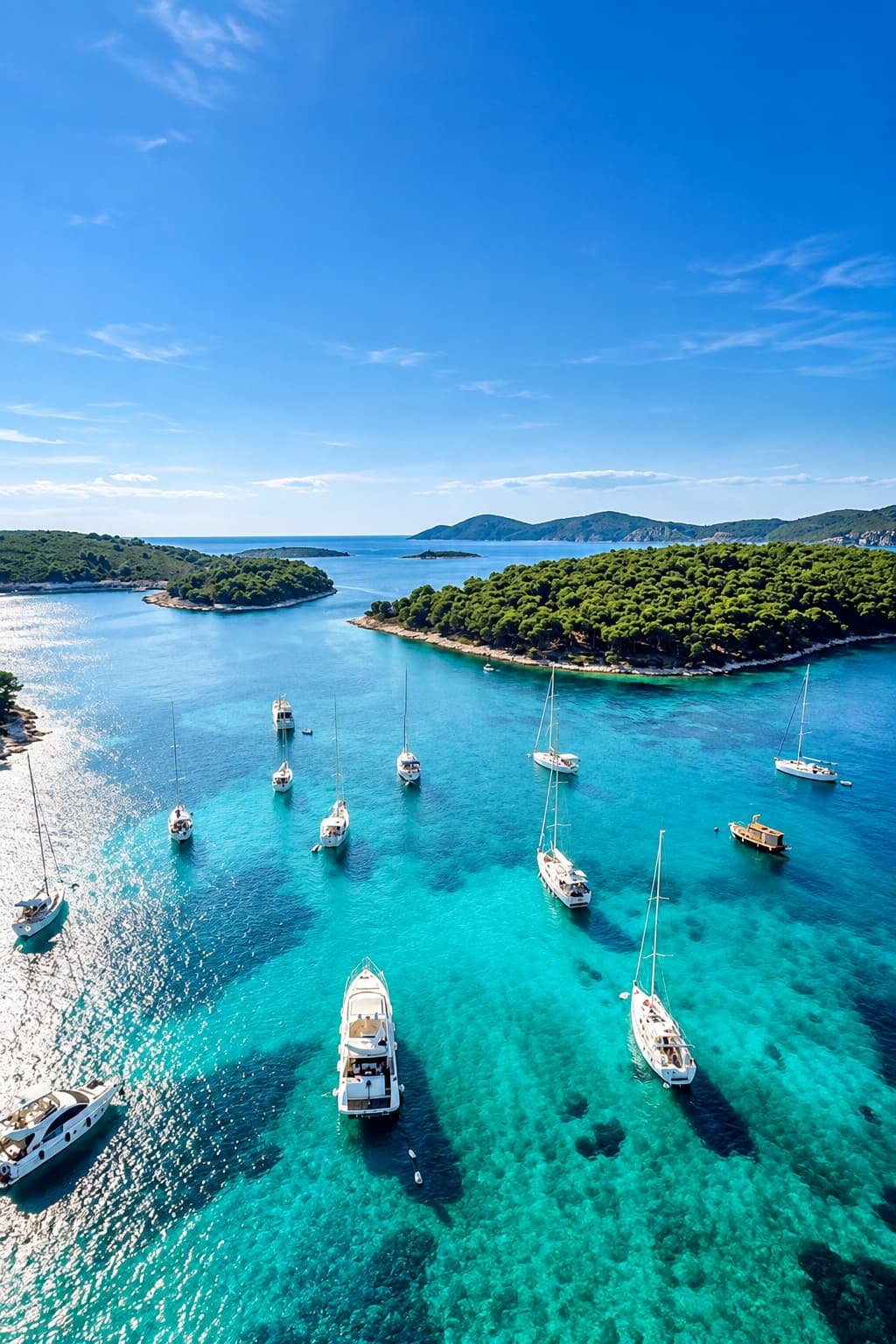
The turquoise shallow bay between Čiovo island and Šolta is the most photographed spot within reach of Split — and deservedly so. Boat tours leave the Riva in the morning, stop for 1–2 hours of swimming, and often include Trogir. The water is genuinely that colour and genuinely that clear. In October the sea is still around 20°C and the boats are half-full. This is the version to take.
If Split is the start or end of a longer Dalmatian coast drive, the Dalmatian coast road trip guide covers the full route — Split works equally well as a departure point or an arrival, and the islands become more accessible if you build the route around the ferry schedule rather than the driving distance. The Zagreb to Dubrovnik road trip also runs through Split and is worth reading if you’re driving the full coast.
07 — Split in October: Is It Worth Visiting?

October in Split Croatia is the best-kept not-very-secret on the Dalmatian coast. The crowds thin dramatically after mid-September — the Peristyle goes from shoulder-to-shoulder in August to pleasantly spacious in October. Restaurants no longer require booking a week ahead. The sea stays warm enough to swim through early October (around 20–22°C). Accommodation prices drop considerably — sometimes by 40–50% compared to peak summer.
The honest caveats: some smaller island restaurants close by the third week of October, so island day trips are better earlier in the month. A few of the more seasonal businesses (beach bars, some boat tour operators) wind down. The weather is reliable but not guaranteed — you’ll get warm, sunny days and you’ll occasionally get grey ones.
The trade-off is strongly in October’s favour for most people. The city is more itself in October. The Palace is walkable at any hour. The day trips feel like discoveries rather than organised processions.
For a broader look at autumn timing across Croatia and the rest of Europe, the best European cities in October guide covers where this month actually works vs where it’s just a budget compromise. Split is on the right side of that list. The Croatia in October guide goes deeper on the Dalmatian coast as a whole — when things close, which islands stay open, and what the shoulder season actually feels like outside the city.
See also: Croatia in September vs July — the full seasonal breakdown for the Dalmatian coast.
Planning Your Split Stay
Diocletian’s Palace and Getting Around
Where to Stay and What Not to Miss

Split doesn’t announce itself. It accumulates — over coffee in the Peristyle, over the view from Marjan Hill, over dinner in an alley in Varoš that you found by accident and didn’t want to leave.
That’s the city. It takes its time with you, and it rewards taking time with it.