Road Tripping Through Central Europe with Friends: What Works, What to Plan, and How to Make It Run Smoothly
A nine-day road trip through Dresden, Prague, Bratislava, Budapest, and Vienna with four friends in one car. Here is an honest account of how group travel actually works on a trip like this — and what to sort before you leave.
How the trip actually worked
The idea started simply enough: four friends, one car, nine days, and a route through a part of Europe that none of us had done together before. Dresden to Vienna via Saxon Switzerland, Prague, Bratislava, and Budapest. The route made geographical sense, the timing worked around everyone’s schedule, and the logic of splitting costs four ways made it one of the more affordable trips any of us had done.
What we did not plan was how naturally the trip would find its shape once we were actually on the road. Group travel has a reputation for being complicated — too many opinions, too many preferences, too many moments where someone wants to leave and someone wants to stay. That can be true. In our case, it was not — and I think the reason is worth examining, because it says something useful about what actually makes a group road trip work.
This post is about the mechanics and the experience of doing Central Europe as a group of four. The route itself is covered in detail across the other posts in this series. This one is about the how: planning, roles, decisions, costs, and the specific things that group travel does better than solo travel, on a trip like this one.
What this post covers
01 — Why Four Is the Right Number
Four people in one car is the mathematical sweet spot for a European road trip. It is large enough to split costs meaningfully — the car rental, the fuel, and the accommodation divided four ways changes the daily spend considerably. It is small enough to make decisions without a committee. Furthermore, four people fit comfortably in a standard rental car without anyone spending nine days in a middle seat resenting the person next to them.
The group dynamic on a long trip
There is a specific quality that close friends bring to a road trip that acquaintances or travel companions cannot replicate: the comfort of not having to perform. On a nine-day trip, you will spend a significant portion of your waking hours in a car, in apartments, in restaurants, and in transit — and the social energy required to be pleasant company with people you do not know well is exhausting over that duration. With close friends, the silences are comfortable. The decisions are faster. The tolerance for someone being tired or quiet or not in the mood for another museum is higher.
That matters more than any logistical consideration. The right group makes a difficult trip easy. The wrong group makes an easy trip difficult. Four close friends who have travelled together before — or who know each other well enough to predict each other’s preferences — is about as good a starting condition as a group road trip can have.
02 — How Responsibilities Divided Naturally
One of the things nobody tells you about group travel is that it works best when people stop trying to share everything equally and start doing the things they are actually good at. Equal contribution does not mean identical contribution. On this trip, that division emerged without anyone planning it, and it made everything run more smoothly than any formal system would have.
The planner
Every group has one — the person who reads the booking confirmation three times, who knows what time the train leaves and what the cancellation policy is, and who has already looked up the opening hours of the thing everyone wants to visit tomorrow. On this trip, that responsibility fell to the person who is simply built for it: detail-oriented, organised, and genuinely calmed rather than stressed by the act of managing logistics. Accommodation was booked in advance at every stop. Restaurant reservations were made where they mattered. The route was mapped before we left Dresden. None of this happened by accident — it happened because one person took it on and the others trusted them to.
The navigator
A road trip needs someone who is comfortable with maps, traffic conditions, and the specific anxiety of approaching a border crossing with five cars behind you and no clear sense of which lane to be in. Navigation on this route was handled by whoever was in the passenger seat, rotating naturally with the driving. The lesson here is not to rely entirely on a single phone’s GPS without a backup — download offline maps before you leave, because there are stretches of the Saxon Switzerland area and the approach to the Czech border where signal is inconsistent.
The driver
Not everyone in the group held a driving licence — which is more common than road trip guides acknowledge and not a problem as long as at least two people can share the driving. On a nine-day trip covering this distance, a single driver would be tired by day four and exhausted by day seven. Sharing the driving means each person covers the stretches they are comfortable with, rest happens in the car naturally, and nobody arrives at a new city having been behind the wheel for three hours and needing two hours to decompress before they can enjoy anything.
The photographer
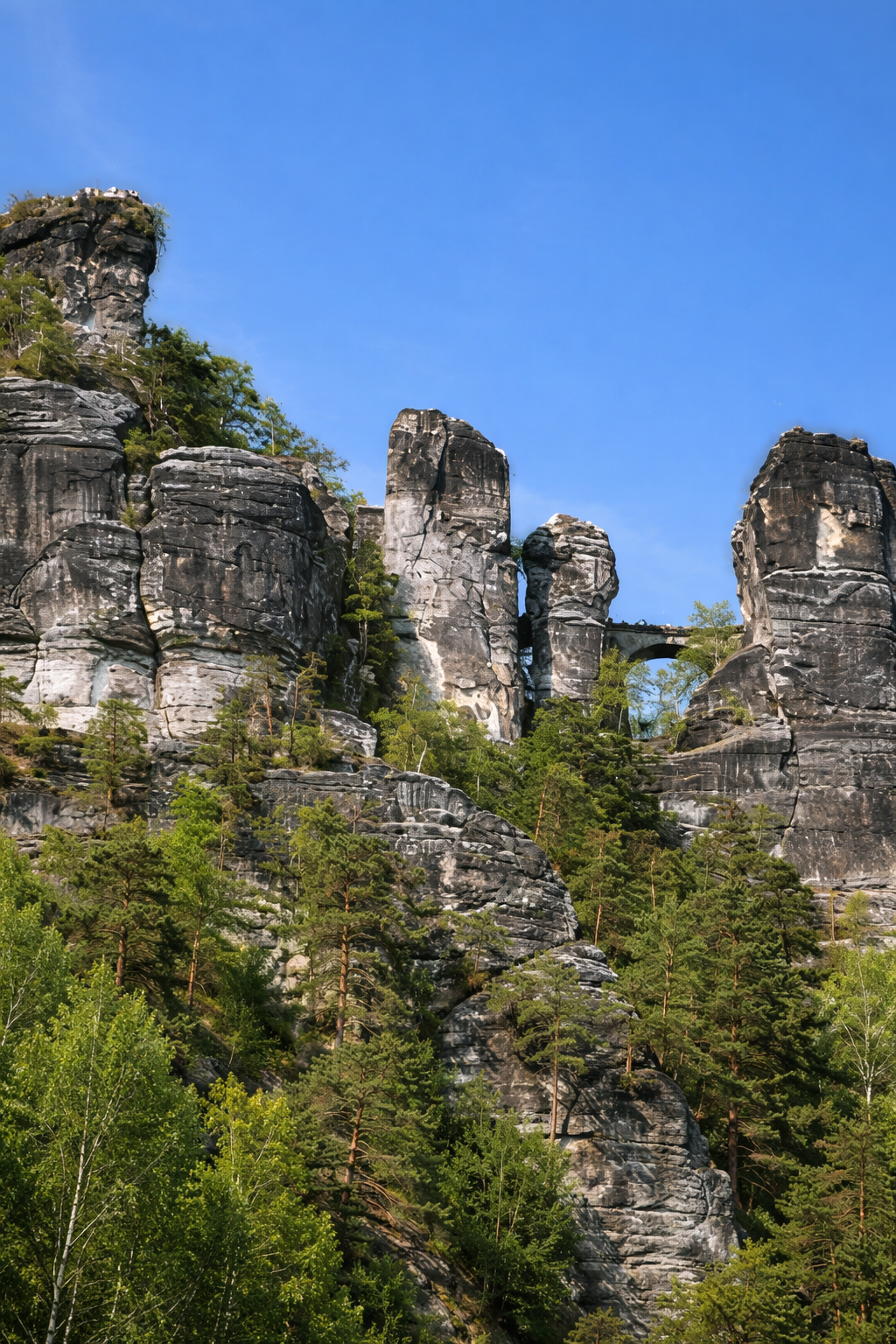
Every group also has the person who stops at the right moment, notices the light, and takes the photographs that everyone else will still be looking at five years later. This is a genuine skill and not an equal one — and the best thing a group can do is identify who has it and get out of their way. The Brühlsche Terrasse in Dresden at golden hour, the Bastei Bridge in Saxon Switzerland, the Parliament building from the Buda bank at dusk — these photographs existed because one person in the group understood how to take them. That is worth acknowledging rather than treating as incidental.
03 — What to Plan Before You Leave
Group trips require more advance planning than solo trips, not because the logistics are more complex but because the cost of a last-minute decision is multiplied by the number of people affected by it. A solo traveller who cannot find accommodation in Budapest on a Thursday night loses one night’s sleep over it. Four people in the same situation lose four nights’ sleep and create a group memory that will be discussed for years.
Book accommodation in advance — without exception
Every apartment and hotel on this trip was booked before we left. That decision cost us some flexibility — we could not spontaneously extend a stay somewhere that was working particularly well — but it gave us something more valuable: the certainty of knowing where we were sleeping at the end of every driving day. Arriving in Budapest after a long day on the road from Bratislava and knowing the apartment keys are waiting is a different quality of arrival from hoping something will come up.
For a group of four, apartment rentals through Airbnb or Booking.com are almost always better value than hotel rooms. A two-bedroom apartment in central Pest costs less per person than two standard hotel double rooms and gives you a kitchen, a living space, and the ability to have breakfast without putting shoes on. Additionally, for the cities on this route — Prague, Budapest, Vienna particularly — a central location justifies the premium. Being 10 minutes from the main sights on foot is worth more than saving €20 per night and spending 30 minutes on public transport each way.
Sort the car before everything else
The car rental is the logistical foundation of the entire trip. Book it early — prices increase significantly as the departure date approaches — and read the cross-border policy carefully before confirming. Not all rental companies permit their cars to cross from Germany into the Czech Republic or from the Czech Republic into Hungary without a separate cross-border fee or written permission. On this route, you will cross at least three international borders. Clarify this before you collect the car, not at the border.
A standard five-seat car handles four adults with luggage comfortably if everyone packs with the boot in mind. The practical rule: one medium bag per person, no exceptions. Four large rolling suitcases will not fit. Four 40-litre backpacks or duffel bags will. The difference between a car that is comfortable for nine days and one that is not is often just the luggage decision made three weeks before departure.
Czech Republic motorway vignette
The Czech Republic requires a digital motorway vignette for highway driving. Buy it online before crossing the border — the 10-day version costs around €14 and can be purchased on the Czech Republic’s official vignette portal. Austria also requires a vignette for motorway driving; the 10-day version costs around €9.90. Both can be purchased before you leave or at petrol stations near the border, but doing it in advance removes one thing to manage on a driving day.
04 — The Car: What to Know
The car is the trip’s infrastructure. Everything else — the cities, the detours, the drives between — depends on it working without drama. On a nine-day route like this one, a few things are worth understanding before you collect the keys.
Which car to rent
For four adults on a nine-day trip, a standard estate car or a compact SUV gives you the right balance of passenger comfort and boot space. A small hatchback is technically possible for four people but leaves no margin for luggage without bags on laps. A large SUV costs significantly more to rent and to fuel without adding meaningfully to the experience. The middle category — a Volkswagen Passat, a Skoda Octavia, a Ford Focus estate — handles the route comfortably and fits four adults and four medium bags without difficulty.
Fuel and driving conditions
The route covers approximately 1,400 kilometres from Dresden to Vienna and back. Fuel costs vary between Germany, the Czech Republic, Slovakia, Hungary, and Austria — Hungary is generally the cheapest of the five for diesel, Germany the most expensive. Fill up when you see a reasonable price rather than waiting for empty, particularly on the Saxon Switzerland stretch and on the approach to Vienna where motorway fuel stations charge a premium.
Driving conditions vary considerably along the route. German roads are well-maintained and fast. The B172 through Saxon Switzerland is narrow and scenic — take it slowly. Czech motorways are good; secondary roads vary. Hungarian roads in the countryside can be rougher than the map suggests. Austrian motorways are excellent and well-signed. The whole route is manageable in a standard car — no 4WD required, no mountain passes to worry about.
Parking in cities
Parking a rental car in a Central European city centre requires some advance thought. Prague and Vienna both have paid parking zones throughout the old town areas — budget for this, and consider parking at the hotel or apartment and using public transport for city days. In Budapest, the central districts have a parking app system that takes some navigation on arrival. Generally, the simplest approach is to find parking near the accommodation on arrival, leave the car there for the city days, and collect it only when moving to the next destination.
05 — How the Costs Work Out
One of the strongest arguments for a group road trip over a solo one is the economics. The car rental is fixed regardless of how many people are in it. The fuel cost is fixed. And in most Central European cities, a two-bedroom apartment costs less than two separate hotel rooms — so the accommodation saving is real as well as the transport one.
| Car rental | A nine-day rental of a standard estate car or compact SUV costs roughly €400–600 total depending on the company, season, and vehicle class. Split four ways: €100–150 per person for the full trip. |
| Fuel | The full route covers approximately 1,400km. At average European fuel efficiency and mid-2026 prices, budget around €180–220 total for fuel. Split four ways: €45–55 per person. |
| Accommodation | A central two-bedroom apartment in Prague, Budapest, or Vienna costs €100–160/night. Split four ways: €25–40 per person per night — comparable to a budget hostel private room but with a kitchen and living space. |
| Daily spend per person | Food, attractions, and incidentals in Prague and Vienna: €40–65/day per person. In Budapest: €25–45/day. Dresden is comparable to Prague. Bratislava is a half-day stop with minimal additional cost. |
| Total trip cost per person | A reasonable estimate for nine days including everything: €700–1,000 per person depending on accommodation standard, restaurant choices, and how many paid attractions you visit. Budapest brings the average down; Vienna pushes it up. |
06 — What Group Travel Does Better
Solo travel has genuine advantages that group travel cannot replicate: the freedom to change plans without consultation, the solitude that produces a certain quality of attention, the social openness that comes from needing to talk to strangers. None of those are small things. But group travel has its own category of experience that solo travel cannot produce, and a road trip specifically is where those advantages are most apparent.
Spontaneous decisions land differently
The Bastei Bridge detour through Saxon Switzerland was not originally on the itinerary. Someone raised the idea the evening before, everyone agreed in under two minutes, and we went. A solo traveller can make that same decision faster. But the experience of arriving at the bridge and sharing it — the specific quality of standing somewhere extraordinary with people you know well — is categorically different from standing there alone. Some things are better witnessed collectively. The Bastei Bridge is one of them.
Shared meals are better than solo ones
Eating alone in a foreign city is an acquired taste, and some people never acquire it. Eating with three friends in a Budapest restaurant, ordering more than you need because everyone will share it, talking across dishes — that is one of the better things travel produces, and it requires other people. The Central Market Hall in Budapest, the fish restaurants in Rathen below the Bastei, dinner in Prague’s Old Town — these meals existed as experiences rather than just as nutrition because of the company around the table.
The car becomes a conversation
Long drives on solo road trips can be productive — good music, clear thinking, the meditative quality of motion without obligation. But long drives with close friends produce something different: conversations that would not happen at a dinner table, the specific intimacy of being enclosed together in a moving vehicle with nowhere else to go. Some of the better conversations on this trip happened between Vienna and the German border on the last day, in the dark, with three hours of motorway ahead. That is not a selling point you will find in a road trip brochure. It is, however, true.

08 — Practical Notes
| Best group size | Four people in one car is the practical optimum — costs split well, decisions stay manageable, and a standard five-seat car handles the group and luggage without compromise. |
| Trip duration | Nine days covers this route at a pace that feels unhurried without padding. Seven days is possible but removes flexibility. Ten to twelve days would allow longer in Budapest and a day trip from Vienna. |
| Best season | April through June and September through October. Summer (July–August) is busy and hot in all five cities; Dresden and Prague in particular feel the tourist pressure. Spring and autumn offer better conditions at lower accommodation prices. |
| Who should drive | At least two people with driving licences is strongly recommended for a nine-day trip of this distance. Sharing driving keeps everyone fresher and makes the long transit days — Dresden to Prague, Budapest to Vienna — significantly less tiring. |
| Currency | Germany, Austria: Euro. Czech Republic: Czech Koruna (though many tourist-area businesses accept euros at a poor exchange rate — use local currency). Hungary: Hungarian Forint. Have some local cash in each country; cards are widely accepted but not universal at smaller restaurants and markets. |
Communication, currency, and what to pack
| Communication | EU roaming applies for most European SIM cards across all five countries on the route. Check your plan before leaving — unlimited data roaming in the EU makes navigation, accommodation check-ins, and group coordination significantly easier. |
What to pack
| What to pack | One medium bag per person — 40 litres maximum — for the boot to work. Comfortable walking shoes are more important than anything else in the wardrobe. A portable charger for the car is worth having for four people running navigation on their phones simultaneously. |