
Vienna in Two Days: What to Prioritise When Time Is Short
Vienna does not announce itself. Instead, it simply exists — heavy, beautiful, and entirely sure of its place. So this is how to spend two days in Vienna — what to see, what to prioritise, and what to leave for a longer trip.
We arrived in Vienna after sunset, driving in from Budapest on the seventh evening of the trip. As approaches go, the motorway gives you nothing — flat, dark, unremarkable. However, the city appears all at once: lit up, composed, and immediately different in character from the two capitals we had already spent time in. Whereas Prague announces itself with spires, Budapest does so with scale. Vienna, by contrast, offers no such introduction. Instead, it simply materialises — fully formed — and waits for you to catch up.
A city that resists being rushed
We had a full day and a half — one complete day and a morning before the drive back toward Dresden. That is not a lot of time for a city of this weight. Furthermore, Vienna is not a city that rewards rushing. In some fundamental way, it is built against the very concept. So the question the trip forced on us was a useful one: if you have two days in Vienna, what actually matters?
That, then, is the answer we arrived at.
01 — The First Morning: Breakfast at Joseph Brot
The morning set the tone for everything that followed. We found Joseph Brot — a well-regarded organic bakery and café with several branches across Vienna — and spent longer there than we had intended. That is, I think, exactly what the place is designed to produce.
What Joseph Brot is like
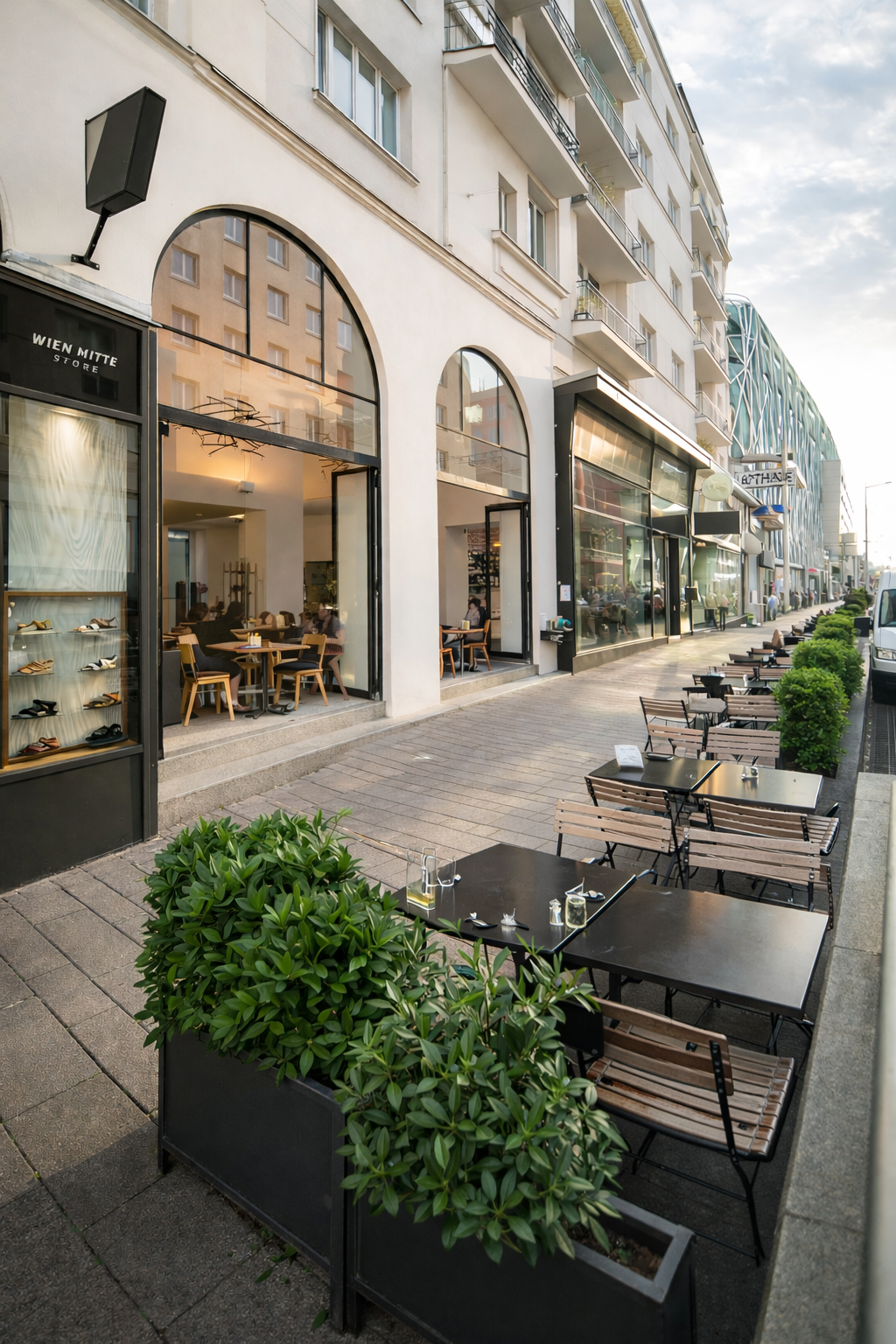
The interior is clean and light — white walls, warm wood, the smell of bread that has been baked that morning and not at any point before that. Meanwhile, the menu leans into proper breakfast: egg dishes, fresh pastries, sourdough with good accompaniments, excellent coffee. Overall, everything feels considered without feeling precious. Moreover, it is a place where locals actually eat — not a tourist café that has learned to perform the aesthetics of a good café, but the real version.
Why it sets the tone for the day
We ordered egg dishes and pastries. Predictably, the coffee was strong and properly made. Unsurprisingly, the bread here — for a place that has made it the centre of its identity — was exceptional. Additionally, the bill was higher than anything we had paid in Budapest — but that is Vienna, and Joseph Brot is worth it. As a result, a breakfast like this changes the quality of the day that follows.
Two food spots from this trip are worth mentioning specifically. Joseph Brot for breakfast — an organic bakery café that is genuinely one of the finest breakfast experiences Vienna offers. Artisan sourdough, proper egg dishes, excellent coffee. Multiple branches across the city; any of them will do. And for dinner, a halal Turkish fried chicken spot that one of our group tracked down — the fried chicken burger was excellent, crispy and properly seasoned, and the place had the unassuming quality of somewhere that does one thing and does it well. Overall, the halal food scene here is stronger than most Western European capitals — if you know where to look.
02 — Walking the Imperial Centre
Vienna’s historic centre is dense in a way that rewards walking without a precise agenda. In particular, the streets between Stephansplatz and the Hofburg are full enough to occupy an entire morning — and most of what matters is on the surface, visible without buying a ticket to anything.
Stephansplatz and the Cathedral
Stephansdom — St. Stephen’s Cathedral — is the obvious starting point, and it deserves its status. Specifically, its Gothic exterior is one of the most detailed in central Europe, featuring a south tower that rises to 136 metres and roof tiles forming a herringbone mosaic visible from the square below. Inside, the space is darker and more austere than the exterior promises — high vaulted ceilings, side chapels, and the characteristic smell of old stone and candle wax that belongs to every cathedral of this age and weight.
Graben, Kohlmarkt and the Road to the Hofburg
From Stephansplatz, the Graben pedestrian street runs west — wide, tree-lined, and flanked by buildings that only a city with deep historical wealth could maintain. Consequently, the area feels remarkably preserved. At the far end stands the Pestsäule, the Plague Column, a Baroque sculpture erected in the late 17th century to mark the end of a bubonic plague epidemic. Although it is extraordinarily elaborate for a monument commemorating a catastrophe, such excess is perhaps appropriate for Vienna. Additionally, the Kohlmarkt — continuing west from the Graben — leads directly to the Michaelerplatz, the ceremonial entrance to the Hofburg.
The Hofburg Palace
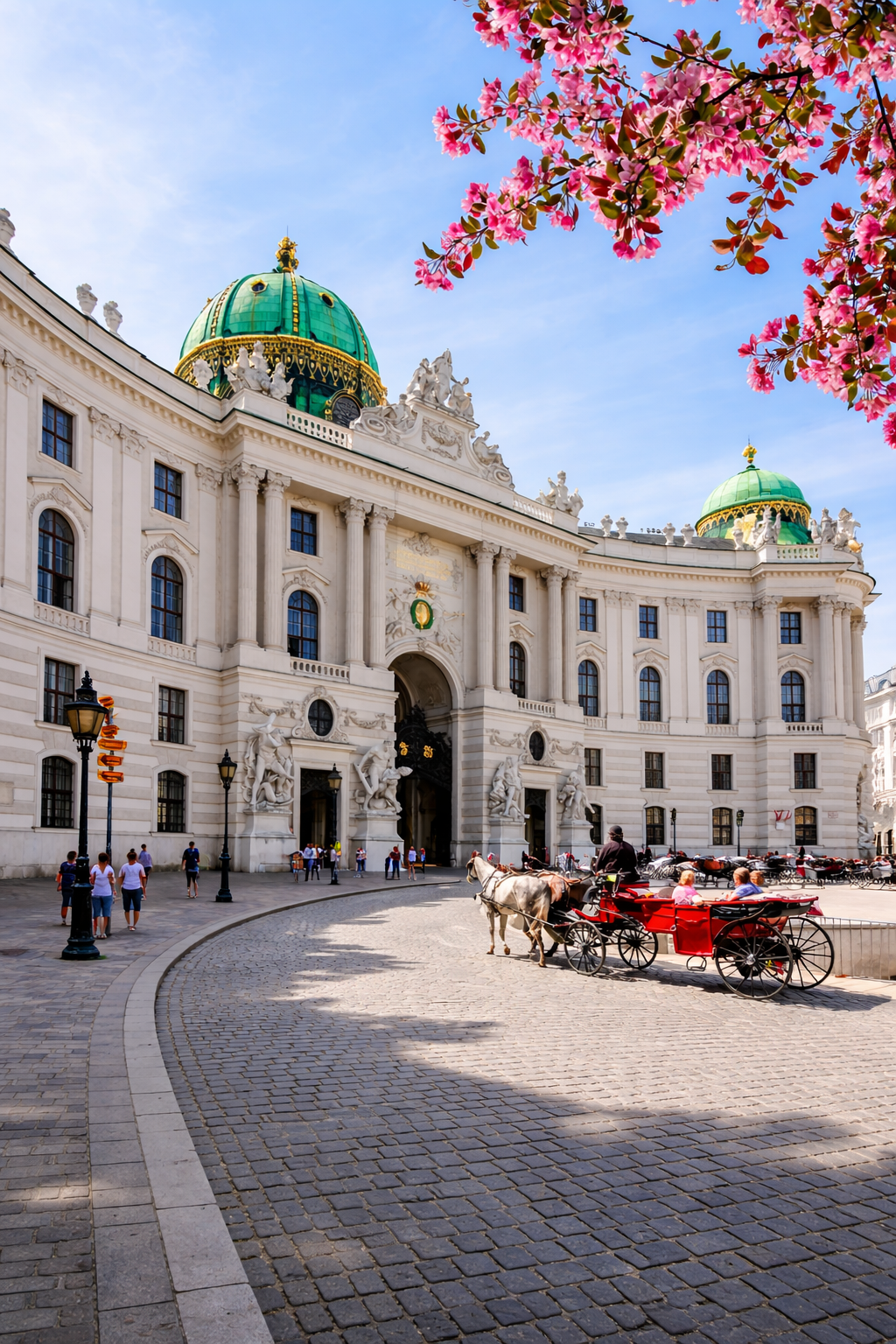
The Hofburg is not a single building but a complex of interconnected structures that accumulated over roughly six centuries of Habsburg rule. From the outside, the complex appears vast and formally beautiful — the Michaelerplatz entrance particularly so, with its dome and paired fountains flanking the archway. Passing through the inner courtyard brings you out toward the Heldenplatz: a large ceremonial square framed by two equestrian statues, with the Kunsthistorisches Museum and Naturhistorisches Museum facing each other across the Ringstrasse beyond.
The Imperial Apartments and Sisi Museum
Inside, we visited the Imperial Apartments — the private rooms of Emperor Franz Joseph I and Empress Elisabeth, known as Sisi. Both rooms are well preserved and, more interestingly, the museum around them is genuinely thoughtful: it addresses the myth of Sisi that Austrian tourism has constructed and, to some degree, gently complicates it. In particular, the Sisi Museum is worth the combined ticket price. Consequently, allow at least ninety minutes; the audio guide is included and earns its keep.
The sights at a glance
For a two-day visit, here are the best places to visit in Vienna in 2 days — listed not by popularity but by the quality of the experience they actually deliver.
Vienna’s Gothic centrepiece — the south tower and patterned roof tiles are iconic. Free entry to the nave; tower access costs extra but gives the best view of the old city. Go early to avoid coach groups.
Habsburg imperial complex in the centre of the city. The interior museum is better than expected — genuinely informative about the lives and myths of the imperial family. Plan 1.5–2 hours. Book tickets online.
Habsburg summer residence southwest of the centre. The palace interior is lavish; the gardens, however, are the real draw. Walk to the Gloriette for the best view of the grounds and city beyond. Gardens are free.
A monumental boulevard built in the 1860s — Parliament, the Kunsthistorisches Museum, the Burgtheater, the Rathaus. Walking the western half takes under an hour and costs nothing. Most buildings have paid entry if you want to go inside.
Further afield and worth the detour
Beyond the immediate centre, several sights justify the extra travel time — particularly if you have an afternoon free or are visiting for three days rather than two.
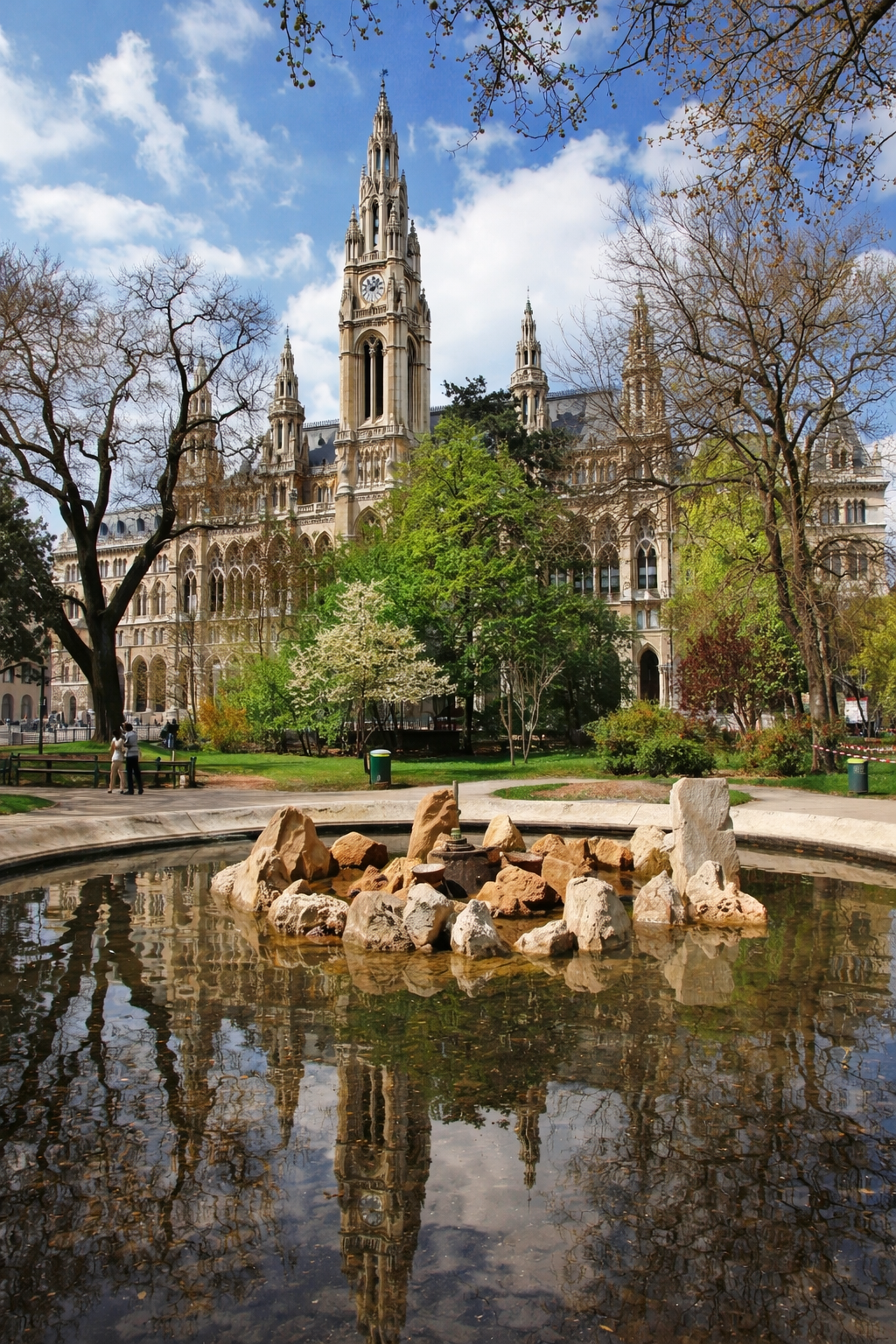
The neo-Gothic city hall fronted by a long park and flanked by the Burgtheater — one of Vienna’s most impressive exteriors. Events fill the park year-round, so it is worth checking what’s on during your visit.
The Upper Belvedere houses Austria’s finest art collection, including Gustav Klimt’s The Kiss — one of those paintings that is more arresting in person than any reproduction suggests. Its formal gardens are also beautiful. Plan 2 hours minimum.
Cross the river on foot for a perspective most visitors never see. To the west, the Baroque old city; on the other side, the modernist towers of UNO City. Furthermore, the walk across takes fifteen minutes and costs nothing. Go in the late afternoon for the best light on the water.
Vienna’s coffee house tradition is a genuine cultural institution — UNESCO recognised it as Intangible Cultural Heritage in 2011. Sitting for an hour with a Melange and a Kipferl is not a tourist activity. It is what Vienna actually is.
03 — Schönbrunn Palace & the Gardens
Schönbrunn is about four kilometres southwest of the city centre — a short U-Bahn ride on the U4 line. Most visitors come for the palace. We came, however, primarily for the gardens, and that turned out to be the right call.
The palace exterior and interior
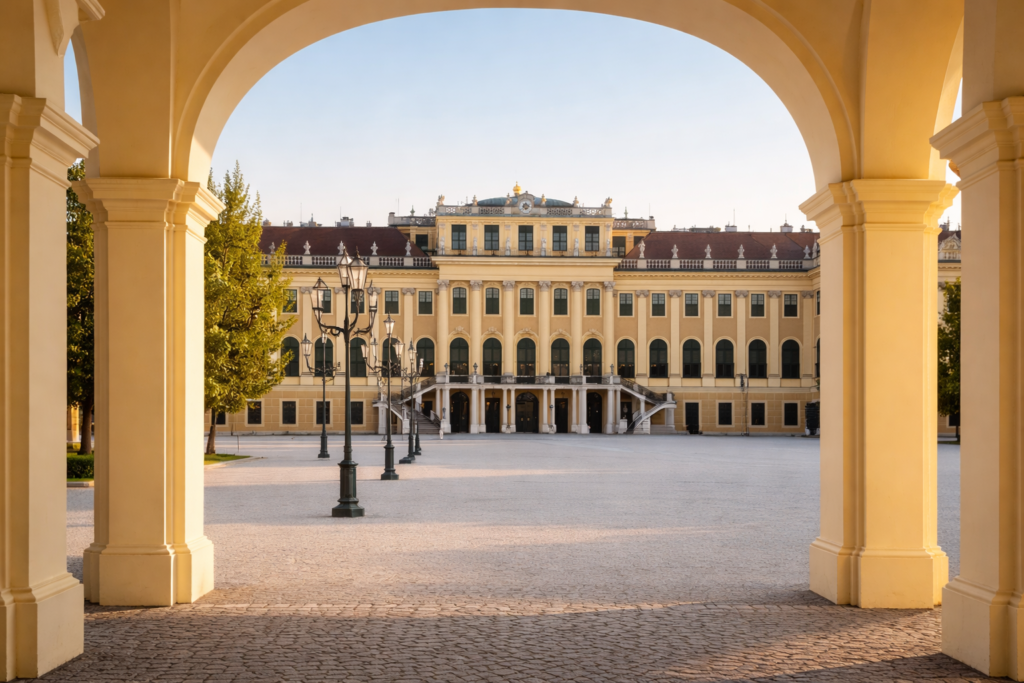
The palace’s yellow façade is immediately recognisable — a specific imperial shade Austria has, with some justification, made its own. From the garden side, the full length of the building becomes clear, and so does the formal symmetry of the grounds. Furthermore, the interiors are gilded and heavily decorated in the Rococo style, which is to say they are quite a lot — but they are also genuinely historic spaces, and the audio guide does a good job of giving each room a specific story rather than letting them blur into one another.
The gardens and the Gloriette
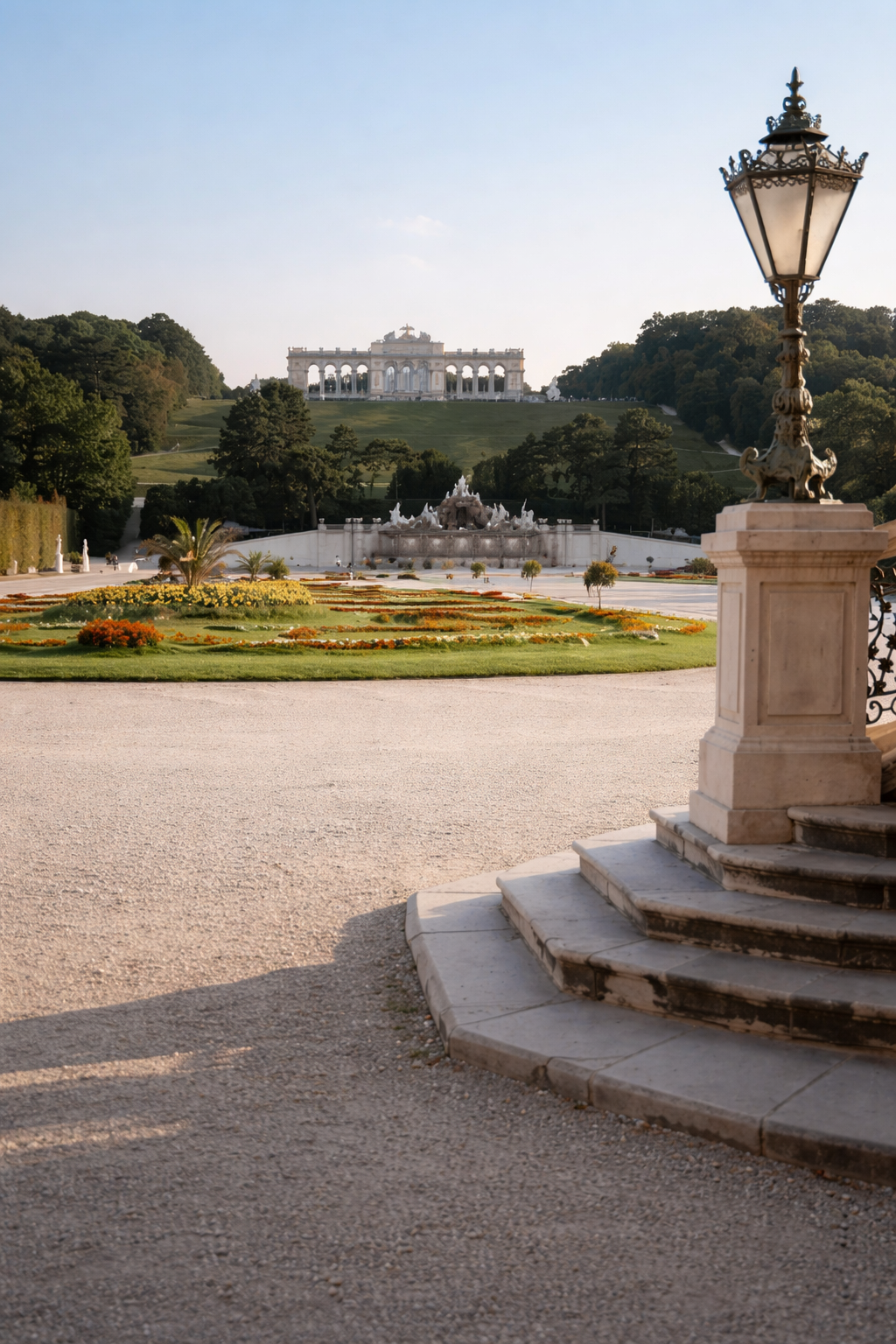
What truly justifies lingering, however, are the gardens. Extending for roughly a kilometre behind the palace, these grounds are formally laid out in the French style with clipped hedgerows and fountains. From there, the walk up to the Gloriette takes around fifteen minutes and rewards the effort with a view across the entire garden to the city beyond. On a clear day, the Stephansdom spire is visible in the distance. Additionally, the gardens are free to enter, which makes them one of Vienna’s best-value hours regardless of what else you have budgeted for the day.
How long to allow
We spent close to two hours here. In contrast, the pace was different from the morning’s walking — slower, more lateral, less purposeful. That contrast, in turn, turned out to be what the afternoon needed.
04 — The Ringstrasse & Vienna City Hall
The Ringstrasse is the wide boulevard that Emperor Franz Joseph I commissioned in the 1850s and 1860s to replace the old city walls. Walking it feels like moving through one of the most deliberately monumental streets in Europe — a continuous procession of major institutional buildings, each in a different historical style, arranged to project the ambition and cultural weight of the Habsburg Empire. Indeed, simply moving slowly and looking up is reward enough.
What lines the boulevard
As you walk, the buildings arrive in sequence: the Kunsthistorisches Museum and Naturhistorisches Museum face each other across the Maria-Theresien-Platz in a heavy Italian Renaissance style. Following these is the Parliament building, designed in Greek Revival and currently fully restored. Further along, the Burgtheater stands in late Renaissance style.
The Rathaus
The Rathaus is built in a neo-Gothic style, with its central tower rising to over 100 metres. Across the façade, pointed windows and heavy stone ornamentation create an effect that could, at a certain angle and in certain light, be mistaken for a medieval structure. In front of it, a long rectangular park runs from the boulevard to the building’s entrance — in summer this space hosts outdoor cinema screenings and food markets; in winter, one of Vienna’s most photographed Christmas markets fills it.
The Ringstrasse runs for about five kilometres in its full loop. Walking the western half — from the Kunsthistorisches Museum past Parliament, the Rathaus, the Burgtheater, and the Votivkirche — covers the most architecturally dense section and takes around 45 minutes at a comfortable pace. If time is short, start here rather than attempting the full circuit.
05 — The Bridge Across the Danube
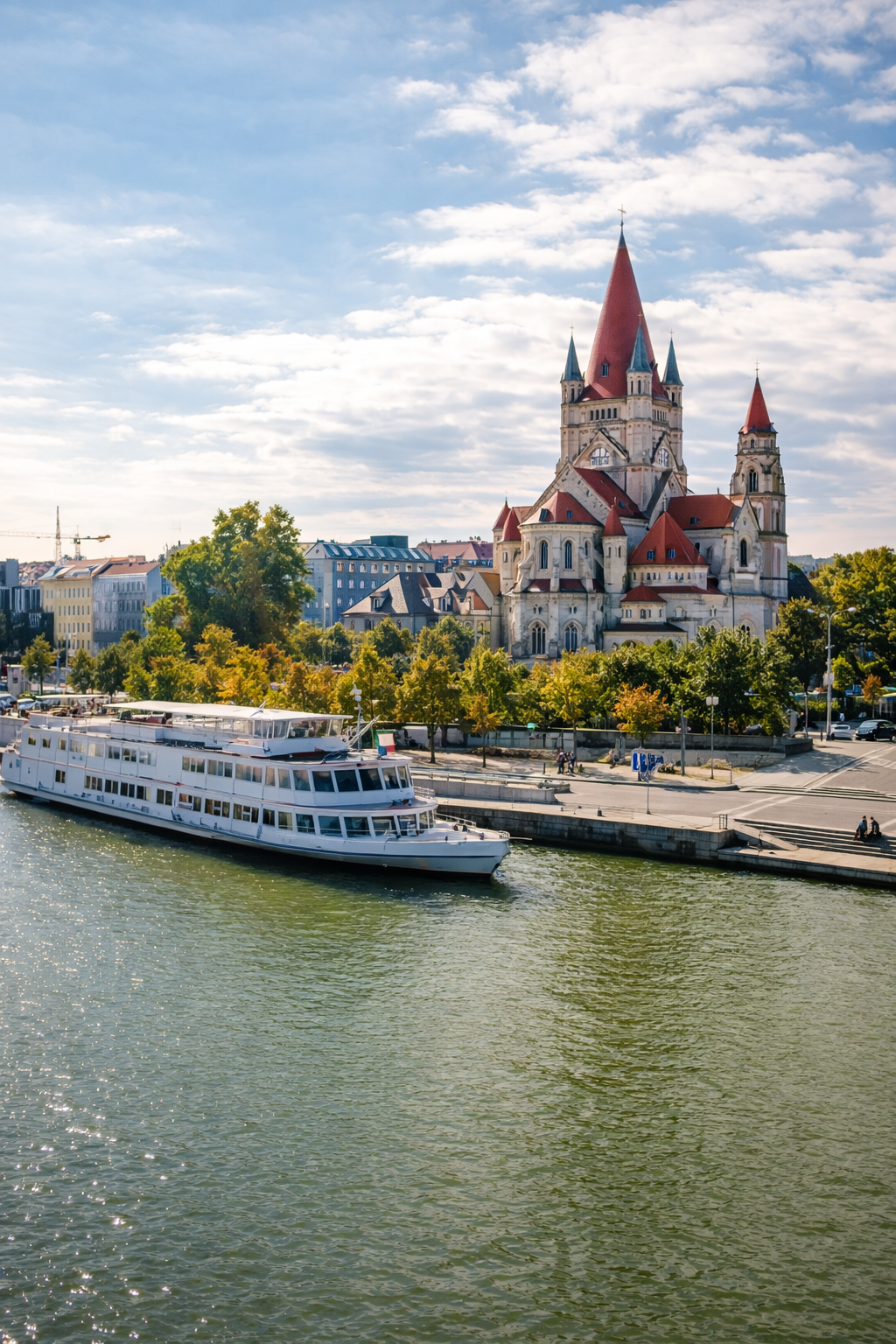
This was not on any itinerary. It happened because one of the group wanted to see the UN building — the Vienna International Centre, also called UNO City — which sits on the eastern bank of the Danube, about four kilometres from the old city centre. Getting there means crossing the river on the Reichsbrücke — a bridge that is, in itself, worth the walk.
The Reichsbrücke
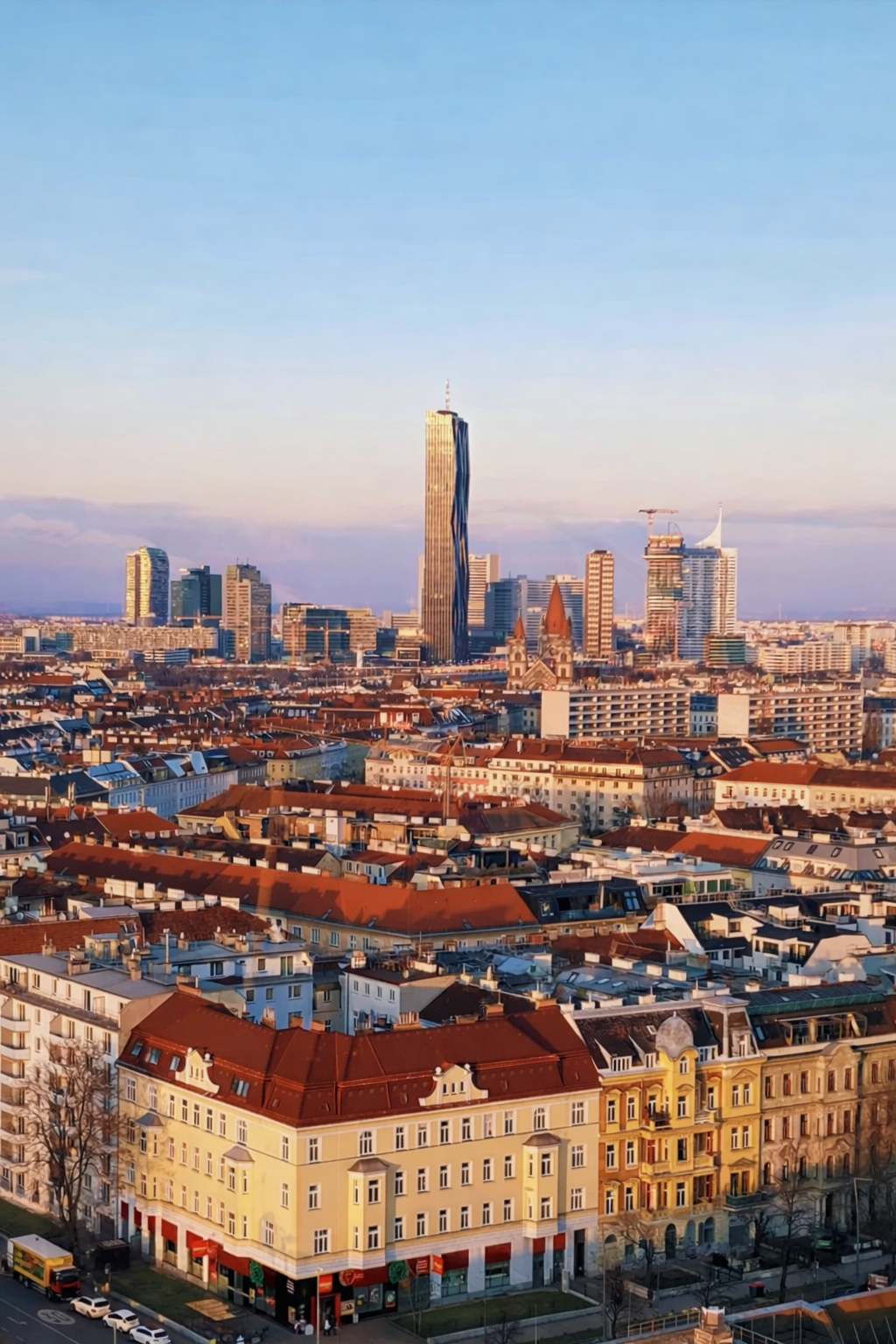
The Reichsbrücke is not particularly beautiful in the way that Vienna’s Baroque buildings are beautiful. Instead, it is functional, wide, and built to carry both road and pedestrian traffic. What it offers is the view: the Danube on both sides, broad and moving quietly below, the city arranged on the western bank behind you, and ahead the modern cluster of the UN complex — all glass and angular towers that belong to a completely different aesthetic register from the imperial city you have spent two days in. That contrast is not jarring so much as clarifying.
UNO City
Vienna’s International Centre is one of four official UN headquarters globally — alongside New York, Geneva, and Nairobi. In practice, it is a significant place in a quieter sense: arms control negotiations have taken place here, IAEA meetings, and the kind of diplomatic work that rarely makes news but matters considerably. What stands out, however, is the contrast. Vienna, it turns out, has an entirely different face on the other side of the water.
06 — Where to Eat in Vienna
As a city, Vienna pairs an excellent food culture with prices that reflect it. Specifically, the traditional Viennese café — the Kaffeehaus — is a genuine institution: a place where sitting for two hours over a single Melange is not only acceptable but expected. That culture extends well beyond coffee and cake, however, and the city’s significant Turkish and Middle Eastern communities mean that halal options are considerably easier to find here than in many Western European capitals.
Breakfast: Joseph Brot
Joseph Brot was the clear highlight of our eating in Vienna. Specifically, it is an organic bakery and café with multiple branches — the kind of place that has earned its reputation quietly, without needing to announce itself. Furthermore, the bread is genuinely exceptional, the egg dishes are properly made, and the coffee comes without the slight apology that some European countries have historically attached to their espresso. If you are in Vienna for two days, start at least one morning here.
Halal food: better than you’d expect
Beyond the tourist circuit, Vienna has a substantial Turkish community and a halal food scene that extends well beyond döner kebab, though the döner is also very good. On one evening, the group found a Turkish fried chicken spot that had earned strong local reviews — the fried chicken burger was crispy, well-seasoned, and served without fanfare in the manner of somewhere that does not need to perform confidence because the food provides it. Frankly, it was one of the better things any of us ate on the entire nine-day trip. Moreover, the city rewards a small amount of searching for halal options beyond the obvious tourist-facing restaurants.
Vienna Eating — Practical Notes
Expect to pay more than in Budapest or Prague — a sit-down lunch runs €12–18 per person, dinner €18–30 without drinks. For the full Viennese coffee house experience, Café Central or Café Landtmann near the Rathaus are the most atmospheric. The Naschmarkt open-air market on Linke Wienzeile is worth a browse — Turkish and Middle Eastern stalls make it one of the more halal-friendly food markets in the city. Tipping: round up to the nearest euro or leave 5–10% — expected in sit-down restaurants.
07 — Practical Notes for Two Days in Vienna
Getting There, Around and Where to Stay
| Getting there | Vienna is on the main Central Europe rail and road network. Budapest is roughly 2.5 hours by car or direct train. From Prague: approximately 4 hours by car or train. Vienna Airport (VIE) has a fast rail link to the city centre taking around 16 minutes. |
| Getting around | Vienna’s historic centre is compact and walkable. Public transport options, specifically the U-Bahn and tram network, are excellent and cover everything beyond walking distance, including Schönbrunn (U4 line) and the Danube area. Purchasing a 24-hour transport pass costs around €8 and covers unlimited travel. |
Where to Stay
| Where to stay | The 1st district (Innere Stadt) puts you within walking distance of the Hofburg, Stephansdom, and the Ringstrasse. The 6th and 7th districts (Mariahilf and Neubau) are slightly cheaper, more residential, and still well-connected. Avoid booking outside the Ringstrasse if you want to walk everywhere. |
Tickets, Money and the Two-Day Plan
| Schönbrunn tickets | Book online in advance — queues at the ticket desk can be long in peak season. The Grand Tour (40 rooms) costs around €22. Gardens are free to enter. The Gloriette viewing terrace costs a few euros extra. |
| Hofburg Imperial Apartments | Combined ticket for the Sisi Museum, Imperial Apartments, and Imperial Silver Collection costs around €18. Allow 1.5–2 hours. Audio guide is included and genuinely worth using. |
| Currency | Euro. Card payments widely accepted throughout the centre. Vienna is noticeably more expensive than Budapest — budget accordingly. |
| Language | German. English is widely spoken in tourist areas, hotels, and restaurants. Basic German phrases are appreciated but not strictly necessary. |
| What to do in Vienna in 2 days | Day 1: Morning in the city centre (Stephansdom, Graben, Hofburg) → afternoon at Schönbrunn. On day 2: Ringstrasse walk, City Hall, Danube bridge → relaxed evening in the centre. |
Planning Your Visit
Getting There and Getting Around
Specifics Worth Knowing
Halal Food Options
We left Vienna on a half-morning, driving north toward Dresden with the city diminishing in the rear-view mirror. Even so, Vienna did not look different from how it had looked when we arrived — composed, certain, entirely itself.
This sense of permanence is, in the end, the defining thing about the city. It requires no validation — just your full attention while you are there.